The Bakery That Wasn't There
Maya stopped on the third-floor landing with one foot still in the air.
"Bread," she said. "Somebody's baking bread."
Soren sniffed. "Nobody's baking bread. Your grandmother lives in the only apartment up here, and she's making soup. I can smell the soup."
"I can smell the soup too. And bread. Warm bread, the brown crust part." Maya turned a slow circle on the landing. "There's no bakery in this building."
"So you're wrong."
"I'm not wrong about smelling it." She said this without any heat, the way she said most things. "I'm just wrong about where it's coming from."
They stood there. The stairwell smelled of soup, and bread, and underneath that the cold-stone smell of old buildings, and underneath that something Maya didn't have a word for, green and sharp.
"Okay," said Soren. "Test it. Close your eyes."
She closed them.
"What is it really. Don't say bread. Take it apart."
Maya breathed in slowly. "Warm. Sweet but not sugar-sweet. A little burnt at the edge. And something that makes the back of my mouth feel like a kitchen."
"That's not bread. That's a list of things bread also has."
Her eyes opened. "Huh."
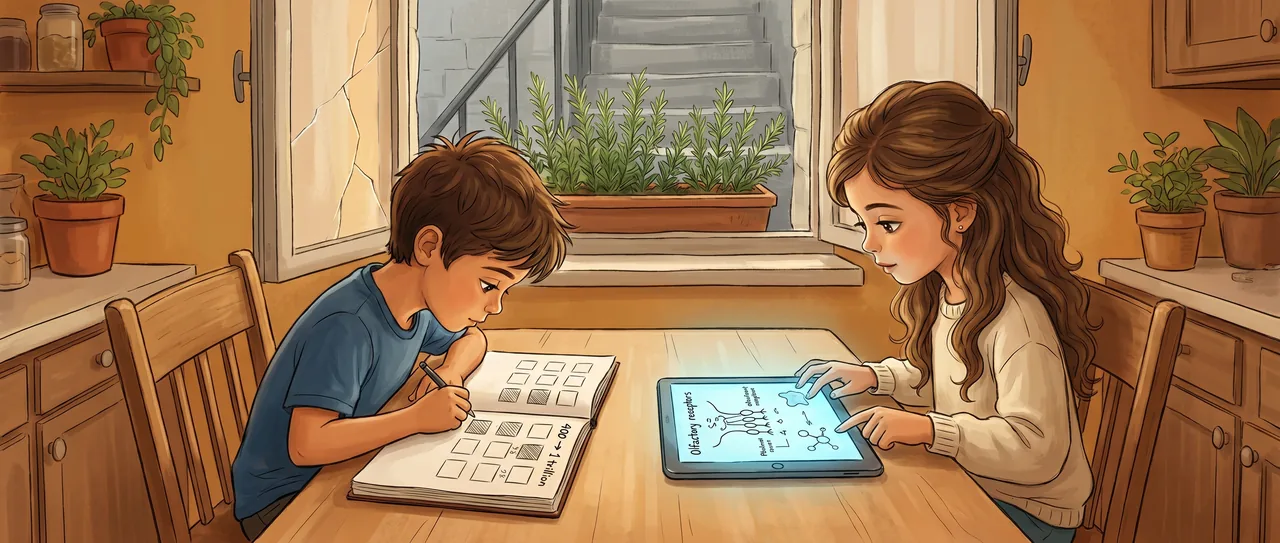
They followed the green-sharp thing instead of the bread. It got stronger going up, not down. At the top of the stairs a window stood open a crack, and on the sill outside sat a window box, and in the window box somebody three floors up was growing herbs in the last warm week of autumn.
Soren put his nose nearly into the gap. "Rosemary. And something toasty from somebody's actual oven, way down, coming up the stairwell because heat rises." He pulled back. "Two different things. From two different floors. You smashed them together and called it bread."
"My brain called it bread," Maya said. "I didn't tell it to."
Inside, Maya's grandmother was at the stove, and she did not look up from the soup. "You two found my rosemary," she said. "Mrs. Okafor upstairs grows it. Drives me mad every September. I keep wanting to bake."
"See," Maya said to Soren. "Her too."
Her grandmother tapped the spoon on the pot. "Smell makes you hungry for things that aren't even there. Now wash up."
They washed up. But Soren had his notebook out at the little table, and he was drawing boxes.
"What," said Maya, sitting down hard next to him.
"The bread thing. It's bugging me." He drew a row of little boxes, then another row underneath. "There's no bread. So why do both of you smell bread?"
Maya pulled the notebook sideways so she could see. "Because rosemary plus toast equals bread."
"But equals how. Rosemary is one smell. Toast is another smell. You'd think two smells would just be two smells. You'd smell rosemary, and also toast, like hearing two songs." He chewed the end of the pen. "Instead you got a third thing. A thing that isn't in the room."
Maya went quiet, which her grandmother filled with the sound of the spoon.
"Smell isn't songs," Maya said finally.
"What's it then."
"Songs you can pull apart. You can hear the guitar and the drum at the same time and keep them separate." She tapped his boxes. "Smell smushes. Why does smell smush."
They didn't know. So after soup, Maya's grandmother let them use the tablet, and they looked, and what they found made Maya put both hands flat on the table.
"Soren."
"I'm reading."
"Soren. We don't have a smell for bread."
He looked up.
"We don't have a smell for anything. Listen." She read it off the screen slowly, the way she read things she wanted to keep. "Inside your nose there's around four hundred different kinds of catchers. Receptors. Each kind grabs onto certain shapes of molecule and ignores the rest."
"Four hundred," Soren said. "That's not very many. There's way more than four hundred smells."
"That's the part." Maya turned the screen toward him. "You don't get one catcher per smell. A smell switches on a whole bunch of catchers at once, like." She pressed several keys on an imaginary piano. "Like a chord. The bread molecules hit catchers seven and forty and two hundred and ten. The rosemary hits some of the same ones plus a few others. Your brain doesn't get a list. It gets which catchers lit up, all together, and it goes, that pattern, that's bread."
Soren looked at his row of boxes. He started filling some in.
"So when rosemary and toast came up the stairwell together," he said slowly, "they lit up a pattern. And the pattern they lit up was almost the same pattern bread lights up. So your brain read the chord and said the word it knew."
"Bread," said Maya.
"Bread that isn't there."
They sat with it.
"How many chords," Soren said. "Four hundred catchers, each one on or off, in different amounts. How many different patterns can that even make."
Maya did the imaginary piano again, all ten fingers, then ran out of fingers. "A lot."
They looked it up. The number on the screen was one trillion. Roughly one trillion smells a person can tell apart, from four hundred catchers playing chords.
"One trillion," Soren said. He wrote it down. He wrote the four hundred next to it, with an arrow between them, because the small number making the huge number was the whole thing, the whole entire thing.
"Most of them don't have names," Maya said. She was looking at the open window, where the rosemary was still coming in. "There's no word for almost any of them. A trillion smells and we named, what, soup. Bread. Rain. We named maybe a hundred."
"So most of what you can smell," Soren said, "you can't say."
"I smell one right now," Maya said. "By the window. I don't have any word for it at all."
She went and stood at the open window, and breathed in the unnamed thing, and held it.
Read the interactive version, listen to the narration, and earn a gold star →
A science-verified short story for curious kids · Curiosity Land