Twenty-Two Hours
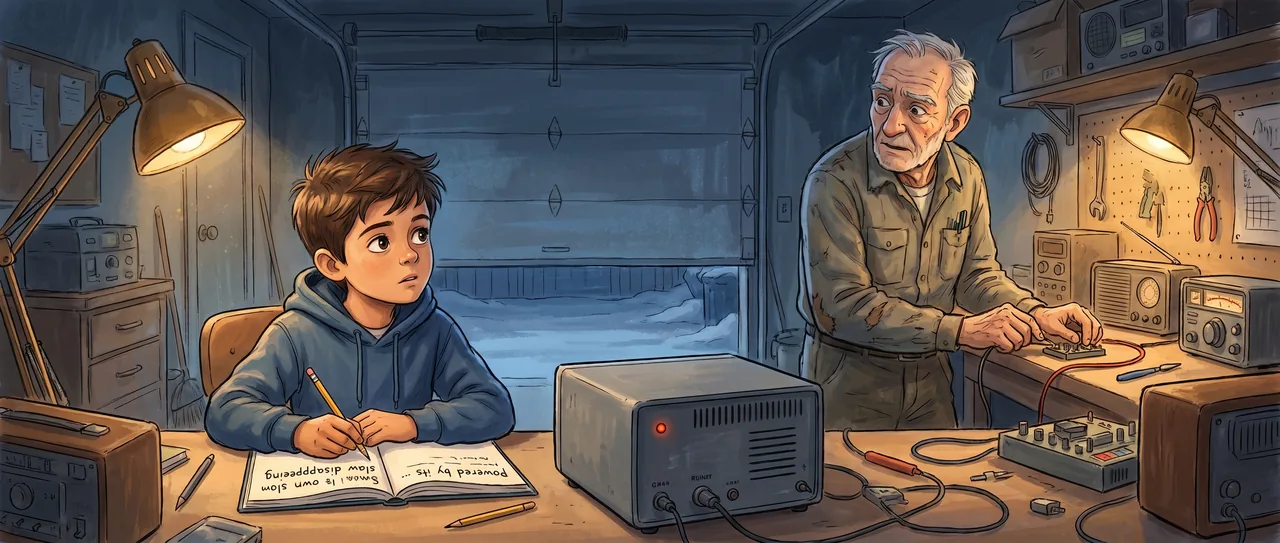
Great-Uncle Bo's garage smelled like solder and cold coffee. Wires looped between shelves like the webs of a very organized spider. In the middle of it sat the radio, a gray box with a hundred dials, humming a soft static that Bo called the sound of everything at once.
"You can't actually hear it," Bo said, not looking up from the connector he was wiggling. "Voyager, I mean. That's a misunderstanding. Its signal is fainter than a refrigerator bulb seen from across the country. You'd need a dish the size of a baseball field. We've got a coat hanger and hope."
Soren had asked the question carefully, so this answer disappointed him in a precise way. He set down his notebook on the workbench.
"But it's still talking," Soren said. "Right now."
"Still talking," Bo agreed. "Older than your dad. Out past everything. They built it to last four years." He laughed once, dry. "It's been forty-seven."
Soren did the arithmetic without meaning to. The spacecraft had left in nineteen seventy-seven. It had visited Jupiter and Saturn and then just kept going, because there was nothing to stop it and nobody had told it to slow down.
"What's keeping it on?" Soren asked. "There's no sun out there. Not really."
Bo set down the connector. This, apparently, was a question he liked.
"That's the good part," he said. "It carries a lump of stuff that falls apart. Plutonium. Every atom that breaks gives off a little heat. The heat makes electricity. So the thing is powered by its own slow disappearing." He tapped his chest. "Same way you're warm, sort of. Burning something to stay lit."
Soren wrote that down. Powered by its own slow disappearing. He looked at the words and felt something move under them that he couldn't get to yet.
"So it gets weaker," he said.
"Every year. Fewer atoms left to break. They've been switching off the heaters one by one to save power. Letting parts of it go cold so the rest can keep talking. In a few years it'll be too faint to hear at all."
"Then it stops?"
"Then it keeps going," Bo said. "Just quiet. Coasting. For a long time. Longer than the word long means."
Soren sat with that. The static hummed. Outside, the wind pushed against the garage door and the door pushed back.
He picked up his pencil, then put it down again.
"Bo," he said. "How far is it? In time. Not miles."
Bo squinted. "What do you mean, in time."
"The signal. You said we'd need a giant dish. But the signal does reach us. It just takes a while. How long."
Bo scratched his jaw. "Twenty-two hours, give or take. Light speed. Fastest thing there is, and it still takes most of a day to cross the gap."
Twenty-two hours.
Soren stared at the gray box. He was not thinking about the box anymore. He was thinking about the gap.
"So," he said slowly, the way he did when he was building a thing out of steps and didn't want to drop one. "If the radio could hear it. If we had the dish. The signal coming in right now. That left yesterday."
"That's right."
"Yesterday morning. While I was at school."
Bo nodded, half-attention back on his connector.
But Soren had found the loose thread now and he pulled it.
"That means we never hear it where it is," he said. "We hear it where it was. A whole day ago. It's already someplace else. Someplace we can't point at yet."
Bo's hands went still on the wire.
"The thing that sent the signal," Soren said, "isn't there anymore. It moved. For twenty-two hours it kept moving while the message crossed. So every signal we ever get is from a Voyager that's already gone ahead. We're always listening to a ghost of where it used to be."
"Huh," said Bo. It was a small word and he said it like it cost something.
Soren wasn't finished. The steps were laying themselves down in front of him faster than he could write.
"And it's worse for the far ones," he said. "The stars. The light from the close stars is years old. Some of them, the light is older than people. So when you look up, you're not seeing the sky. You're seeing where everything was. Different distances, different ago. All at once. The sky isn't a picture. It's a pile of yesterdays stacked up so they look flat."
The wind hit the door. The static hummed its everything-at-once.
"Nobody ever sees it now," Soren said. "There's no now you can see. Now is the one thing that's invisible."
Bo set the wire down entirely. He looked at his great-nephew the way you look at a noise in a house you thought was empty.
"You know," Bo said, "I've been listening to that hum for thirty years and I never once turned it around like that."
Soren barely heard him. He was looking at the gray box, but past it, at the closed garage door, and past that, at the part of the dark behind the dark where a thing the size of a car was falling away from everyone it had ever known, still warm, still spending itself one broken atom at a time, still throwing a whisper backward toward a planet that would only ever catch the part of it that had already happened.
He thought about the word now and how he had used it his whole life like it was a place you could stand.
He picked up the pencil. Under powered by its own slow disappearing he wrote one more line and underlined it twice.
Bo leaned over the workbench, reading upside down, and didn't say anything.
The static filled the garage, twenty-two hours late, carrying the voice of a thing that was already somewhere none of them could point to, and the receiver's small red light blinked on, and on, and on.
Read the interactive version, listen to the narration, and earn a gold star →
A science-verified short story for curious kids · Curiosity Land