Three at Once
The roses were losing.
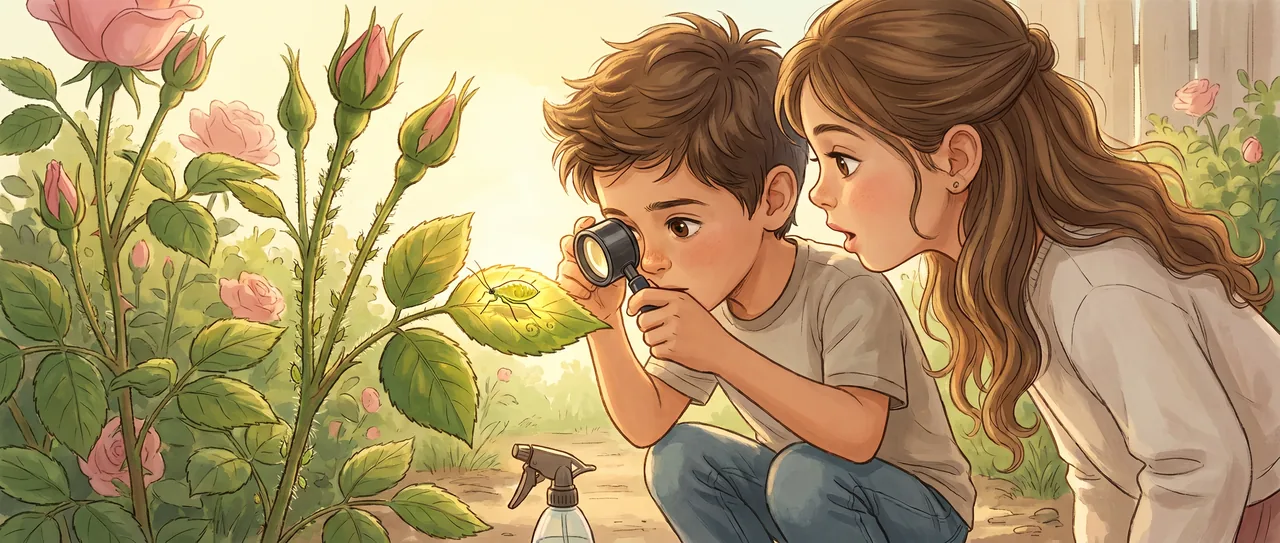
Maya held the magnifying lens her grandmother kept in the kitchen drawer, the one with the cracked handle, and aimed it at the underside of a bud. The whole stem was furred green with aphids, hundreds of them, packed shoulder to shoulder like commuters.
"There were maybe twenty yesterday," Soren said. He had counted. He counted things.
"Now there's a city."
"That's not possible in one day."
"Tell them that."
They had come out to spray the bushes with soapy water, which Maya's grandmother swore by and which the internet mostly agreed with. The spray bottle sat forgotten on the path. Maya had made the mistake of looking first.
"Soren. This one's giving birth."
He leaned in. Under the lens, a fat pear-shaped aphid was easing out something soft and pale from her back end, a smaller copy of herself, already kicking with stubby legs.
"Where's the egg?" he asked.
"What egg?"
"The egg it came out of. Bugs lay eggs."
"No egg. It just came out alive."
Soren took the lens. He watched the little one find its feet and walk three steps, already eating, already settling its mouth into the green skin of the rose. No egg anywhere. No father anywhere either, that he could see, just rows and rows of identical mothers and daughters.
"Okay," he said slowly. "So they're born live. That speeds things up. No waiting for eggs to hatch."
"That's not fast enough." Maya was doing the thing with her hands she did when numbers wouldn't sit still. "Twenty to hundreds. In a day. Even if every single one had a baby, that's not hundreds."
"Unless the babies have babies."
"The babies are babies. They were just born."
Soren didn't answer. He was watching the newborn one. Something about it bothered him, the way it was already so plump, already so ready.
"Get the other lens," he said. "The strong one. The little black one in the same drawer."
Maya ran. She came back with the loupe, the kind jewelers use, and Soren pressed it right up against his eye and bent until his nose nearly touched the leaf.
For a while he said nothing.
"Soren."
"Hang on."
"Soren, what."
He sat back on his heels. His face had gone strange.
"There's one inside it."
"Inside what?"
"The newborn. The one that was just born a minute ago." He handed her the loupe carefully, like it might spill. "Look at its middle. Look hard."
Maya looked. The newborn aphid was nearly see-through in the sunlight, and inside its small body, curled where its stomach should be, was a shape. A smaller shape. Coiled. Waiting.
"That's a baby," Maya said.
"It's a baby inside a baby that was just born."
"It hasn't even eaten a full meal yet."
"It was born pregnant."
Maya put the loupe down and looked at the bush. The whole bush. Hundreds of green bodies, and now she was seeing through all of them at once, the way you suddenly hear every conversation in a noisy room.
"Soren. If the newborn already has a baby inside it." She stopped. Started again. "Then when its mother was carrying it. The mother was already carrying its baby too."
"The grandmother," Soren said.
"The grandmother was carrying the granddaughter. Already. Before the daughter was even born." Maya pressed her hands flat against her knees. "Three of them. Three generations. In one body."
"Stacked," said Soren. "Like those Russian dolls."
"That's why the numbers were wrong." She was almost laughing now, the helpless kind. "I kept multiplying one times the next. But they're not waiting in line. They're already built. The factory ships the next factory inside the box."
Soren had pulled out the notebook. His pencil moved down the page in a quick column of figures, doubling, doubling again, and he stopped and stared at where the column had gone in only a few lines.
"Two days," he said. "If they double every two days, then by the end of the month one aphid is." He shook his head and didn't finish.
"Where do the boys go?" Maya asked suddenly. "I don't see any boys."
"Maybe they don't need them. Right now. In summer." Soren chewed his pencil. "They're just copying themselves. Over and over. No waiting, no eggs, no fathers. Just the same girl, again and again, already loaded."
"So every one of these," Maya said, looking at the swarming green city, "is basically the same one. The first one. Just unpacked more times."
They both went quiet at that.
The spray bottle was still on the path. Neither of them reached for it.
"My grandmother said they appear overnight," Maya said. "She always said it like a complaint. They just appear, she'd say. Out of nowhere."
"They don't come from nowhere."
"No. They come from inside each other. She's been right next to it her whole life and never knew." Maya picked the lens back up but didn't raise it yet. "That's the part I can't get over. It was always here. On her own roses. Three of them folded into one and nobody looked."
"You looked."
"We looked."
Soren wrote one more line, then turned the notebook so Maya could see it. He had drawn three circles, one inside the next inside the next, and beside the smallest he had put a tiny dot.
"What's the dot," Maya asked.
"The fourth one. Has to be. If the granddaughter's already in there, she's already starting the one after her." He tapped the dot. "It just keeps going in. We can't see that far down."
Maya bent back to the rose. She found the plumpest aphid, the slowest one, the grandmother of them all, and she held the loupe steady over its back, and she waited.
The pale shape inside it shifted, settled, and grew still, and somewhere inside that one, too small for any lens in the kitchen drawer, the next was already curled and waiting to be born already carrying the next.
Read the interactive version, listen to the narration, and earn a gold star →
A science-verified short story for curious kids · Curiosity Land