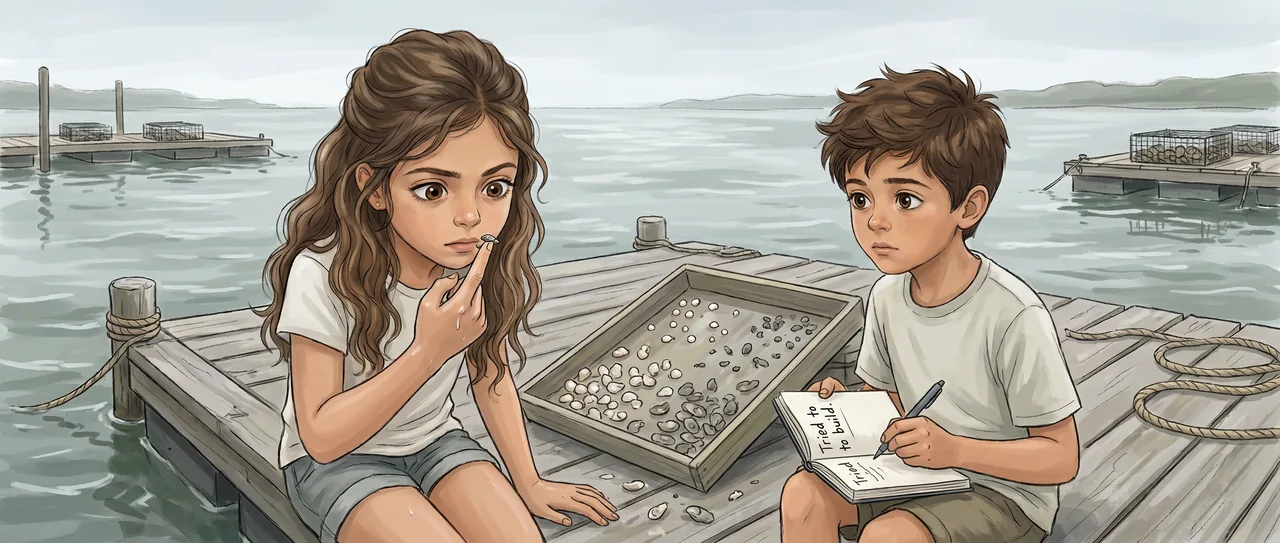
The Oysters That Forgot How
"These ones are dead," Maya said. She tipped the tray so Soren could see. The baby oysters inside were the size of pepper flakes, gray instead of pearl.
"Aunt Pen calls them spat," Soren said. "The live ones are supposed to be spat too."
"Then your aunt has a lot of dead spat."
Aunt Pen was at the far end of the floating dock, on the phone, walking in a tight angry circle the way people do when the person on the other end is saying something they don't want to hear. She had been on the phone a lot that week.
Soren ran his thumb along the inside of a tray. "They start fine. Free swimming. Then they have to build a shell and settle down. Pen says the trouble is right there. At the building part."
"Building from what?"
"The water. They pull stuff out of the seawater and make it into shell." He opened his notebook and uncapped the pen. He had drawn a tiny oyster three days ago and labeled it with a question mark.
Maya dipped a finger in the tank and tasted it, which made Soren wince. "Salty," she reported. "Obviously. But the building part. If they can't build, the water changed. Not the oysters."
"How do you know it's the water and not the oysters?"
"Because last year these same oysters built fine. Pen said. Same oysters, same farm. Something is different and it isn't them." She wiped her finger on her shorts. "Where's the building stuff come from?"
Soren flipped pages. Aunt Pen had given him a printout, the kind with small type and a graph nobody had explained. "Calcium carbonate. They need it dissolved in the water so they can grab it. The printout says when there's more carbon dioxide in the water, there's less of the stuff they can grab."
"More carbon dioxide. From where?"
"The air. The ocean drinks it from the air. Always has."
Maya stopped. She looked at the tray of dead gray flecks, then out at the inlet, which looked exactly like ordinary water, which it was. "So the air over the whole world changes, and it shows up here. In a tray. In these."
"That's what the graph is." He turned the printout so she could see the line. It went up gently, then steeply, like a hill that decided to become a cliff.
"Why is it the wrong shape," Maya said. It wasn't really a question. She put her finger on the place where the line bent. "That bend. Water's been drinking from the air forever. It should be a slow line."
"It used to be slow." Soren read from the small type, careful, because he didn't want to get it wrong. "It says this has happened before. The ocean got more acidic in the deep past. But slowly. Over thousands and thousands of years, slow enough that the building animals had time." He looked up. "This time it's about ten times faster than any of those."
"Ten times faster than ever."
"Faster than any time in the rock record. The rocks remember the old times. There's nothing in the rocks like now."
Maya was quiet. Down the dock Aunt Pen put her phone in her pocket and stood looking at the water with her hands on her hips, not moving.
"Okay," Maya said slowly. "So the oysters aren't broken. They're doing exactly what oysters always did. Reach out, grab the stuff, build. The instructions are the same. They're following them perfectly."
"Yeah."
"The instructions just don't work anymore. Because the water answered slower than they expected." She picked up one dead fleck on her wet fingertip and held it close to her eye. "It tried to build. There just wasn't enough to grab in time."
Soren wrote that down. Tried to build. He pressed too hard and the pen tore a little dot in the paper.
"Soren." Maya was still looking at the fleck. "How fast did the air change?"
"Couple hundred years. Since the factories."
"Couple hundred years to do something the rocks never saw in millions." She set the fleck down very gently, as if it could still feel things. "That's not the ocean's clock. That's ours. We did that fast. People."
"That's the part nobody wanted to say to me," Soren said. "Pen kept almost saying it."
They both looked at Aunt Pen, who was now crouched at the edge of the dock, trailing her hand in the inlet, doing exactly what Maya had done a minute ago. Tasting the problem with her skin. Not finding it. Because you can't taste it. The water that drowned the spat looked and felt and tasted like every summer she had ever had here.
"If we did it fast," Maya said, "then it's a thing that can be done. Fast things have switches. Slow things just are. This has a switch."
Soren stopped writing. "That's a weird way to feel better."
"I'm not feeling better. I'm feeling like there's a door." She turned to him, and her eyes had the bright too-much look that made some grown-ups step back from her. "The oysters can't change their instructions. They've got the only ones they know. But we put the carbon in the air on purpose, mostly, without meaning this part. The bend in the line is us. Which means the bend can come back down. It's the one part of this whole thing that can hear you."
Soren looked at the printout. The cliff. He looked at the trays, the gray and the pearl mixed together, the living spat that had managed to grab enough, this batch, this year, by luck or by being early.
"Aunt Pen," he called. "Last year's water. Did anybody keep any?"
"Frozen. In the chest freezer." She didn't turn around. "Why."
"We want to grow some spat in last year's water. And some in this year's. Side by side."
Now she turned. Something in her face had been folded shut and was unfolding. "You want to show the bend," she said.
"We want to show it isn't the oysters," Maya said. "It's the year."
Aunt Pen walked back up the dock toward them, fast, and for the first time all week she was not on the phone with anyone.
Maya was already pulling two clean trays off the stack, one for each year, and counting living spat into them, her wet finger moving, one, two, three, four.
Read the interactive version, listen to the narration, and earn a gold star →
A science-verified short story for curious kids · Curiosity Land