The Map That Kept the Hand
Uncle Devi's right hand had been gone for nine years, and his right hand hurt.
Maya knew the first part because the sleeve of his jacket was pinned up neat, the way it always was. She learned the second part on a Sunday in his kitchen when he set down his tea and said, very quietly, that his fingers were clenched again.
"Which fingers," Maya said.
"The ones I don't have." He smiled when he said it, but the smile was working hard. "They curl up. Like a fist that won't open. And the nails dig in."
Maya looked at the pinned sleeve. There was no fist. There was no arm below the elbow. There was cloth, and a fold, and a safety pin gone slightly gold with age.
"You feel the nails," she said.
"I feel the nails."
She did not say that's impossible, because clearly it was not impossible, because it was happening to a person she loved at a kitchen table. Impossible was a word for things that had not occurred. This had occurred. So she put it on the list in her head, the running list of things that did not make sense yet, and she stared at the empty space beside his shoulder as though staring could fill it in.
"Does the doctor know," she said.
"The doctor knows. There are pills. They help a little. They make me sleepy." He turned his teacup with his left hand. "The hand is gone, Maya. The pain doesn't seem to have heard the news."
That was the part she could not put down. The hand was gone. The pain was not in the hand, because there was no hand. So the pain was somewhere else, pretending. The pain had an address it kept writing to even though the house had been torn down.
She thought about where a feeling lives.
A feeling in your finger does not actually live in your finger. She knew this the way she knew the sun was far. The finger sends a message up the arm, into the spine, into the brain, and the brain is the one that decides finger. The brain draws a little map of the whole body and feeling happens on the map.
Maya went very quiet, and then she asked, "Did anyone ever erase the hand off the map?"
"Off what map?"
"The one in your head. The one that knows where your hand is." She pressed her own right hand flat on the table, fingers spread. "Mine knows where this is without looking. With my eyes shut I could touch my nose. There's a map. Your hand left. Did the map get told?"
Uncle Devi looked at her for a long moment.
"No," he said slowly. "I don't think anyone told the map."
The map was still drawing a hand. The map was still sending orders to a hand, open, close, and getting no answer back, no message from the fingers saying done, we opened, we relaxed. So the map shouted the order louder. Close. Close. And the imaginary fist clenched harder around nothing, and the imaginary nails went into an imaginary palm, and the brain felt all of it because the brain is where feeling happens anyway.
"It's stuck," Maya said. "It's telling the hand to open and the hand can't write back. So it never finds out it worked."
"How would you tell it," Uncle Devi said. He was not humoring her. He was leaning in now, the way she leaned in.
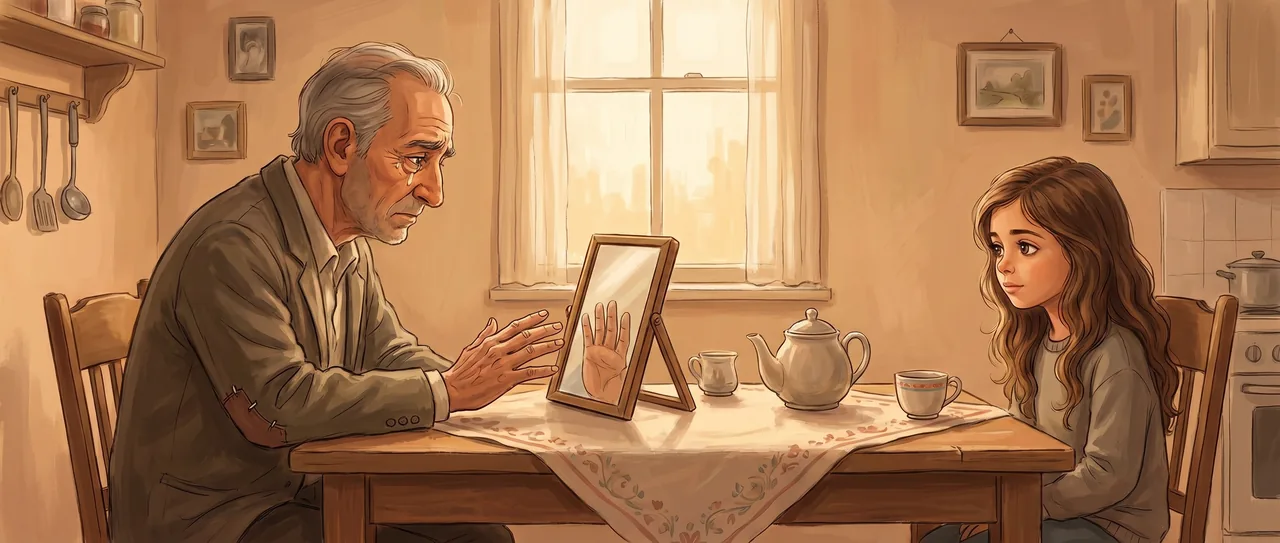
Maya looked around the kitchen for an answer and found one on the table, folded shut. The little standing mirror he used for shaving the days he stayed in. She unfolded it and set it upright, standing on its edge, splitting the table in two.
"Put your left hand here," she said, on the side of the mirror facing him. "Where you can see it in the glass."
He laid his left hand on the table. In the mirror his left hand had a twin, reaching out from behind the glass, sitting exactly where his right hand would have been. He went still.
"Now," Maya said. "Look at the one in the mirror. Pretend it's the right one. And open your fingers."
Uncle Devi looked at the reflection. His real left fingers spread, and the mirror fingers spread in the place the missing hand lived, and his eyes were fixed on the empty side of the table where suddenly, in the glass, a right hand was opening. Opening slowly. Spreading wide.
He made a sound she had never heard him make.
"Maya," he said.
"Is it open?"
He didn't answer for a while. His left hand opened and closed, opened and closed, and his eyes never left the reflection of the hand that was not there, the hand the map could finally see obeying. His shoulder, the right one, the one that ended early, came down from where it had been hunched for nine years.
"It's opening," he whispered. "The fist. It's letting go. I'm watching it let go."
His eyes were wet. He kept moving the hand. The brain was getting its message back at last, not through a nerve, because there was no nerve, but through the eyes, through light bouncing off a mirror, the only messenger that could still reach the part of the map that drew his hand. The map was watching the hand do what it was told. And the map, finally, was believing it.
Maya sat very still and did not say anything clever. There was nothing clever to say. There was a man and a mirror and a hand made of light, and a feeling that had been writing letters to a torn-down house was finally getting one back.
"It doesn't hurt," Uncle Devi said. He sounded like someone who had just put down something heavy. "For the first time. It doesn't hurt."
Maya thought about all the maps. Everyone walking around with a body drawn inside their head, the real body and the drawn body usually agreeing, lining up so neatly you never noticed there were two. She thought about how the drawn one could keep a hand the real one had lost. How a brain could love a hand so much it refused to stop feeling it.
Uncle Devi opened and closed the hand in the mirror, watching it the whole time, and did not stop.
Read the interactive version, listen to the narration, and earn a gold star →
A science-verified short story for curious kids · Curiosity Land