The Last Thousand Ants
Soren had been watching the ants for eleven days, and for eleven days they had been stupid.
He wrote that word down on the second day, then crossed it out, because his grandmother said you should not call a thing stupid until you understand what it is trying to do. So he wrote slow instead, which was also wrong, but felt politer.
The rain had drowned the old nest in the corner of the porch steps. Now a few ants wandered the cracked concrete one at a time, bumping into pebbles, turning around, going nowhere. He timed one. It took four minutes to travel the length of a single step and arrive back where it started. A single ant, Soren decided, knew almost nothing. It could follow a smell. It could carry a crumb. That was the whole list.
"They're not building anything," he told his grandmother through the screen door.
"Give it time," she said. She was inside fixing a clock, the kind with a hundred tiny brass parts spread on a towel, and she did not look up. "Time's the only ingredient I've ever trusted."
This was the sort of answer Soren found unsatisfying. He wanted a mechanism. He went back to the steps.
Over the next days he counted. He was careful about it. He used a grain of rice to mark the crack where the ants came out and tallied how many crossed it in a minute. On day four there were maybe twenty ants working, and the porch was chaos. Lines crossed lines. Ants carried grains the wrong direction, set them down, picked them up again. Twenty ants, he wrote, are exactly twenty times as lost as one ant.
He believed this completely. It made sense. If one ant knew nothing, then a crowd of nothings was just a bigger nothing.
Then the colony got bigger, and Soren turned out to be wrong, and being wrong was the most interesting thing that happened to him all summer.
It did not happen gradually. That was the part he could not get over afterward. On day nine he counted around forty ants and the porch was still a mess of crossed trails. On day ten he counted what he guessed was over two hundred, and the mess was gone.
Not tidied. Gone. Replaced by a road.
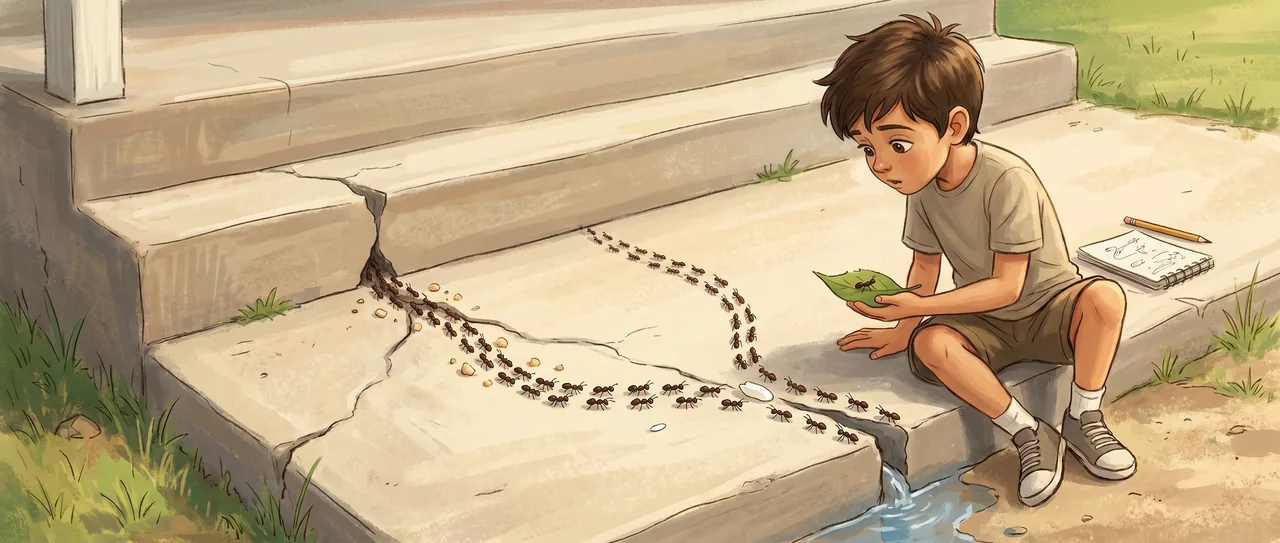
A single dark line ran from the crack in the step, across the concrete, down to a gap under the gutter where water collected. Ants moved along it in two streams, one loaded, one empty, like a highway with lanes. Nobody bumped. Nobody doubled back. At a fork near the rice grain, ants leaving the nest peeled left and ants returning peeled right, every time, as if someone had painted arrows.
Soren sat down hard on the bottom step.
He knew there was no someone. He had been watching the whole time. No ant had stood at the fork directing traffic. No ant was in charge. He had checked for that on day three, half hoping to find a big one wearing a tiny hat, and there was no big one. Every ant out there was the same kind of almost-nothing he had timed crawling in a confused circle eleven days ago.
The single ant still knew nothing. He was sure of that. He picked one off the road with a leaf and set it on the far side of the porch, alone, and watched it do exactly what the day-one ant had done. It wandered. It bumped a pebble. It turned around. By itself it was as lost as ever.
He put it back near the road. Within a minute it found the line, fell into a lane, and became part of the thing that knew where the water was.
Soren wrote, then stopped, the pencil pressing a dent into the page. He did not have a sentence for it yet. The road was not inside any of the ants. He had taken one apart from the rest and looked, and the knowing was not in there. The road only existed when there were enough of them. Add ants one at a time and for a long time you get nothing, nothing, nothing, more lost, and then somewhere past a number he had missed, the road, all at once.
He went to find the number.
All afternoon he tried to catch the threshold. He swept ants off the line with the leaf, gently, dropping them in the grass, thinning the road down. At a hundred or so it still held, frayed but holding. He kept thinning. The line wavered. Ants began to hesitate at the fork. And then, between one count and the next, between maybe sixty ants and maybe fifty, the road was not a road anymore. The arrows vanished. The lanes dissolved back into bumping and turning and going nowhere.
He had not removed a leader, because there was no leader. He had removed a few ordinary ants from a crowd of ordinary ants, and a kind of thinking had switched off.
The screen door creaked. His grandmother came out wiping brass dust on her apron and looked at the empty concrete where the highway had been.
"You broke it," she said, not unkindly.
"It came back when there were enough of them," Soren said. "And then it goes away when there aren't. There's a number. Below the number they're just ants. Above it they're something that knows things no ant knows."
His grandmother thought about that. "My clock's like that," she said. "One gear keeps no time at all. One gear is just a little wheel. Put enough together right and the thing tells you when to wake up." She shrugged. "Never knew where exactly the telling-time started. Somewhere in the middle of the pile."
Soren did not answer. He was thinking about how many things in the world might be piles like this. A brain was cells, and one cell knew nothing. People were people, and one person alone on a porch was fairly lost too. Somewhere there were numbers, thresholds, where nothing crossed over into something, all at once, with no one in charge of the crossing.
He stopped sweeping ants. He let the ones in the grass find their own way home.
By evening the road had healed itself in the dark, two lanes again, thicker than before, carrying its small certain knowledge down to the water while every single ant on it knew nothing at all.
Read the interactive version, listen to the narration, and earn a gold star →
A science-verified short story for curious kids · Curiosity Land