The Hairdresser's Egg
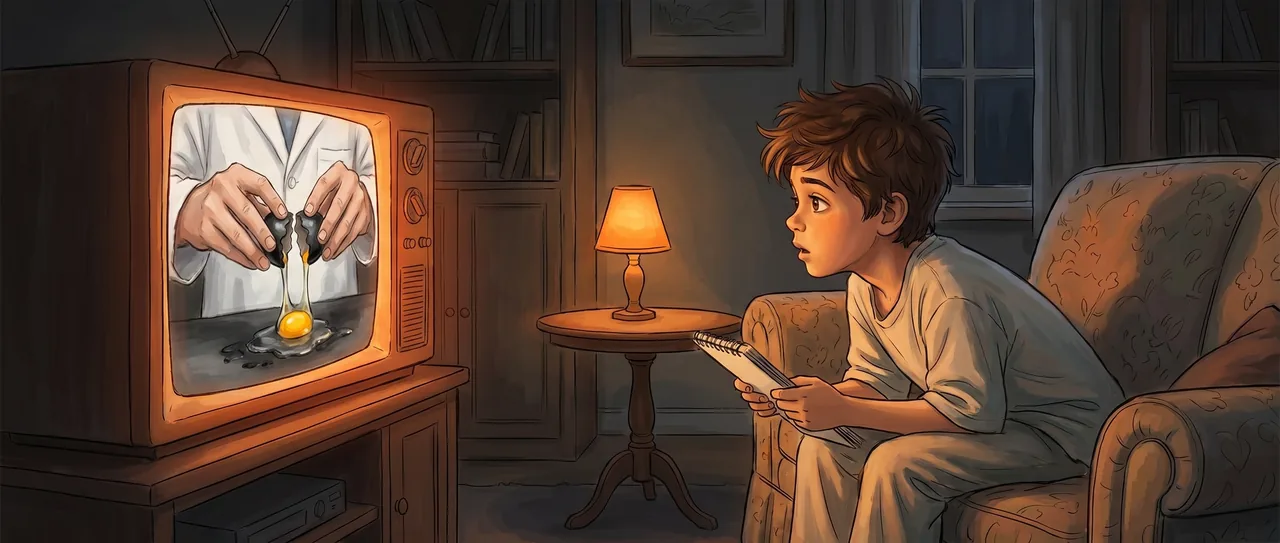
The documentary was old. The colors looked wrong, too orange, like a photograph left in a window. Soren had found it at the bottom of a list of things to watch when nobody else was awake, and he had pressed play because the title was a question, and questions at midnight are hard to leave alone.
A man was holding an egg.
Not a real egg. A chicken egg, ordinary, painted with a thin grey coating that looked like dried mud. The man was a hairdresser from England. He had no laboratory. He had a kitchen, a curious head, and a name for the stuff he had made. He called it Starlite.
Then the scientists turned on the blowtorch.
Soren leaned forward. The flame was the blue-white kind, the kind that cuts steel, and they held it against the egg. They held it for a long time. Five seconds. Ten. The narrator said the flame reached temperatures that would have turned the egg to ash and cinder in an instant. The numbers came up on the screen and Soren read them twice. Hotter than a furnace. Hotter, the narrator said, than the surface of the sun.
They turned off the torch.
A man in a white coat picked up the egg with his bare fingers. He cracked it open. The inside was raw. Still cold. Still liquid. The yolk slid out whole and yellow as if it had spent the evening in the refrigerator.
Soren sat very still on the couch.
He rewound it. He watched the crack and the slide again. The yolk came out whole the second time too, which he had known it would, but he needed to see his own eyes were not lying.
He got his notebook from the kitchen table and brought it back. He wrote down the temperature. He wrote down the words bare fingers. He drew a small egg and an arrow and the word cold.
The documentary kept going. It told him the rest, the way these things always tell you the rest after they have already taken your breath. The hairdresser would not sell the formula. Companies came. The military came. People offered him fortunes for a spoonful of grey paste. He said no. He was afraid that if he sold it, the secret would be inside the thing he sold, and clever people would take it apart and learn it without him.
So he kept it.
And then, the narrator said, in a flat quiet voice, the man died. And the formula died with him. He had never written it down where anyone could find it. He had carried the whole of it inside his own head, and when the head was gone, so was the egg that stayed cold inside the fire.
The screen went to black with the little spinning circle that means the next thing is loading.
Soren did not let the next thing load. He turned the television off.
The living room was very dark and very ordinary. The radiator ticked. Somewhere upstairs a floorboard settled. He looked at his notebook, at the small egg and the word cold, and he felt something he did not have a clean name for, so he sat with it instead of naming it.
It was not that the secret was lost. People lose things. It was that the secret had been real. The flame had been real. The scientists with their instruments had measured it and written papers and shaken their heads, and the cold yolk had slid out into a bowl on television in front of everyone, and none of them could do it again.
The answer existed. It had simply walked out of the world.
Soren thought about the hairdresser standing in his kitchen with no degree and no laboratory, mixing things in a bowl the way you might mix a cake, paying attention to what worked and what did not. Soren thought about how the man must have been the kind of person who stood in a kitchen and wondered what would happen if. The kind of person who tried the thing. Twenty-one ingredients, the documentary had said. Ordinary ones. Things you could buy. The genius was not in any single one of them. The genius was in knowing how they went together, and that knowing had lived in one ordinary head.
Which meant it could live in another one.
Soren turned to a clean page. He did not write the formula, because he did not have it, because nobody had it. He wrote, at the top, the question the documentary had started with, the question he had pressed play on at midnight. How does a thing stay cold inside fire.
Under it he wrote what he actually knew. A flame brings heat. The coating swelled in the video, he had seen it puff up like burnt sugar, and the swollen part went black, and the black part stayed put. Heat travels by touching. If the touching part turns into a layer that will not pass the heat along, then the heat arrives and arrives and arrives and has nowhere to go.
He stopped writing and looked at that.
It was not the formula. It was the shape of the formula. The hairdresser had found one road up the mountain and taken it with him. But the mountain was still there. The cold yolk had proved the mountain was there. A material could exist that drank a sun-hot flame and gave the heat nowhere to go, and the proof of it had slid out whole and yellow into a bowl, and the proof did not die with the man. The proof was the whole point. The proof said: this is possible. Find your own road.
Soren looked at the dark window. His own face was in it, faint, lit by the small lamp, and behind his face the street and the streetlight and the enormous black sky with its scatter of stars that were each, every one of them, hotter than the egg had ever had to bear.
He got up. He went to the kitchen. He opened the refrigerator, and the cold light fell out across the floor, and he took out an egg and held it in his hand, just to feel how easily the cold of it could be ruined, how a single match would cook it, how nothing in his hand should ever be able to survive a flame.
And yet one had.
He set the egg on the counter and stood looking at it.
Read the interactive version, listen to the narration, and earn a gold star →
A science-verified short story for curious kids · Curiosity Land