The Fish Who Lived in the Wrong Place
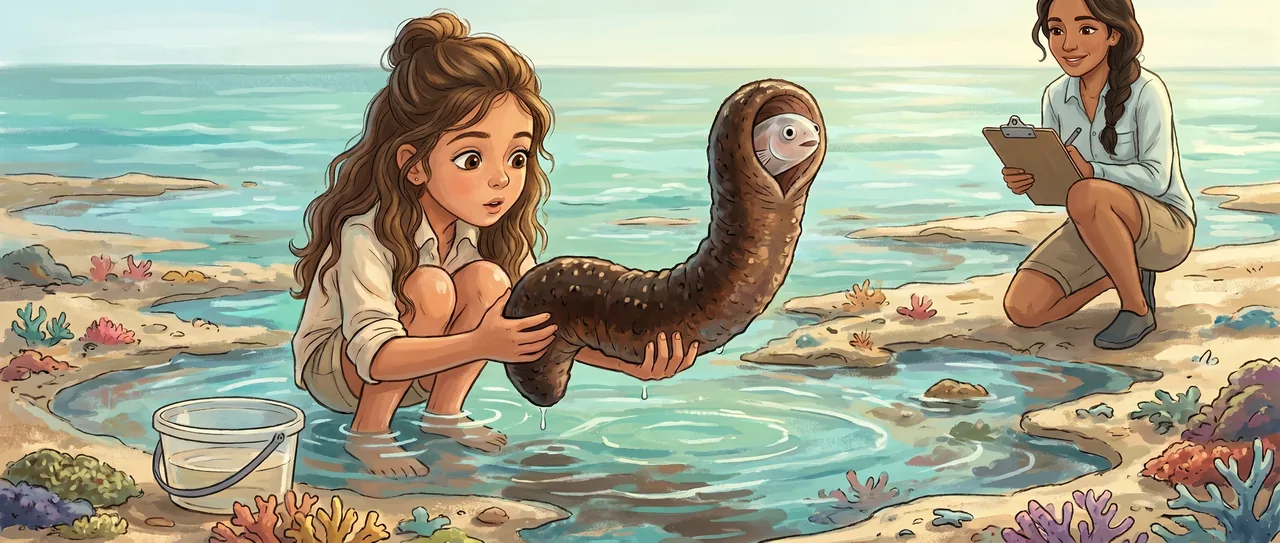
Maya had a sea cucumber in both hands and it was breathing out of the wrong end.
She knew it was the wrong end because her aunt had told her, twenty minutes ago, that sea cucumbers breathe through their backsides. Water in, water out, all day, through the same hole everything else came out of. Maya had laughed. Then she had stopped laughing and started watching, because if it was true she wanted to see it happen.
It was happening. The cucumber lay heavy and warm in her palms, a fat brown sausage covered in soft bumps, and its rear opening pulsed gently. Open. Closed. Open. A slow, patient mouth at the end with no business being a mouth.
"Aunt Priya," Maya said. "How does it not get stuff in there. When it opens."
"It does get stuff in there," her aunt said, not looking up. She was bent over the survey clipboard, counting, which meant half of her was somewhere else. "That's how it breathes. Sea water goes all the way up into a sort of lung-tree inside."
Maya looked at the slow opening. She thought about a door that had to keep opening, all day, in a place full of things that wanted somewhere to live.
She held the cucumber up to her eye.
The opening relaxed wide, the way it did at the end of each breath, and for one second she saw straight up into the dark of it. Something pale was in there. Not the gray of the gut. A clean, narrow paleness, pointed, fitted to the hole like a cork made of glass.
Then the opening closed and the pale thing was gone.
Maya did not say anything. She set the cucumber down very gently in the shallow bucket and crouched over it and waited. Her knees got wet. A small crab walked over her foot. She waited for the cucumber to breathe.
It breathed. The opening went wide. The pale thing slid down, just to the edge, a thin head with two dark dots for eyes, looking out at her looking in. A fish. A fish the size of her finger, transparent as a peeled grape, living inside an animal's backside and looking perfectly calm about it.
Maya made a sound she did not plan to make.
The fish withdrew. The opening closed.
"Aunt Priya." Her voice had gone strange. "There's a fish inside this one."
Her aunt came over the way adults come over when they expect to correct a child, fast and patient at the same time. Then she saw the cucumber breathe, and the pale head appear, and the dark dots, and she stopped being patient and got very quiet. .
"That," she said, "is a pearlfish. I have read about these. I have never seen one."
"It lives in there."
"It lives in there."
"On purpose?"
"On purpose." Aunt Priya crouched down beside her, the clipboard forgotten in the wet sand. "It goes in tail first. It finds the opening and it backs in, slow, and it waits for the cucumber to relax and breathe, and when the hole opens it slides up a little more. Then it waits again. It works its whole body in, backward, one breath at a time."
Maya pictured it. The fish in the dark, pressed to the closed door, patient as the cucumber itself, riding each breath a little deeper. Not forcing. Just waiting for the open part.
"Why," she said.
"Shelter. Nothing can reach it in there. It's the safest place on the reef." Her aunt paused. "It goes out at night to eat, and then it comes home. The same cucumber. It remembers which one."
Maya watched the opening breathe.
She thought about the word home. She had always thought home was a thing you picked because it was nice. A clean room, a soft bed, a place that looked like the inside of a place. But the fish had looked at the whole entire ocean, the open water, the coral, the bright safe-looking everywhere, and it had chosen the one place no one else would go near. The wrong place. The place that was a joke when you first heard it. And it had backed itself in there, breath by breath, and made it the only place it would ever come home to.
"Some of them eat the cucumber from the inside," her aunt said. "The gonads. They live in the host and feed on the host."
"Does the cucumber know."
"We don't really know what the cucumber knows."
Maya looked at the slow brown animal. It had no eyes. It had no brain to speak of. It breathed in and out, in and out, keeping a door open all day so it could stay alive, and the door it had to keep open was exactly the door the fish needed. The cucumber could not stop breathing. So it could not stop being a home.
"It can't close it," Maya said. "It has to keep opening it. To breathe. So the fish can always get back in."
Her aunt looked at her.
"The thing that keeps it alive," Maya said slowly, "is the same thing that lets the fish in."
Neither of them said anything for a while. The tide was coming back in around their ankles, cold and then warm, and somewhere under the reef there were how many of these, Maya thought, how many cucumbers breathing all night with a pale fish folded up inside each one, going out to eat in the dark and finding their way home to a body that could never lock the door.
The cucumber in the bucket breathed out.
The pale head came to the edge of the opening, two dark dots, looking at her.
Maya tipped the bucket slowly toward the sea and let the water carry the cucumber out over the lip, fish and all, back down into the dark between the rocks.
Read the interactive version, listen to the narration, and earn a gold star →
A science-verified short story for curious kids · Curiosity Land