The Count That Wouldn't Stop
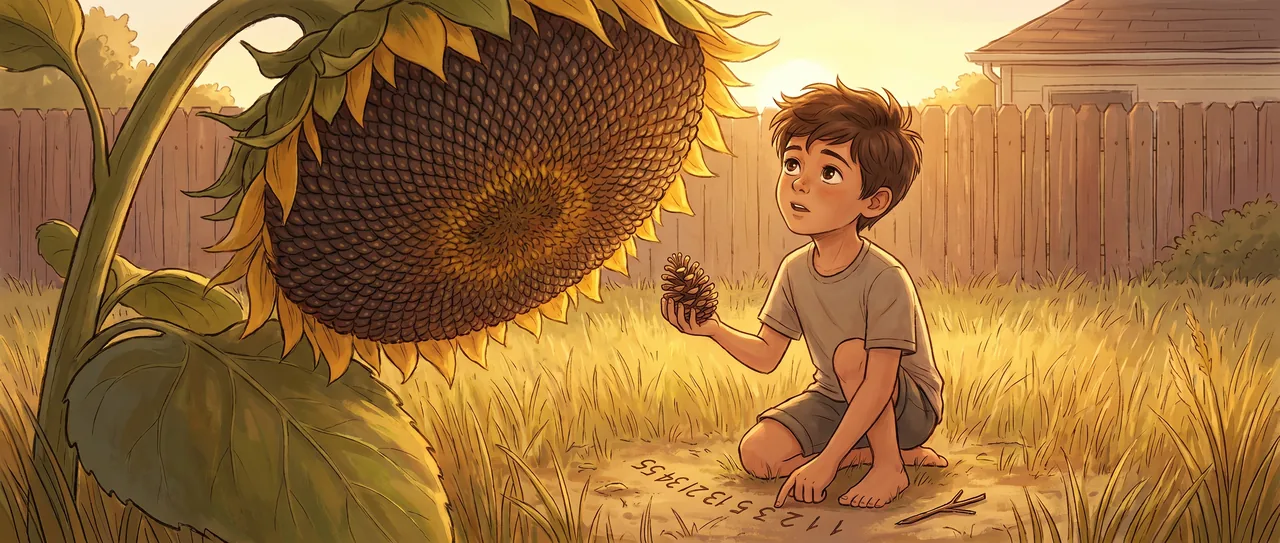
The sunflower was taller than Soren's grandmother, and his grandmother was taller than Soren's father, so the flower had won the whole family without trying.
Soren had bet himself he could count the seeds. Not estimate. Count. He had a toothpick to push each one as he went and a smear of poster paint to mark where he started.
He got to forty before the trouble began.
The seeds did not sit in rows. He had assumed rows, the way corn sits in rows, the way his locker sat in a row of lockers. But these seeds curved. Each one leaned against the next along a line that bent, and the bent lines crossed other bent lines going the other way, and his toothpick kept losing its place in the crossing.
His grandmother came out with two glasses of lemonade and set one in the grass beside him.
"You'll be there till October," she said.
"I'm counting the spirals instead," Soren said. "The whole curvy lines. That's fewer."
"Smart," she said, and went back inside, because she had a crossword that was beating her and she did not consider the sunflower a mystery. To her it was a plant that did what plants do.
Soren put his toothpick at the edge and followed one curve from the outside all the way to the dark center. Then he started over and counted how many curves went that direction, the way they leaned to the right.
Thirty-four.
He counted them twice to be sure. Thirty-four spirals leaning right.
Then he counted the ones leaning the other way, the left-leaners, which crossed the first set like a basket weave.
Fifty-five.
He sat back. Two numbers. Thirty-four and fifty-five. They felt close to something. He could not say what. It was the feeling of seeing a word spelled almost like another word.
He took the toothpick and scratched the two numbers into the dirt. Thirty-four. Fifty-five. He looked at the gap between them. Twenty-one.
He wrote twenty-one in the dirt too, off to the side, and then his hand did something before his head caught up. Under twenty-one he wrote thirteen. Then eight. Then five. Then three. Then two. Then one. Then one.
He read it backward, bottom to top. One, one, two, three, five, eight, thirteen, twenty-one. Then thirty-four. Then fifty-five.
Each number was the two before it added together. One and one made two. Two and three made five. Thirty-four and twenty-one made fifty-five.
The sunflower had grown thirty-four of one and fifty-five of the other. Two numbers that belonged to a line that started at one and one and never stopped.
He got up too fast and had to wait for the dizzy to pass.
There was a pine cone on the path where the squirrels left their wreckage. He picked it up. It had spirals too, he had just never had a reason to look. He counted the ones going one way. Eight. He turned it and counted the other way. Thirteen.
Eight and thirteen. Next to each other on the line in the dirt.
He stood very still with a pine cone in one hand and a sunflower the size of a dinner plate leaning over him, and he understood that the plant was not deciding this. A pine cone does not know arithmetic. A sunflower does not count its own seeds. There was no one inside the flower choosing thirty-four and fifty-five.
So something made the numbers happen without anyone meaning them.
He went inside and found his grandmother glaring at seven across.
"Why," Soren said, "would a sunflower grow exactly thirty-four spirals one way?"
"I'm sure I don't know," she said. "It just grows."
"But it grows the same numbers as the pine cone."
She looked up. "Does it."
"It does."
She put her pen down . "Well," she said. "What do they have in common, a sunflower and a pine cone?"
It was not an answer. But it was the right question, and Soren took it back outside with him.
He sat in front of the flower again and watched it the way you watch something you have stopped assuming you understand. The seeds at the center were tiny. The ones at the edge were fat. The center was where the new ones got made, one at a time, each pushing out as the next arrived behind it.
He took the toothpick and pressed it into the dirt and tried to draw it. A new seed in the middle. It needed somewhere to sit. The best spot was the gap left over, the empty wedge the last seeds had not filled. So the new one turned a little and sat in the gap. And the next one turned the same little amount and sat in its gap. Every new seed turning by the same fraction, never landing on top of an old one, never leaving a hole.
He could see it now without seeing the whole thing. Each seed only solving its own small problem. Where do I fit. Where is the room. And that one selfish little question, asked the same way millions of times, packed the head so tight there was no wasted space anywhere on it.
The spirals were not the plan. The spirals were the leftover shape of everyone fitting in.
And the numbers that came out of fitting in, the only numbers that came out, were one, one, two, three, five, eight, on and on, the line that never stopped.
He thought about the line not stopping. It went up past fifty-five. It went up past anything a sunflower could grow. It kept going into numbers too big for any plant, and he had read once that the arms of whole galaxies wound out in spirals too, spinning their hundred billion stars.
Nobody told the galaxy the number. Nobody told the pine cone. Nobody told the seed in the middle of the flower that was being made right now, this minute, while he sat in the grass.
The same line, written everywhere, by nothing.
Soren reached up and touched the edge of the great heavy head, and it turned a little on its stalk toward the last of the sun, and a single loose seed dropped out of the center into his open hand.
Read the interactive version, listen to the narration, and earn a gold star →
A science-verified short story for curious kids · Curiosity Land