The Brightest Thing
The engine coughed once and then gave up, and the car rolled to the gravel shoulder in the dark.
Aunt Vera said a word she usually didn't, then breathed out and said, "Tow truck. Forty minutes. Maybe an hour out here." She tipped her head back against the seat. "Sorry, kiddo."
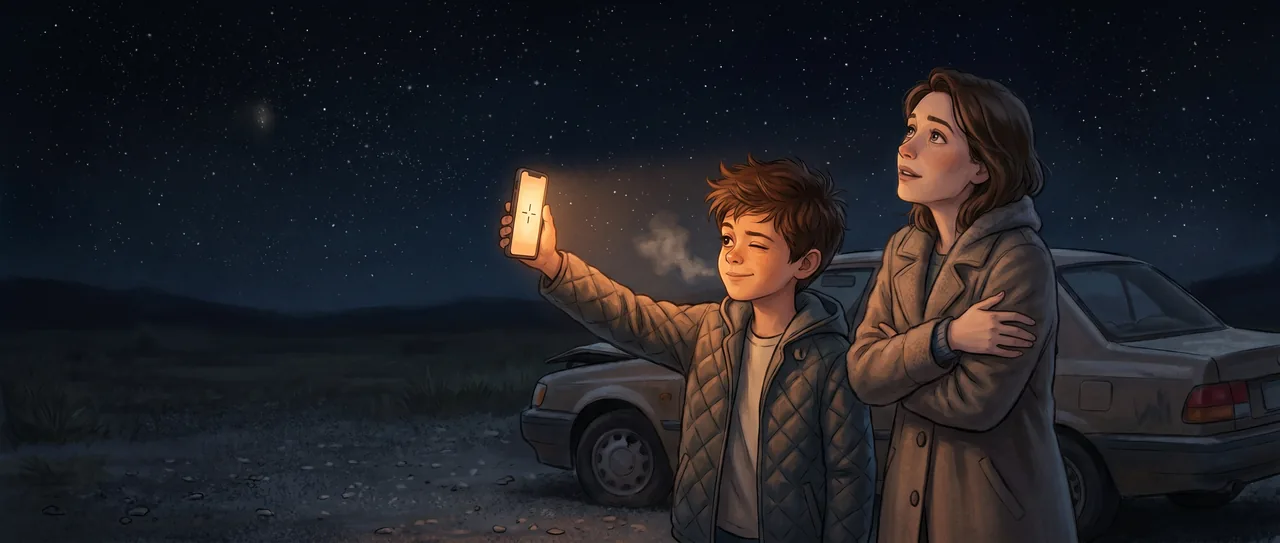
Soren pushed open the door. The cold came in like water. Out here, past the last town, the air smelled of cut hay and cooling metal, and when he looked up he stopped with one foot still in the car.
The sky was crowded. Not the few city stars he was used to, the ones that had to shout to be seen. Thousands. A river of them poured straight overhead, faint and grainy, and the longer he stood the more of them arrived, as though his eyes were buckets slowly filling.
"There's so many," he said.
"Mhm." Vera was already scrolling her phone. "I have that app. The one your mom made fun of. Hold it up and it tells you what you're looking at." She climbed out, knees popping, and held the glowing rectangle against the dark. Names floated up on the screen. Vega. Deneb. A smear labeled Milky Way.
Soren took the phone. He liked how it worked, how it knew which way it was pointing by feeling the planet turn under it. He swept it slowly across the sky, reading the labels as they bloomed.
Then he found one that didn't make sense.
The app had put a little crosshair near the edge of a constellation and a number beside it. He pinched the screen to zoom into the listing. There was almost nothing there to the eye, maybe a grain of light so faint he wasn't sure he saw it at all. But the panel said: 3C 273. Quasar. And then a line about distance that he read three times.
"Aunt Vera," he said. "How far is the farthest star we can see? Just our eyes."
She thought. "Few thousand light years? Something like that. Why?"
"Because the app says this thing is two and a half billion."
The number sat in his mouth, too big to swallow. He looked from the screen up to where the crosshair pointed and back down. A few thousand for the bright ones overhead. Two and a half billion for the faint smudge he could barely find.
That was wrong. That had to be a typo, the way the app sometimes was. Things that far away were supposed to be invisible. Whole galaxies that far were invisible, just milky stains you needed a telescope to drag out of the dark. But this one his eyes could almost, almost catch.
He stood very still and let the cold work into his sleeves If it was that far and he could nearly see it, then it had to be brighter. Not a little brighter. Stupidly, impossibly brighter, to throw light across two and a half billion years and still reach a kid standing on gravel in a hay field.
He read the listing again, all the way down. Powered by a supermassive black hole. He frowned at that, because a black hole was the thing that ate light, the thing nothing escaped. The darkest thing there was. And the app was telling him it powered the brightest.
"Vera," he said slowly, "it says the bright part is a black hole."
"That's the joke of them, isn't it," she said, not really listening, hugging her arms. "They eat stuff."
And then it turned over in his head, the way a lock turns when the last pin drops.
The black hole wasn't the light. The black hole was the drain. Everything falling toward it, gas and dust and torn-apart stars, all of it crowding in and grinding against itself on the way down, getting hotter and hotter the way his hands got hot when he rubbed them, until the whole spinning mess screamed with light. The thing nothing escapes was surrounded by the loudest light in the universe, made by everything trying not to fall in and losing.
He pulled his notebook out of his coat. He pressed the pen down and the line came out shaky from the cold. He wrote the number, two and a half billion, and circled it twice.
"Whatcha got," Vera said.
"This one little dot," he said. "It's a whole galaxy. Like, all of it, billions of stars, more than this whole sky." He swept his free hand across the river overhead. "And the dot isn't the galaxy. The dot is one spot in the middle of it. And that one spot is so bright it makes the entire rest of the galaxy look like nothing."
Vera lowered her phone. "How much brighter?"
He checked. He had to read it twice to believe the zeros. "The brightest ones. Ten thousand times. One little center, ten thousand times more light than every single star in the whole galaxy around it, added up."
He felt it then in his chest, the wrongness flipping into something else. All those stars overhead, the river, the buckets of his eyes filling, all of it was the cozy near part. The faint dot was the far part, and the far part was howling. Somewhere out there a drain the size of nothing was lit up brighter than every star Vera had ever named, and the light had been traveling since before there were fields, or hay, or eyes to fill.
And it had arrived. Tonight. On the night the car broke down.
"Vera," he said. "It only got here because we stopped."
She didn't answer. She had stopped scrolling. She was looking up now too, at the patch he was pointing to, the wrong patch, the empty-looking one.
Soren held the phone out at arm's length and lined the crosshair up exactly, so the little marker sat right over the grain of light, the spot he could almost see and almost not. He shut one eye. He looked along the side of his sight the way the faint things asked you to, the way he'd learned with the aurora, off to the edge instead of straight on.
For one second the dot brightened, and held, and stayed.
Read the interactive version, listen to the narration, and earn a gold star →
A science-verified short story for curious kids · Curiosity Land