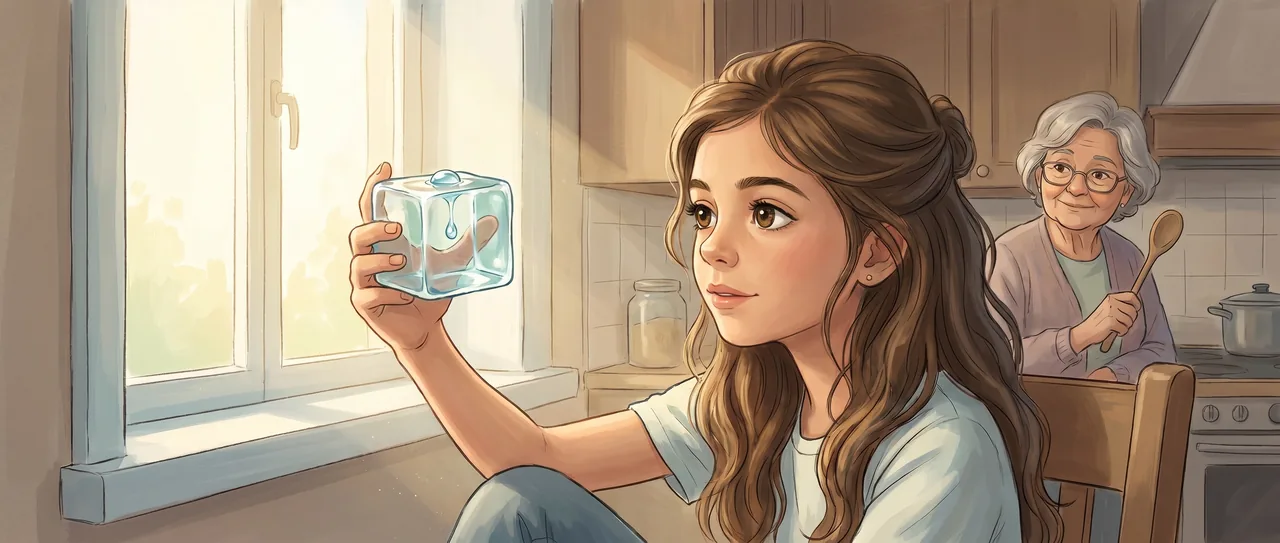
The Almost-Water
The lens went down the drain before Maya could close her hand on it.
One second it sat on her fingertip, a clear curved sliver, almost nothing. Then it slid off, hit the wet edge of the sink, and was gone. She stood there with the cold tap running over her knuckles, annoyed at how something could be that real and that close to not being there at all.
Her grandmother didn't look up from the stove. She wore glasses. She had opinions about lenses.
Maya turned off the water and that was when she noticed the jar on the windowsill, the one that had been there all week and that she had decided not to ask about because asking sometimes meant a long story.
Inside the jar sat a cube. It was clear like the lens had been clear, clear like glass, except glass does not wobble when you tap the jar, and this wobbled. It trembled and settled. It was sitting in no water. The jar was dry inside. The cube was just there, holding its corners, holding its own shape with nothing holding it up.
Maya tipped the jar sideways. The cube leaned against the glass and stayed a cube.
"That," said her grandmother, "is mostly water."
"It's not though." Maya set the jar down. "Water doesn't have corners."
"Open it."
Maya unscrewed the lid and reached in. The cube was cool. It gave under her finger the way a grape gives, then pushed back. It was wet but it did not drip. She pressed harder and a bead of water came up around her fingertip and then sank back in when she lifted off, like the cube was breathing it.
She lifted the cube out. It weighed almost nothing. She could see the kitchen through it, the window, her grandmother's shoulder, all of it bent and swimming. When she squeezed, water pearled out between her fingers and ran down her wrist. When she stopped, the cube drank it back up and was a cube again.
"It's leaking," Maya said. "But it's not getting smaller."
"Try and make it leak all the way."
Maya squeezed until her hand ached. Water came. Water kept coming. And the cube stayed, smaller now, denser, but whole, refusing to fall apart into the puddle it so obviously mostly was. She opened her hand. It plumped back, soft and full, pulling the spilled water off her palm.
She sat down with it. Outside the window the morning was doing its ordinary things. Inside her hand was a thing that was a puddle pretending to be a brick, or a brick that was almost entirely puddle, and she could not decide which way around the sentence went.
"What's the part that isn't water," she said.
"A net. So small you can't see it." Her grandmother finally turned around, a wooden spoon in her hand. "Long strings, all tangled and tied to each other. The water sits in the holes of the net. The net won't let the water leave, and the water won't let the net dry up."
Maya looked at the cube. She thought about a fishing net dropped into the sea, except the net was so fine and so tied to itself that it lifted a cube of sea straight up into the air, and the sea came with it, and stayed.
"Almost none of it is net," she said.
"Almost none."
Ninety-nine, Maya thought. More than ninety-nine. A whole thing she was holding, and the part that gave it corners was the smallest part, the part you could not see, the part doing all the work while the water got all the credit for being there.
She held it up to the window light. The light went through it and came out soft. That was the thing about the lens, she thought. The lens had been this. Mostly water, held in a net so fine it could sit on an eye all day and the eye would never know it was carrying a tiny held puddle that bent the world into focus.
"My lens was made of this."
"A cousin of this."
Maya turned the cube. A bead of water rose to the surface, sat, sank.
"You could put medicine in the holes," she said slowly. "In the net. The water's already going in and out. So the medicine would come out slow. Wherever you put the cube."
Her grandmother stopped stirring.
"You could grow things in it," Maya said, faster now. "Because it's wet like the inside of a person is wet. If a cell wanted somewhere to sit, it would want a net. It would want water it couldn't drown in." She looked up. "You could grow a piece of a person. In a net of almost-water. The way you grow cells in a body, except the body is this."
Her grandmother did not tell her she was right. She did not tell her she was wrong. She put the spoon down and came and looked at the cube in Maya's hand as if she had not been looking at it all week, as if Maya had brought something new into the kitchen.
Maya pressed the cube once more, gently, and felt it push back, felt the water move under the surface without leaving, the whole impossible held ocean of it answering her thumb.
She thought about her lens, gone down the drain, a held puddle slipping into the pipes to be just water again. She thought about a heart that could start as a net. She thought about how much of the world might be sitting around as water that simply had not been given corners yet.
She carried the cube to the window where the light was best and held it still. A single bead climbed to the top of it, hung, and slid back down inside, going nowhere, staying.
Read the interactive version, listen to the narration, and earn a gold star →
A science-verified short story for curious kids · Curiosity Land