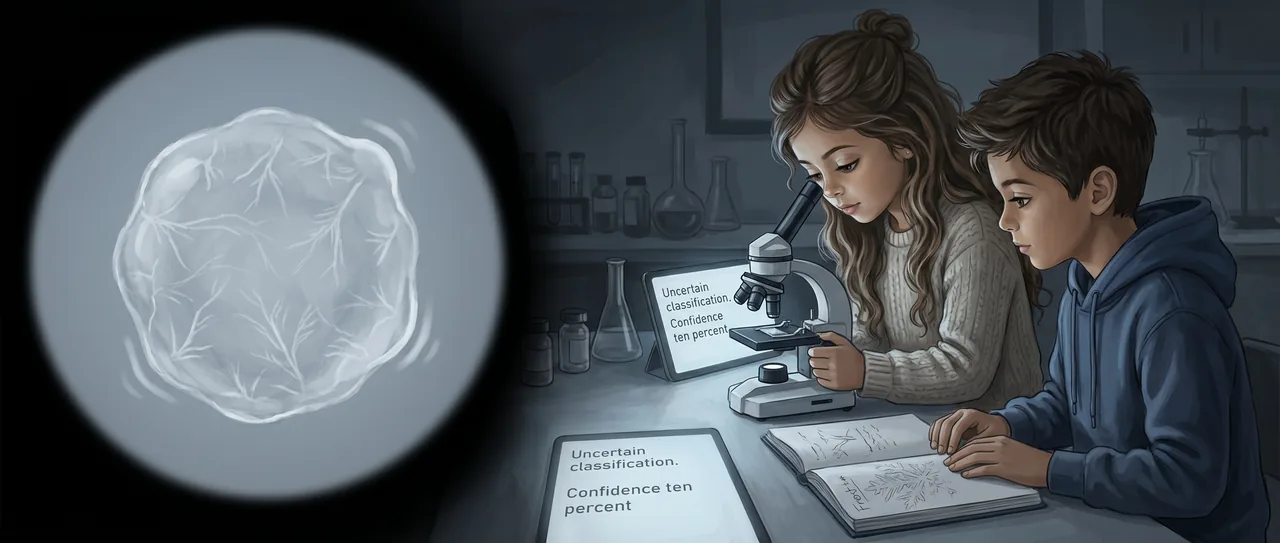
Uncertain Classification
The cleaner had already turned off half the lights when Soren slid the last slide under the lens.
"One more," he said. "Then we label everything and go."
The tablet beside the microscope listened to every image. It had been trained on millions of cells, more cells than any one person could study in a lifetime, and it named them faster than either of them could blink. Paramecium. Confidence ninety-nine percent. Green algae. Confidence ninety-eight. Rotifer, twisting like a tiny machine, named before it finished turning.
"It's better than Mr. Acharya," Maya said. She wasn't being mean. Mr. Acharya had said so himself, cheerfully, before he left them his keys and his coffee thermos and went home.
"It's better than every biologist," Soren said. "That's the whole point of it. Shape and texture. It doesn't even need the color."
Maya nudged the slide a little. A new shape drifted into the bright circle.
The tablet went quiet.
They both looked at it.
Where the green words usually appeared, a single line sat in gray. Uncertain classification. Confidence twelve percent.
"Bump it," Maya said. "Sometimes it just needs the thing centered."
Soren centered it. The cell sat perfectly still in the middle of the light, round but not quite round, with a texture inside it like frost on a window, fine lines crossing fine lines.
Uncertain classification. Confidence eleven percent.
"It went down," Soren said.
"It went down when you showed it more." Maya leaned in. "That's backwards. The more it sees, the surer it gets. It just got less sure."
Soren reached for his notebook. He drew the frost pattern, the crossing lines, the way one edge of the cell came to a soft point instead of curving.
"Okay," he said, the way he did when he wanted to slow a thing down. "Two reasons it could say uncertain. One, it's broken. A smudge. A bubble. A bit of dust pretending to be alive."
"It's not dust." Maya watched the point on the cell's edge. It pulsed. Just slightly, just once, the whole shape tightening and letting go. "Dust doesn't do that."
Soren saw it too. He wrote: it moved on its own.
"Two," he said. "It's real, and the machine has never seen anything like it."
"It's seen millions of things."
"It's seen millions of things people already put in front of it," Soren said. "It only knows the cells we already found. The ones in the textbooks. The ones somebody already named."
Maya straightened up.
"So the gray line isn't the machine failing," she said slowly. "The gray line is the edge of everything anybody's ever named."
For a second neither of them said anything. The cleaner's cart squeaked somewhere far down the hall.
"We have to make sure it's not a bubble," Soren said. "Or we'll be the kids who got excited about a bubble."
They worked. Maya tilted the stage so the cell rolled. Bubbles don't roll like solid things, they slide and shiver, and this one tumbled with a weight to it. Soren changed the focus up and down. A smudge on the lens stays sharp when the slide goes blurry, because it lives on the glass, not in the water. This stayed with the water. When the pond layer blurred, it blurred too.
"It's in there," Soren said quietly. "It's swimming in there with everything else."
Maya fed the tablet a clean paramecium again, just to check. Paramecium. Confidence ninety-nine. The machine wasn't broken. It knew exactly what it knew. It was only honest about what it didn't.
She brought the frost-cell back.
Uncertain classification. Confidence ten percent.
"It keeps dropping," Maya said. "Every time we look harder it gets more sure that it has no idea."
Soren laughed, a short surprised sound. "That's the most truthful thing I've ever seen a computer do."
"Mr. Acharya's better-than-every-biologist machine," Maya said, "just told us it found something no biologist has named."
"Or an artifact."
"Or that." She looked at him. "You really think it's an artifact?"
Soren looked at the pulsing point on the cell's edge, the frost crossing the frost, the slow tumble of a thing with real weight, swimming in real water, in a sample they had scooped from a real pond behind a real school that afternoon.
"No," he said. "I think it's alive. I think nobody's looked at this exact pond on this exact day, and the machine's only ever been told about the cells somebody already caught."
Maya pulled the second tablet over and started a recording, the cell turning in the light, the gray line glowing under it like a held breath.
"There are how many ponds," she said. It wasn't really a question. "How many puddles. How many drops of water nobody's ever put under anything."
"More than the machine's ever seen." Soren wrote the date. He wrote the pond. He wrote: confidence ten percent and falling, and underlined falling, because that was the part that mattered, that the surer they got it was something, the surer the machine got that it was nothing it knew.
"We should save it," Maya said. "The actual water. Before it dries. People are going to want to see this who aren't us."
Soren capped a small vial and labeled it in careful letters. Pond, west fence. Then, after a second, he added one more word, the only honest name they had for it.
Unknown.
They stood the vial upright in the rack where it couldn't tip. Through the lens, the cell kept turning, patient, frost over frost, the soft point on its edge tightening and letting go, tightening and letting go, in no hurry at all to be named.
Maya reached over and stopped the lab clock's hand from where it ticked too loud. The tablet's gray line held. Uncertain classification. The cell pulsed once more in the circle of light, alone in all the catalogs of the world, and went on living anyway.
Read the interactive version, listen to the narration, and earn a gold star →
A science-verified short story for curious kids · Curiosity Land