The Twelve-Hour Knock
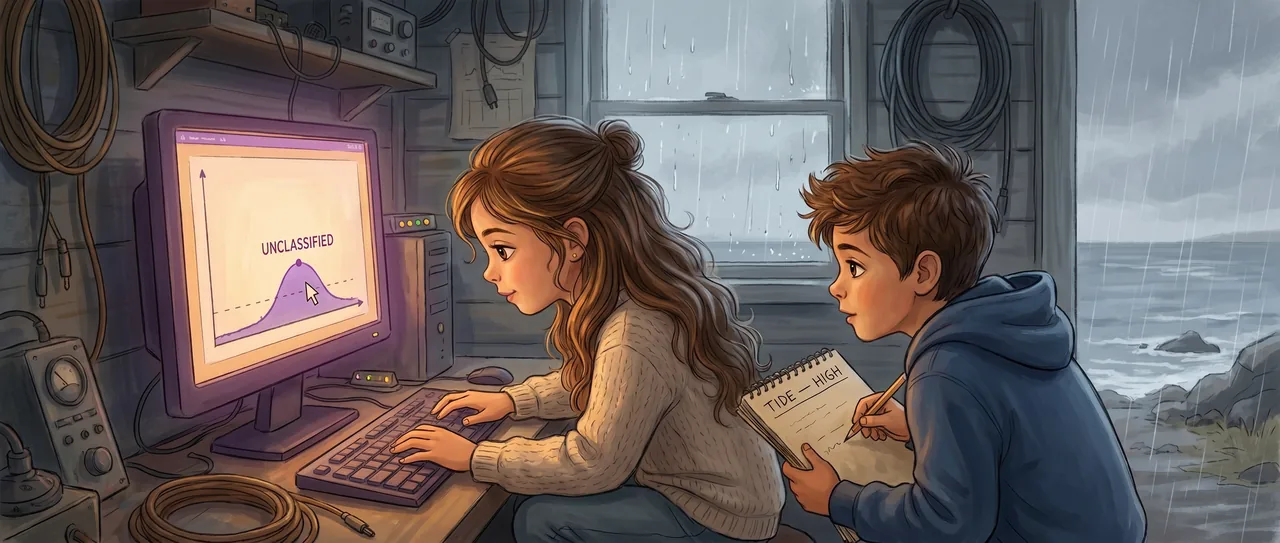
The shed smelled like dust and warm electronics. Rain ticked on the tin roof. On the screen, the AI had sorted the night into neat colored bars: earthquakes in red, quarry blasts in orange, trucks in gray, the slow gray smear of the highway.
"It missed one," Maya said.
"It didn't miss it," Soren said. "Look. It put a question mark on it."
The question mark sat over a small purple bump. The label said: UNCLASSIFIED. Below it, in smaller letters: confidence too low to assign.
"That's the AI being honest," Soren said. He liked that about it. "It's saying it doesn't know."
"There's another one," Maya said, and scrolled. "Same shape."
They scrolled back through three days. The purple bump kept showing up. Always the same gentle swell, always a question mark.
"Pull the times," Maya said.
Soren wrote them down. He copied each timestamp in his small square hand.
"Five forty in the morning," he read. "Five fifty-two in the evening. Six oh-three the next morning. Six fifteen."
"It's sliding," Maya said.
"By about twelve minutes," said Soren. "Every time. Forward twelve minutes."
Maya stopped scrolling. "So it's not exactly twelve hours."
"It's twelve hours and about twenty-five minutes," Soren said, doing the gaps. "Twice. Two bumps a day, and the whole pattern walks forward."
"An explosion doesn't do that," Maya said. "A quarry blasts at noon because people eat lunch. People don't slide twelve minutes a day."
"Machines don't either," Soren said. "A pump runs on a clock. A clock doesn't drift forward and then come back around."
They sat with it. The rain got louder, then softer.
"What does drift forward by about fifty minutes a day," Maya said slowly, "and come back around."
Soren looked up from the notebook. "The moon."
They said it almost together. The moon rises about fifty minutes later each day. Twice a day, roughly, it pulls the same patch of ocean up and over.
"The tide," Maya said. "It's the tide."
"That's not seismic," Soren said, but he was already arguing with himself. "Or. Is it."
Maya was up out of the chair. "We're a coastal station. The whole town sits on rock and the ocean sits on the rock too. When the tide comes in, that's a billion tons of water climbing up onto the shelf."
"And weight on rock," Soren said.
"Bends it," Maya said. "The water leans on the seafloor and the seafloor takes the weight and the rock flexes. A little. Every twelve and a half hours."
Soren was writing fast now. "So the bump isn't something breaking. It's the ground being pressed."
"The whole shelf," Maya said. "Loading and unloading. Like standing on a diving board and the board going down, then coming back when you step off."
They looked at the purple bump together, and it was not a small thing anymore. It was the ocean leaning on the world, and the world leaning back, and a needle in a shed in the rain feeling it happen.
"Check the tide table," Soren said.
Maya pulled it up on her phone. High tide. Five forty-one that morning. High tide again that evening. The numbers lined up against Soren's timestamps like two hands meeting.
"It's high tide," Maya breathed. "Every bump is high tide. The ground knows when the ocean is full."
"That's why the AI couldn't name it," Soren said.
"It only knows things that break," Maya said. "Earthquakes, blasts, trucks. Things that snap or hit. It doesn't have a box for the ground just. Bending. Quietly. Forever."
Soren stopped writing. "Nobody told it about the tide."
"Nobody thought it would feel it," Maya said.
That was the part that got into Soren's chest. Somebody, a long time ago, had built this AI a whole world of categories, every loud thing the earth can do. And they had left out the quietest, biggest, most patient thing of all, because it was too gentle to be an earthquake and too slow to be a truck. The machine had been faithfully marking it UNCLASSIFIED for three years, every twelve and a half hours, waiting for someone to look.
"It kept the record," Soren said. "Even though it didn't understand. It didn't throw it away."
Maya turned and looked at him, and he knew she'd heard the thing under the words. He was the kid who wrote in a paper notebook. Who kept things he couldn't explain yet, in case. The machine had been doing exactly that. Keeping the question. Not pretending it was an answer.
"It's like you," Maya said.
"It's like both of us," Soren said.
Maya crouched by the screen. "Okay. Okay. If it's tidal loading, then it should be everywhere there's a coast. Every coastal station should have a purple bump it can't name."
"We could check," Soren said. "The data's open. Other stations. Other oceans."
"Other moons," Maya said.
Soren looked at her.
"Europa has an ocean," she said. "Under the ice. And a tide, because Jupiter pulls way harder than our moon. Way harder. If you put one of these in the ice, it would feel that ocean leaning on the rock too. The whole moon flexing."
Soren wrote EUROPA in capital letters and underlined it twice.
"We can't go to Europa," he said.
"Not yet," Maya said. "But the bump would be there. Right now. Twice every Europa day. Nobody listening."
The rain had stopped. Outside the shed, down past the road, they could hear the actual ocean, the slow drag of it on the shingle, in and out.
Soren slid the timestamp list across to Maya. She added a column to the right of his neat times and labeled it, in her loose fast writing: TIDE — HIGH.
Then she changed the label on the screen. Where the AI had written UNCLASSIFIED, the station let volunteers add a name. Maya typed it in, and the next purple bump, the one due that evening at high tide, would arrive already knowing what it was.
The needle drew its quiet line across the paper, flat, flat, flat, and far down the beach the tide turned and started, very gently, to lean.
Read the interactive version, listen to the narration, and earn a gold star →
A science-verified short story for curious kids · Curiosity Land