The Thing Without a Name
"Watch this," Maya said. "I told it to look at gaps between primes. Up past a trillion."
Soren leaned in. The app was free, the kind that let you point an AI search at whatever you wanted and walk away. They had pointed it at the primes because Maya liked them. She said primes were stubborn. She meant it as a compliment.
"It's still going," Soren said.
"It looks at ranges we can't," Maya said. "A human could check a thousand numbers in an afternoon. This thing checks billions before lunch."
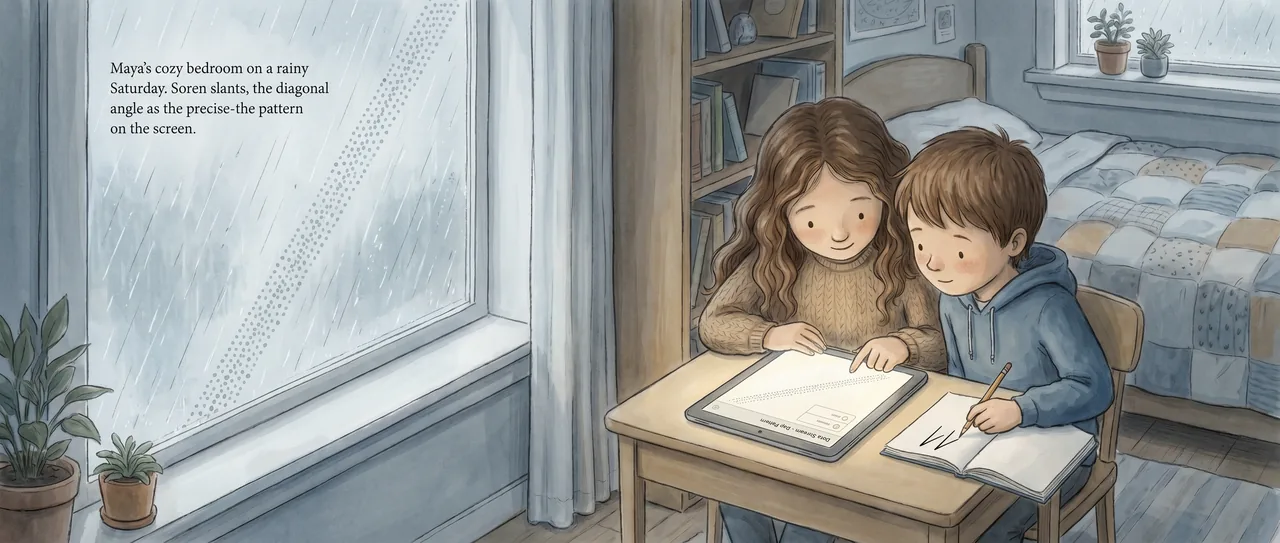
The screen filled with a long ribbon of dots, each dot a prime gap, the spaces between numbers that nothing divides. Most of it looked like noise. Then the app pulsed, the way it did when it thought it had found something.
A shape lifted out of the noise. A faint, leaning stripe, like rain slanting across a window.
"There," Maya said. "It keeps doing that. Right there."
Soren pulled his notebook over and copied the shape. The slant. The way it repeated, just barely, every few hundred million numbers. He drew it twice to be sure his hand wasn't inventing it.
"Ask it what it's called," he said.
Maya tapped the box. She typed: what is the name of this pattern.
The app thought. Then it answered: This regularity does not correspond to any named theorem in my references.
"Try again," Soren said. "Maybe you have to ask it differently."
Maya tried differently. She asked which theorem predicted the slant. She asked which mathematician had described it. She asked for a citation, a paper, a textbook page, anything.
Every time, the app gave the same shape of answer. It could show her the pattern. It could measure the pattern. It could find the pattern again in a fresh range it had never touched, which meant the pattern was real and not a fluke in one stretch of numbers.
It could not tell her what it was.
"That's a glitch," Maya said. But she said it the way you say a thing you already don't believe.
"It found it twice," Soren said. "In two different places. A glitch wouldn't do that."
They sat with it. Rain ran down the real window beside them, slanting the same way the dots did, and for a second Maya couldn't tell which slant was which.
"Okay," she said slowly. "So either it made a mistake. Or."
"Or it found something true that doesn't have a name yet," Soren said.
Maya looked at him. "Things have names. Math things especially. People have been counting primes for two thousand years."
"People have been looking at the small ones for two thousand years," Soren said. He flipped back through his notebook, hunting for something. "You said it yourself. A person checks a thousand in an afternoon. Nobody has ever looked at the place this app is looking. There was never a person standing there."
Maya went quiet. Then she did the thing she did. "So this might be the first time," she said. "In the whole history of anybody. That a thing in the primes got seen."
"We don't know that," Soren said, because he didn't.
"But we don't know it isn't," Maya said, and that was worse, and better.
Soren made himself slow down. He wanted the mechanism. "Let's check that it's not just our app being wrong. Lots of these search tools see faces in clouds. They find patterns that aren't there."
So they tested it. Maya fed the app a fake stretch of numbers, scrambled, random, not primes at all. The slant did not appear. She fed it the primes again, a brand new range, numbers so large she had to scroll to read one of them out loud. The slant came back. Faint. Leaning. The same every time.
"It's in the primes," Soren said. "It's not in us."
Maya stood up and walked a small circle, which she did when something was too big to sit under.
"There are people," she said. "Real mathematicians. Whose whole job is the primes. And the machines they run are finding shapes that match no theorem anybody wrote. And those people don't know what the shapes are either."
"Some of them, yeah," Soren said. "I read that. The machine sees a regularity. And then a human has to figure out why it's true. And sometimes nobody has yet."
"So the answer exists," Maya said. "The why exists. The primes are doing it on purpose, sort of. There's a reason."
"There has to be a reason," Soren agreed. "Primes don't decide things. If they lean, they lean for a reason."
"And the reason doesn't have a name."
"The reason doesn't have a name," Soren said. "Not yet."
Maya stopped circling. She came back and looked at the screen, at the faint slant pulsing in a range of numbers larger than every grain of sand on Earth, larger than she could hold in her mouth when she tried to say it.
"Soren," she said. "Somebody is going to name this."
"Probably," he said.
"Somebody who notices it and won't let it go." She wasn't quite talking to him. "Somebody who keeps a list in their head of things that don't make sense yet and doesn't mind the list being long."
Soren looked at her. He knew that list. He had his own version, in ink, in his hand.
"Could be a grown mathematician," he said. "Could be in fifty years."
"Could be a kid," Maya said.
"Could be a kid," he said.
Neither of them said the rest of it. The rest of it sat in the room with them, the way the rain sat against the glass, patient, leaning, waiting to be understood.
Maya reached over and tapped the box one more time. Not a question this time. She typed a single instruction and hit enter: keep looking.
The app pulsed. The ribbon of dots scrolled upward into numbers no human eye had ever reached, and somewhere in that climbing dark the faint slant appeared again, and again, and again, holding its shape, waiting for its name.
Read the interactive version, listen to the narration, and earn a gold star →
A science-verified short story for curious kids · Curiosity Land