The Other Half of Me
The fever made everything slow and bright. Maya lay on the kitchen floor because the tiles were cool against the back of her neck, and her grandmother had given up telling her to get off them.
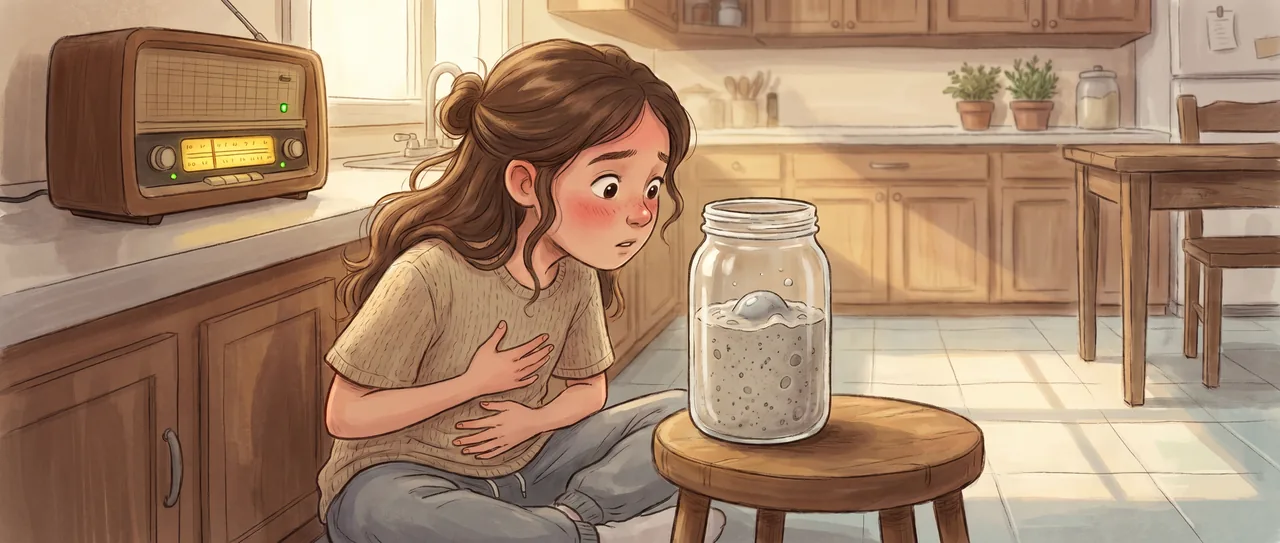
On the counter, the sourdough starter breathed. That was the only word for it. A slow blister rose at the surface of the gray batter, swelled, and popped with a tiny wet click. Then another. Maya had fed it that morning, flour and water, and now it was awake and chewing on what she had given it.
"It's eating," she said.
"It's working," her grandmother said, not looking up from her crossword. "It does the part you can't. You can't turn flour into bread on your own. You need the little ones in the jar."
The radio was on, low, a man's voice talking about the gut. Maya was only half there. The fever kept tipping her sideways into half dreams and pulling her back.
Then the radio said a number and she came all the way back.
Thirty-eight trillion.
The man said it twice, the way you say something you don't quite believe yourself. That was how many bacteria a person carried. Not in a sick way. In a normal way. In a you-right-now way. About the same number as the cells the body grew itself. Half of what walked around as Maya was not, strictly, Maya.
She lay very still and listened to the starter pop.
Click. Click.
"Gran," she said. "How many of me are me?"
"All of you, last I checked."
"No." Maya pressed her hot hands flat on the cool floor. "The radio said half the cells in a person aren't the person. They're, like, passengers. Bacteria."
Her grandmother turned the radio up.
The man kept going. The passengers carried genes, he said. A hundred and fifty times more genes than the body's own. And they used those genes to do jobs the body had never learned. Breaking down fibers the human gut couldn't touch. Making vitamins the body could not make for itself. Working in the dark, all day, doing chemistry no human cell knew how to do.
Maya thought about her fever. About the soup her grandmother kept pushing at her. About the bread.
She sat up too fast and the kitchen swung.
"It's the same thing," she said.
"What is?"
"The jar." She pointed at the starter, blistering and chewing. "You said it does the part I can't. Turning flour into bread. The little ones in the jar do it because I can't." She put her hand on her own stomach. "And there's a jar in here. The whole time. Doing the part I can't."
Her grandmother set the pen down.
Maya looked at the starter, then at her own hand, then back. The starter had a smell, sour and alive, and she realized she had been smelling something like it her whole life and never named it. The smell of something living doing work for her.
"I always thought I ate food," Maya said slowly. "And my body used it. Just me. One thing."
"And now?"
"Now there's a crowd." She laughed, and the laugh hurt her sore throat, and she didn't care. "There's a crowd in here and I'm feeding them and they're feeding me. The carrots. I can't even open a carrot. Not all the way. The fibers. They open it. They hand it back."
She pulled her knees up and looked at the gap between her arm and the floor, the small warm space there, and thought about how many things lived in that small warm space and on her skin and in her mouth right now, doing chemistry, not asking permission, keeping her alive in a language her own cells had never learned to speak.
The fever did not feel lonely anymore. That was the strange part. She had been sick on the floor by herself all afternoon, and she was not by herself. She had never once been by herself. Not in her whole life.
"How do they know what to do?" she asked. "Nobody tells them. I don't tell them."
"Nobody tells the jar either," her grandmother said. "And it knew before you were born. People made bread for thousands of years before anyone knew there was anything living in it at all."
Maya turned that over. People had been carrying a hundred and fifty times their own genes around inside them since the very first people. Walking around as crowds and calling themselves one name. Not knowing. Doing it anyway.
And somebody had to be the one to notice. Somebody who lay on a floor and counted the clicks and asked a question that sounded, out loud, a little ridiculous. How many of me are me.
"They don't know yet," she said. "All of it. The radio man. He kept saying we're only starting to find out."
"Then you're early," her grandmother said.
Maya got up. Slowly, holding the counter, because the kitchen still wanted to tilt. She leaned over the starter jar and put her face close to the smell of it, the sour, living, working smell, and watched a blister rise at the surface.
It swelled. It held. She waited for it.
The blister popped, and a breath of warm sour air touched her cheek, and somewhere under her own skin, in the dark, thirty-eight trillion of them kept working without her.
Read the interactive version, listen to the narration, and earn a gold star →
A science-verified short story for curious kids · Curiosity Land