The Origami That Folded Itself
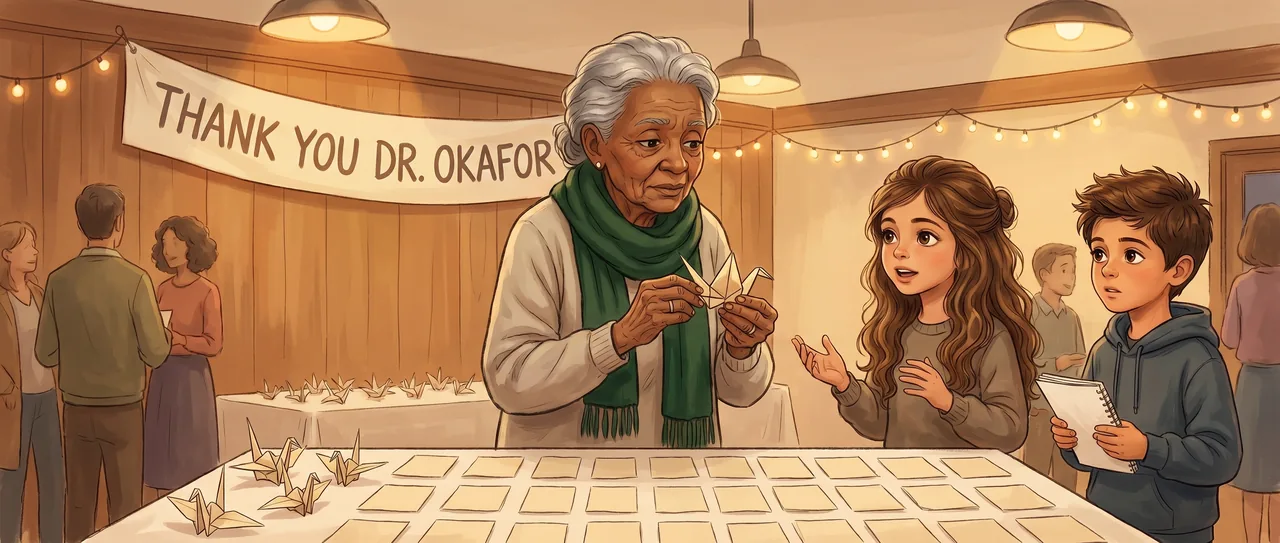
The community hall had a banner that said THANK YOU DR. OKAFOR, FORTY YEARS, and a table of paper cranes that nobody was folding fast enough.
"We need a hundred," Maya said. "There are twelve."
"There are fourteen," said Soren. "Two are under the napkins."
They folded. Maya's cranes came out crumpled and fast. Soren's came out slow and exact. At the front of the room, an old woman in a green scarf was holding a microphone and talking about a thing she had spent her whole life on.
"For thirty years," Dr. Okafor was saying, "I tried to figure out the shape of one protein. One. We knew the recipe. We did not know the shape."
Maya stopped folding.
"That's weird," she said. "You have the recipe but not the shape?"
"Shh," said somebody's parent.
Soren leaned in. "A protein is a chain," he whispered. "Like a string of beads. The body builds the string in order. Then the string folds up into a blob."
"So the recipe is the string."
"The recipe is the order of the beads. Yeah."
"Then why don't you know the shape? The string folds into the shape. The string already knows."
Soren picked up a finished crane and looked at it. "That's the thing nobody could do," he whispered. "The string folds itself in about a millionth of a second. But if you try to figure out the shape from the order, just by thinking, there are more ways for it to fold than there are atoms in the universe."
Maya took the crane out of his hand. She unfolded it back into a flat square. Then she looked at the creases.
"Refold it," she said. "With your eyes closed."
Soren did. His fingers found the creases. The crane came back.
"See, your fingers knew," Maya said. "The paper told them. The folds were already in it."
"My fingers knew because I'd folded it before."
"Right." Maya's eyes were going somewhere. "You learned the folds. So if you'd seen a million cranes get folded, you wouldn't have to think. You'd just know where the next one goes."
Up front, Dr. Okafor's voice changed. It went softer, the way a voice does when it gets to the part that hurt.
"And then in twenty twenty," she said, "a machine learned to do it. Not one protein. Nearly all of them. Two hundred million. The shapes my whole field had pulled out of the dark one at a time, over fifty years. The machine predicted them in a matter of months."
The hall was quiet. Even the parents were quiet.
"People asked me if I was angry," Dr. Okafor said. "Forty years, and a computer finishes the job over a long weekend."
Maya was not folding. She was watching the old woman the way she watched a thing that didn't fit yet.
"How did it learn?" Maya whispered. "The machine."
Soren had his notebook out. His pencil moved.
"From the shapes people already figured out," he whispered. "All of them. Every protein anybody had ever solved the slow way. People spent careers getting maybe a hundred thousand shapes. The machine read all hundred thousand and learned the rules of how strings fold."
"So it couldn't have learned without the slow people."
Soren stopped writing.
"No," he said. "It couldn't."
Maya looked at the table of cranes. Twelve, no, fourteen, that two children had made by hand. And she looked at Dr. Okafor, who had made one crane, basically, in forty years, and made it so perfectly that a machine could learn from it.
"She's not the loser in this," Maya whispered. "She's the teacher."
"The machine learned to fold," Soren said slowly, "because she folded one for real. Her and everybody like her."
Dr. Okafor was finishing. "They named the program, and the people who built it won a prize. And do you know what I felt, the day I saw the shape of my protein appear on a screen in three seconds?"
Nobody answered. It wasn't that kind of question.
"I felt the dark get smaller," she said. "All the shapes I would never live long enough to find. There they were. Every one. Ready."
The parents clapped. Maya did not clap. She walked up to the front, past the napkins, past the cake, while Soren made a small alarmed noise behind her.
"Dr. Okafor," Maya said. "The machine learned from your protein. Right?"
The old woman looked down at her. The green scarf shifted. "From mine and thousands of others, yes."
"So it knows what it knows because you stayed in the dark for forty years feeling around."
A long pause. Something happened in the old woman's face that took a second to arrive.
"I had not thought of it as a gift I gave it," Dr. Okafor said. "I had thought of it as a race I lost."
"You can't lose a race to something you taught how to run," Maya said.
Soren had come up beside her, notebook still open. He held out the crane, the one he'd folded with his eyes closed.
"It still doesn't know everything," he said. "Right? There are shapes it gets wrong. Ones nobody's solved yet, so it never learned them."
Dr. Okafor took the crane from him. She turned it in her old fingers, finding the creases the way Soren had.
"There are proteins that change shape depending on what they touch," she said. "There are ones that fold differently in a living cell than anywhere else. There are some it has never seen, because no human has ever held them in the dark long enough to bring them out." She looked at the two of them. "The machine is very good at the cranes that have already been folded once."
"So somebody still has to fold the first one," Maya said.
"Somebody always has to fold the first one."
Maya looked back at the table. Eighty-six cranes still to go before they reached a hundred, and every single one of them would have to be made by a hand that had never made that exact fold before.
She sat back down and pulled a flat square toward her. Across the table, Soren closed his notebook and pulled one toward himself.
Dr. Okafor stood at the front with the closed-eyes crane in her hand, turning it over, finding a crease that wasn't there yet.
Read the interactive version, listen to the narration, and earn a gold star →
A science-verified short story for curious kids · Curiosity Land