The One the Machine Couldn't Explain
The list was eight hundred long and almost all of it was garbage.
"That one's fake," Maya said, scrolling. "That one's fake. That one would explode. That one's basically rust."
"They're not fake," said Soren. "They're predicted. The model thinks each of these might carry a current with zero resistance if you cooled it down. It just thinks some are likelier than others."
"It thinks rust is likely."
"It ranked rust four hundredth."
They had asked the AI a simple thing. Give us combinations of elements that might superconduct warmer than the cold ones already known. It had thought for nine seconds and produced eight hundred candidates, ranked, each with a confidence number. The top of the list was the boring part. Copper things. Hydrogen things crushed under pressures you could only make in a diamond vise. Everyone chasing those already.
Maya wasn't reading the top.
"Soren. Number six."
He leaned in. Number six was ugly. A lanthanum, some nickel, a splash of sulfur, and something the formula wrote as a fraction, like the atoms couldn't agree on how many of themselves to be.
"That's a weird one," he said.
"It's ranked above things people have actually built. Why does it like that one so much?"
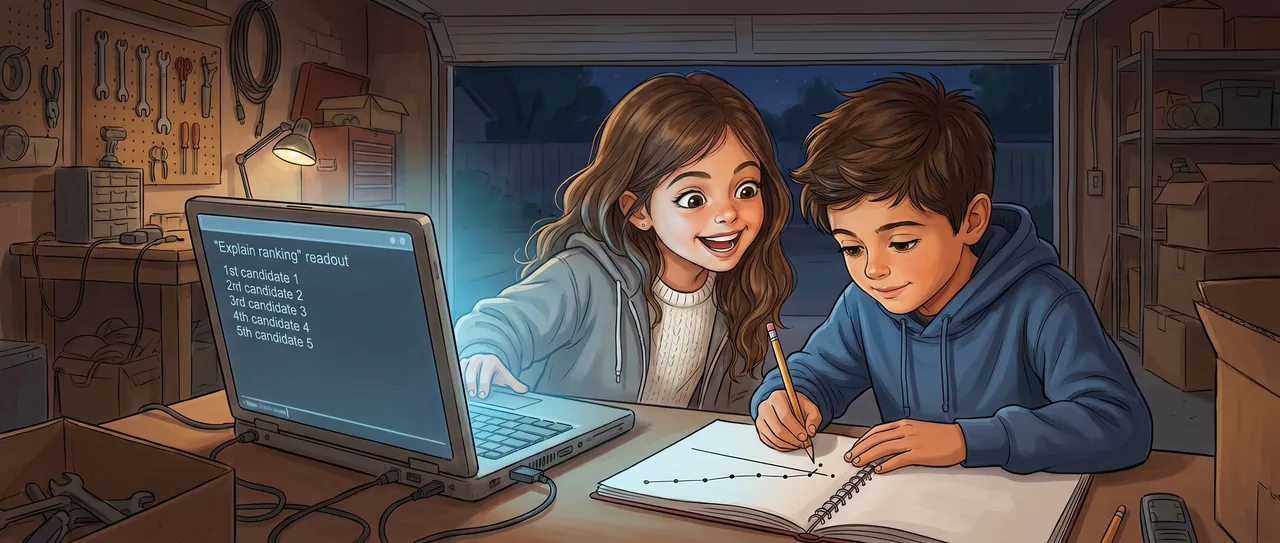
There was a button under each candidate. Explain ranking. Soren had been ignoring it because mostly it spat out sentences like high structural similarity to known cuprates, which meant the machine had seen something that rhymed with success and guessed it would sing too. He clicked it on number six.
The machine wrote: Ranked highly due to predicted electron-phonon coupling consistent with high-temperature pairing.
"Okay," said Soren. "Normal answer."
"Click it again."
"It'll say the same thing."
"Ask it the why under the why," Maya said. "Ask which measurement made it sure."
Soren typed slowly. Which measured property in your training data is this prediction most based on?
The machine thought for two seconds, which was a long time for it.
Prediction is not based on a measured property. The compound's lattice has not been synthesized. Confidence derives from an inferred property: the spacing between two atomic layers under strain.
They both went quiet, but it was the kind of quiet with a lot moving inside it.
"Inferred," Soren read. "Not measured. It's never seen this thing measured because the thing's never been made."
"So what's it standing on?" Maya said. "What does it actually know?"
Soren opened a second window and started writing in his notebook, the pencil scratching while the laptop fan whirred. He wrote the formula. He drew two flat layers with a gap between them and put a question mark in the gap.
"Ask it to show its work," he said. "Make it list every compound that taught it this."
Maya took the keyboard. List the training examples that most influenced this ranking.
The machine gave seven. Soren copied them down. Maya read them out, and halfway through she stopped reading and started frowning. "These seven," she said. "They're not the famous superconductors. They're the boring cousins. The ones nobody got excited about."
"Why would it learn from the boring ones?"
She pulled the seven up, side by side, and they sat with them the way you sit with a puzzle that's almost a face. Soren checked each compound's known numbers. Temperature it worked at. Pressure. The width of that gap between layers.
"Wait," he said. "Look at the gaps."
He wrote the seven numbers in a column. The pencil went still on the last one.
"They go down," Maya said. "As the gap gets smaller, the temperature it superconducts at goes up. Every single one."
"Seven points," said Soren. "That's not a coincidence. That's a line."
"And number six?"
He checked. Number six's inferred gap was smaller than all seven. Off the bottom of the column. Below the line, where the line said the temperature should be highest of all.
"That's why it loves it," Maya breathed. "It's not copying the famous ones. It found a pattern in the cousins that nobody bothered to draw, because nobody was looking at the gap. The machine drew the line and slid number six down to the warm end of it."
Soren sat back. "But here's the thing. Has anyone measured the gap and the temperature together, on purpose, as the thing that matters?"
He searched. They searched for an hour. They found papers that measured the gap. They found papers that measured the temperature. They found nobody who had put the two in the same column on purpose and called the line a law.
"So the machine is leaning its whole guess," Soren said carefully, "on a relationship that no human has ever written down as real."
"It noticed it," Maya said. "In the leftovers. In the data we were too bored to read."
They looked at each other.
"It might be wrong," Soren said. "Seven points and a stretch past the edge. That's a guess, not a fact."
"It might be wrong," Maya agreed, and she was grinning now, fierce. "But somebody has to make number six to find out. And the only reason anybody would ever make number six is this line. And the only thing that drew the line is sitting in our garage being told it can't be the kind of person things happen to."
"I never said that."
"You think it loud."
Soren looked at his column of numbers, seven measured and one inferred and a gap at the bottom with a question mark he hadn't erased.
"We can't make it," he said. "We don't have the furnace. We don't have the cold."
"No," Maya said. "But we can write to someone who does. And we can tell them the part the machine couldn't. We can tell them what to measure."
Soren turned to a clean page. At the top he wrote, in careful letters, a single sentence: The gap between the layers is the thing. Measure the gap.
Then he wrote the formula for number six underneath, and the seven cousins under that, and he drew the line through all of them and let it run off the edge of the paper, past the last point, into the white where nothing had been measured yet.
The pencil came down on the empty space below the line and made one small mark, exactly where the machine said the warmest one should be.
Read the interactive version, listen to the narration, and earn a gold star →
A science-verified short story for curious kids · Curiosity Land