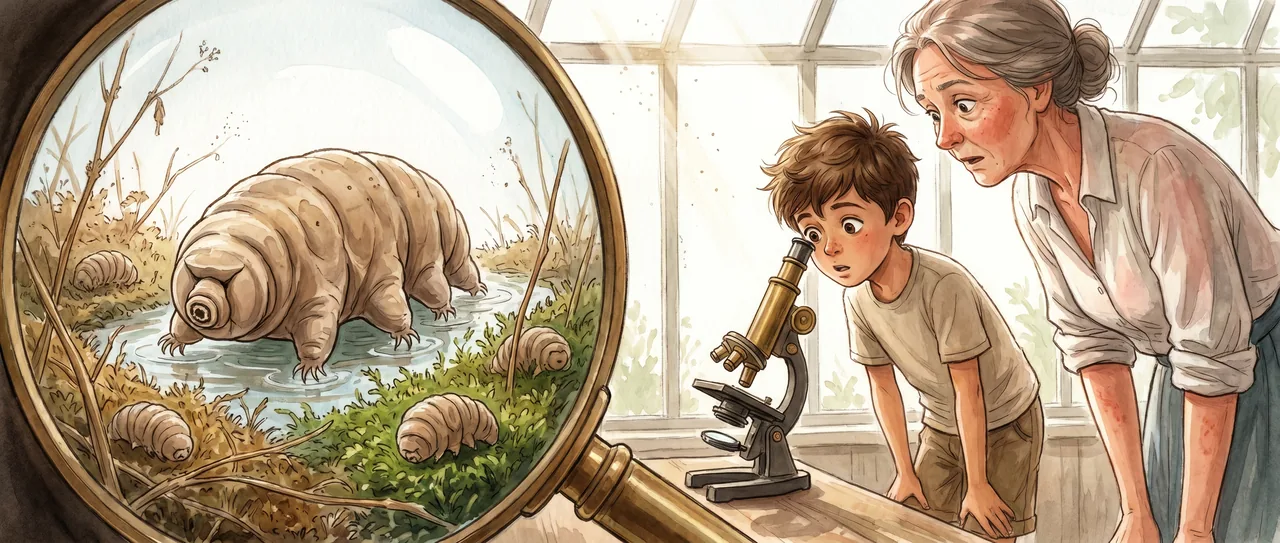
The Dry Garden
The moss came off the gutter in a sheet, light as a scab, and it crackled when Soren bent it.
That was the wrong sound. Moss was supposed to give. This moss snapped like a cracker, brown all through, the green burned out of it by six weeks of no rain. His grandmother had been carrying buckets to the tomatoes since June and letting everything else go. The gutter moss was everything else.
He put a piece on the bench under her old brass microscope, the one with the cracked mirror that you had to tilt toward the window to catch the light. Through it, the moss looked like a forest after a fire. Dead stems. Dust. Nothing moving.
"You can throw that out," his grandmother said from the doorway. She had dirt to the elbows and a sunburn on the back of her neck. "It's gone. Whole roof is gone this year."
"Can I keep it," Soren said. It wasn't really a question. He was already pulling the chair closer.
She shrugged and went back to her tomatoes. She was a practical woman. A dry thing was a dead thing, and you composted dead things. That was the whole rule, and it had worked for her for seventy years.
Soren looked at the dead forest for a long time.
There were shapes in it. Tiny barrel shapes, tucked between the dead stems, the color of nothing. They had pulled their legs in. They looked like grains of something a body had shed. He counted eleven of them in one field of view and not one of them so much as twitched.
He wrote down: eleven barrels, no legs, no moving. He drew one. It looked like a seed with the idea of legs erased.
Then he did the thing his grandmother would have called a waste of good water.
He filled the cap of her watering can and laid the moss in it.
Nothing happened. He hadn't really thought anything would. Dead was dead. He watched the brown stems go dark as they drank, the way a dry sponge goes dark, and he was already deciding the barrels were just husks, the empty cases of something that had left, when the first barrel moved.
Not much. One end of it swelled. A leg came out, slow as a minute hand, and felt the water.
Soren stopped breathing the way you do when you don't decide to.
The barrel kept unfolding. It had been a barrel because it had folded itself down into one, packed everything in, pulled the water out of its own body until there was almost none left, and stopped. Now it was filling back up. A second leg. A third. It had a head, blunt and groping, and it put the head down and it walked, swaying, fat and clumsy and impossibly alive, across the dead forest that was turning green again under it.
He found the second one. Then four more. They came back in no order he could predict, one here, one minutes later three stems over, each one swelling out of its barrel and remembering how to walk.
He sat back and his chair scraped and he didn't care.
They had not been sleeping. Sleeping things breathe. Sleeping things burn a little something all night long, which is why you wake up hungry. These had not been doing that. He was sure of it the way you are sure of a thing your body has decided before your mouth catches up. There had been no slow burn in them. There had been nothing. No clock running anywhere inside the barrel. You could have weighed what they spent in six dry weeks and the scale would have said zero.
And then water, and they started again from exactly where they stopped, with not one second lost, because for them not one second had passed.
He pulled the moss closer and his hand was not quite steady.
Where was it, then. The being-alive. While they were barrels it had not been in their breathing, because there was none. It had not been in their moving, or their eating, or any beating thing. All the things he could have measured were switched off, every one, and the animal had still been there inside the off, waiting, the whole animal, folded up around itself in the dust on his grandmother's roof.
He thought about the roof. The roof got cold in January, so cold the gutter cracked. It got blasting hot in August. The rain came and went and came and went, and the barrels rode all of it out, on for a day, off for a month, on for an hour, off all winter, keeping themselves dry on purpose so that the cold could not freeze water that wasn't there.
He thought about how high the roof was. Then he thought about higher.
People had taken these. He had read it once and not believed it enough. People had taken these barrels up past the air, past the blue, and held them out in the actual vacuum, in the raw radiation, in the cold that is almost the bottom of all cold, the cold there is no colder than. And brought them down. And put them in water.
And the barrels had swelled, and the legs had come out, and they had walked.
Soren looked up through the cracked greenhouse glass at the white afternoon sky, which had no rain in it, which had not had rain in it for six weeks, and which kept going up and up past where his eyes could follow, past the air, into the place where the barrels had walked and come home.
His grandmother came back in with an empty bucket. She saw his face and stopped.
"It's gone," she said again, gently, meaning the moss, meaning be sensible, meaning a dry thing is a dead thing.
Soren turned the microscope toward her without a word and tilted the cracked mirror until the light caught.
She bent down. She was a practical woman who had composted seventy years of dry dead things, and she put her eye to the brass and went very still over the green coming back, and the slow legs, and the small fat bodies walking out of the nothing they had been.
The watering can dripped once onto the bench, and three stems over, another barrel began to open.
Read the interactive version, listen to the narration, and earn a gold star →
A science-verified short story for curious kids · Curiosity Land