The Cells That Stay
The pamphlet was the boring kind, gray and folded in three, the kind adults leave on tables and never read.
Soren read it because it was there. He read everything that was there.
"Listen to this," he said. "They found cells in your grandmother's heart that weren't hers."
Maya looked up from the photographs. "What does that mean, not hers?"
"It says some women have cells in their organs with different DNA. From other people." He turned the pamphlet over. "They were studying the tissue. It's normal, apparently. They put it in the recovery folder like it's nothing."
"Whose cells, though?" Maya said. "You don't just have other people's cells. That's not how people work."
"That's what I'm telling you. They do."
Maya pushed the photographs aside. In the next room they could hear Grandma's television, low, and the small machine that beeped to say her heart was still keeping time.
"Read the actual words," Maya said. "Not your version."
Soren read the actual words. "Cells from a pregnancy can cross into the mother and stay. For decades. They've been found in the heart, the liver, the brain." He stopped. "The brain."
"A pregnancy," Maya said slowly. "So the cells are from the baby."
"From every baby. It says each child leaves some behind."
Maya was quiet. She picked up one of the photographs again, a black and white one, a young woman holding a baby on a porch step.
"That's Grandma," she said. "And that's my mom. The baby."
Soren leaned over to look.
"So if the pamphlet is right," Maya said, "there are cells from my mom in there. In Grandma. Right now. In the heart they just operated on."
"Cells that are fifty years old and aren't hers," Soren said. "Hold on." He reached for his notebook and wrote a line, his hand moving fast, then stopped to look at what he'd written.
"It can't just be your mom," he said. "She had three kids. Your mom, your uncle, the one who died as a baby."
Maya's hand went still over the photo.
"All of them," she said.
"All of them," Soren said. "If the cells stay, they all stayed."
Neither of them said anything for a moment. The machine in the next room beeped.
"Wait." Maya sat up straight. "Say that again. The cells from the baby that died."
"It doesn't say they leave when the person leaves," Soren said carefully. "It says they persist. For decades."
"So they could still be there." Maya's voice was very even. "The cells from a baby that's been gone sixty years. Still in Grandma. Still alive."
Soren checked the pamphlet again, because he wanted to be sure before he agreed to something that large. "It says the cells can be living. Active. They go to where there's an injury and help repair it."
"Help repair it," Maya repeated.
"At the site of damage. That's the words. They found them clustered at the site of damage."
Maya looked at the wall between the kitchen and the room where her grandmother was lying with a healing line down the center of her chest.
"Soren," she said. "They cut into her heart this week."
"I know."
"And if the cells go to where the damage is."
"I know," Soren said again, quieter, because he had gotten there the same second she had.
Maya stood up. She didn't go anywhere. She just stood, holding the porch photograph, the young grandmother and the baby who would become her mother and the two children who weren't in this picture but were, the pamphlet said, somewhere inside the woman holding the camera's gaze.
"That's not a metaphor," Maya said. "That's the thing I want to be sure about. People say a mother carries her children forever and they mean it like a feeling. A poem."
"This isn't a poem," Soren said. "This is cells. With DNA you could actually swab. You could find them."
"You could prove it."
"People did prove it. That's why there's a pamphlet."
Maya sat back down slowly. She turned the photograph face up between them.
"So right now," she said, "in the next room, a woman is mending. And some of the things doing the mending might be her own kids. Every kid she ever had. Working on her at the same time."
"Including the one who never got to grow up," Soren said.
The two of them sat with that. It was too big for the kitchen. Maya felt it the way you feel a room get colder, except the opposite, except she didn't have a word for the opposite.
"I always feel like the only one paying attention," she said suddenly. "Like I notice things nobody else thinks are worth noticing. And everybody acts like that's a lot. Like I'm a lot."
Soren waited.
"But there's a whole thing happening inside people," Maya said. "All the time. Cells from other people, moving around, fixing things, and nobody can feel it and almost nobody knows. The most enormous fact and it's just folded up in a gray pamphlet on a kitchen table."
"You noticed it," Soren said.
"We noticed it."
From the next room, Grandma's voice came, thin but clear. "What are you two whispering about out there?"
Maya and Soren looked at each other.
"Come here," Maya called back. "We want to ask you something."
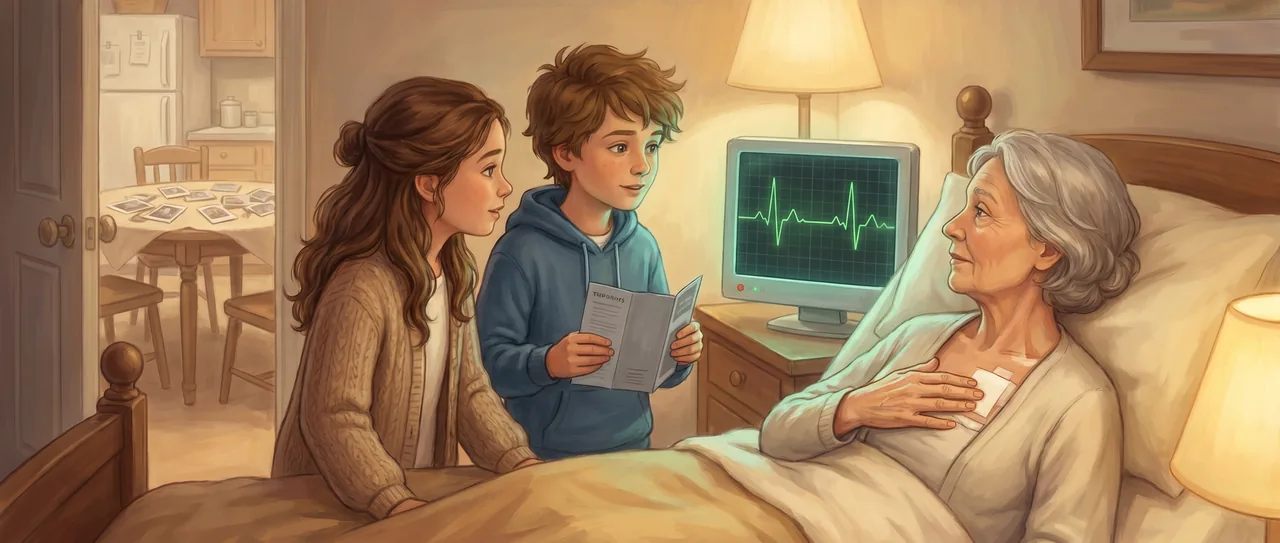
They went in together. Grandma was propped up against the pillows, the blanket rising and falling, the machine beside her drawing its small green mountains across the screen, one after another, each one a heartbeat.
Maya didn't ask the question yet. She watched the green line climb and fall, climb and fall, steady, mending, and she thought about who was in there helping it along.
Soren stood beside her with the pamphlet still in his hand.
"Grandma," Maya said. "Did you know you're carrying all of us? Not us. But Mom. And Uncle Pete. And the baby."
Grandma's face did something complicated. "Carrying them how?"
"In your actual body," Maya said. "In your heart. Their cells. The doctors found them. They're real."
Grandma was quiet a long moment. Her hand came up and rested flat on the center of her chest, over the bandage, over the place where the mending was.
The green line climbed and fell on the screen beside the bed, and none of them looked away from it.
Read the interactive version, listen to the narration, and earn a gold star →
A science-verified short story for curious kids · Curiosity Land