Seventy Things That Are New
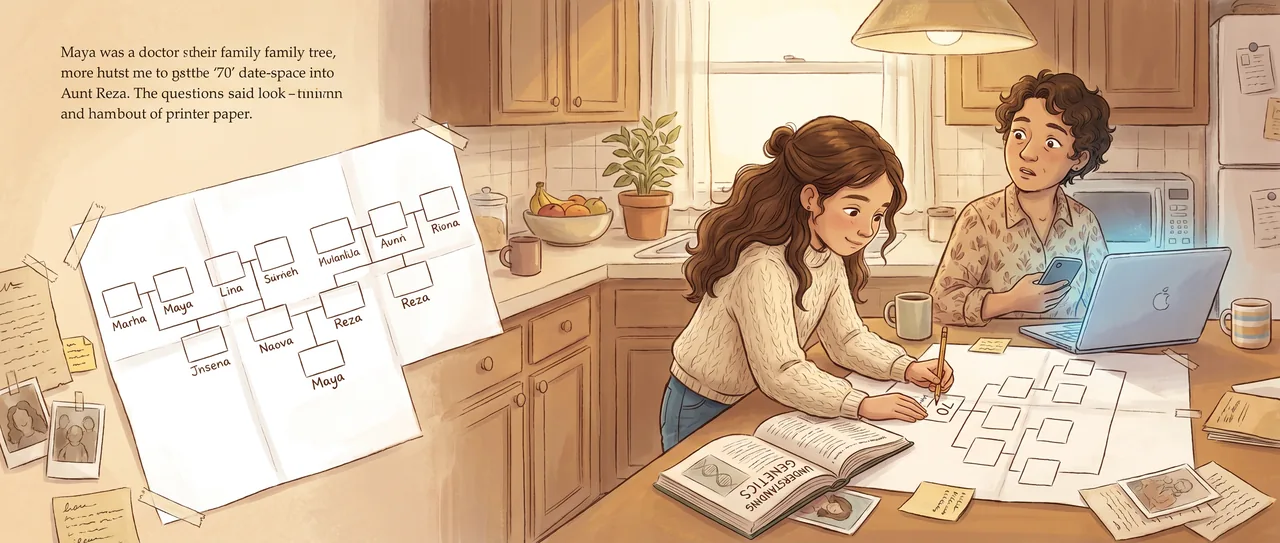
Aunt Reza had taped four sheets of printer paper together to make the family tree big enough. It still wasn't big enough.
"Great-grandma Iris had nine brothers," she said, squinting at a photo on her phone. "Or eight. One of them might be a cousin we adopted into the story."
Maya sat across the table with a pencil she wasn't using. The tree spread out in front of her like a river system seen from a plane. Lines came down from names and split and came down again. Her own name sat at the bottom, a little box at the end of two lines, her mother's and her father's, the way a stream sits at the end of two creeks.
"So I'm half of each of them," Maya said.
"Roughly," said Aunt Reza, not looking up. "Half your mom, half your dad. Quarter each grandparent. It halves all the way up. That's how the tree works."
Maya looked at the box with her name in it. She did the halving in her head, going up. One half. One quarter. One eighth. The fractions got smaller and the people got older and browner in the photographs, and somewhere up near the top of the taped-together paper there were people who were only one tiny sliver of her, a thousandth, a millionth, and still there, still in the river that came down to the box at the bottom.
If the halving never added anything new, then she was only old people, rearranged.
That thought sat wrong. She turned it over.
"Aunt Reza. Where's the new part?"
"The new what?"
"Of me. If I'm half Mom and half Dad, and they're halves of their parents, all the way up." Maya tapped the box with her name in it. "Then everything in me was already in somebody. Just split up and put back together. There's no part that's only mine."
Aunt Reza finally looked up. She did genealogy the way some people do crosswords, for the pleasure of filling boxes, and she had clearly never once asked the box at the bottom what it wanted.
"That's basically right," she said. "You're a recombination. A shuffle of an existing deck."
"A shuffle doesn't make new cards."
"No." Aunt Reza shrugged and went back to counting Iris's maybe-brothers. "It doesn't."
Maya did not like the deck. She knew enough to know what the cards were. Her mom was a nurse and kept a worn book about genetics on the shelf above the cereal, and Maya had read it the way she read everything, in the wrong order, looking for the strange parts. She got up and got it down.
The deck was the genome. Three billion letters, the book said, copied into every cell. When a parent makes an egg or a sperm, the deck gets copied so it can be passed down.
Copied. Maya stopped on the word.
She thought about copying three billion of anything. She thought about copying the phone book by hand, three billion letters, in the dark, fast, with no eraser. Nobody copies three billion of anything and gets it perfect. Not a machine. Not a cell.
She flipped pages until the book caught up with her.
There it was. When the deck is copied, the copying makes mistakes. Small ones. A letter swapped. A letter dropped. Most do nothing at all. They land in the long stretches of the genome where nothing is written down that matters, the way a typo in the margin changes no part of the actual book.
Then the number.
About seventy. Roughly seventy new errors in each child that are in neither parent. Not shuffled down from a grandmother. Not a sliver of someone in an old photograph. Brand new. Written for the first time in the entire history of living things, in the dark, on the day the deck was copied to make her.
Maya read it twice to be sure the book meant what she thought.
Seventy. Seventy little places where she was not her mother and not her father and not Iris with her eight or nine brothers and not anyone in the taped-together paper at all. Seventy places where the river, coming down and down through all those splittings, had quietly added water that had never been in it before.
"Aunt Reza," she said. Her voice came out careful. "It's not just shuffling."
"Hm?"
"The copying makes mistakes. Every time. About seventy of them, every kid." She held the book open with both hands so it wouldn't close on the page. "So I'm not only old people rearranged. There's seventy things in me that aren't in anybody on the wall."
Aunt Reza looked at the tree, at the careful boxes, all those lines coming neatly down. "Mistakes," she said, like the word bothered her. "That doesn't sound like a good thing to build a person out of."
But Maya was somewhere else now. Because if every child carried seventy brand-new letters, then her mom had her own seventy, that her grandmother never had. And Iris had seventy. And the maybe-brother who was really a cousin had seventy. Every box on the wall was not just a shuffle of the boxes above it. Every box was the old deck plus a few cards that had never existed until that exact person was made.
The whole tree had been doing it the entire time. Quietly. In the margins. Adding things that were only that person's, generation after generation, all the way down to her.
The new part wasn't missing from the tree. The new part was the only reason the tree was anything but a copy of its own root.
Maya picked up the pencil she hadn't been using. She found the small box at the bottom with her name in it. Next to it, in the white space Aunt Reza had left for dates, she wrote a single number.
Seventy.
Then she looked up the lines, at all the boxes climbing toward the top of the paper, and started writing it beside every one of them.
Read the interactive version, listen to the narration, and earn a gold star →
A science-verified short story for curious kids · Curiosity Land