What the Shrimp Keeps
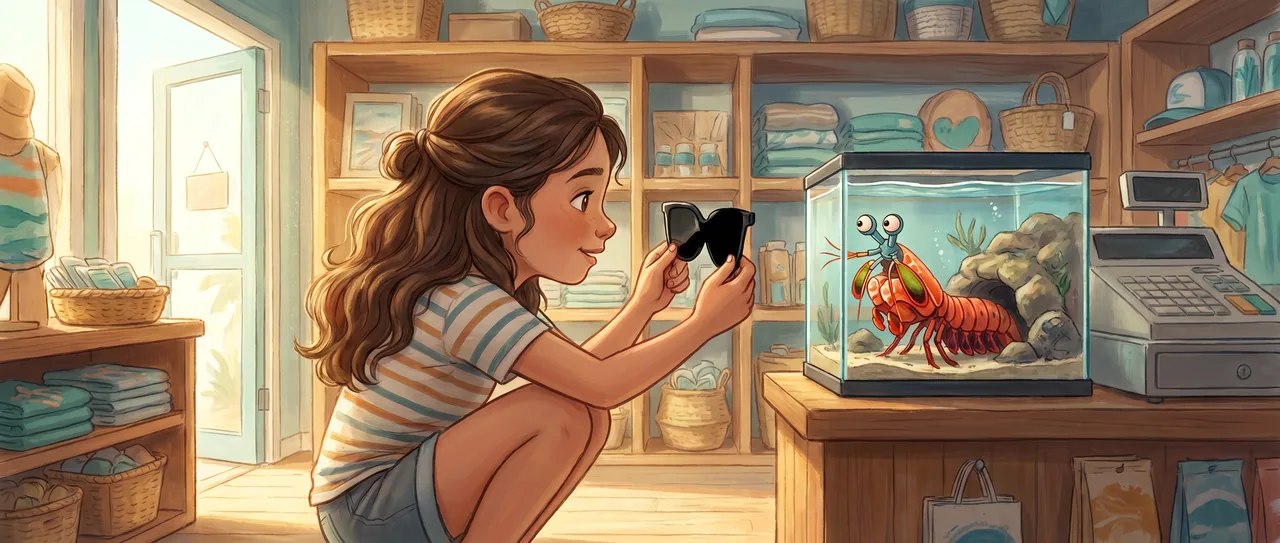
The shrimp was the color of a fire that had decided to be an animal. Maya pressed her face close to the small tank by the register, and the shrimp pressed back, two stalked eyes swiveling on their own like they each had somewhere different to be.
Her aunt sold sunglasses. The whole shop spun on a rack of them, hundreds of dark lenses turning in the salt wind that came through the propped door. Maya had spent the morning trying them on, not for how they looked, but because two pairs did something strange when she held them together.
She held them up again now. One lens in front of the other. Through both, the world looked ordinary. Then she turned the front pair slowly, the way you turn a key, and the light between them died. The lenses went black. No gap. No tint. Just gone, like someone had closed a door made of glass.
She turned it back. The light came alive again.
"You'll wear those out," her aunt said, not looking up from a box of price tags. "They're just polarized. Cuts the glare off the water. People buy them for fishing."
"Why do they go black?"
"Physics." Her aunt licked a tag and stuck it down. "Light's got a direction to it. One lens lets the up-down through, the other only lets the side-to-side. Cross them and nothing gets past. There's a sign about it somewhere."
Maya did not want the sign. She wanted to feel the door close again.
Light has a direction. She turned the lens. The black slid in, the black slid out. There was a whole hidden angle to the daylight, a grain to it like wood had a grain, and her eyes had never once told her. The sun had been doing this above her head her entire life. Sideways light, up-down light, all of it pouring down and her three kinds of eye-cells just averaging it into yellow and calling it a day.
She looked at the shrimp.
It was watching the sunglasses. She was almost sure of it. One eye stalk had locked on the crossed lenses, holding still while the other roamed the shop.
Maya brought the lenses down toward the tank, slow. The eye tracked them. She turned the front pair, and the light between the glasses went black, and the shrimp's body flinched, a tiny full-body twitch, and it scuttled backward into its hole in the rock.
She sat very still.
She held the glasses uncrossed. The shrimp eased out. She crossed them. It bolted.
"Aunt Reema." Maya's voice had gone careful. "It can see the glasses turn."
"It can see you wiggling, you mean."
"No." She did it again, only her wrist moving, the rest of her frozen. Cross. Bolt. Uncross. Out. "I'm not moving. Only the light is moving. The thing my eyes can't see. It's the only thing changing and it knows."
Her aunt came over then, tag gun still in her hand, and frowned at the tank. "Huh."
Maya read the little laminated card taped to the side of the tank, the one she had ignored all summer. Mantis shrimp. Sixteen types of photoreceptor. She had three. The shrimp had sixteen.
Three against sixteen. She turned that over while the salt wind moved the sunglass rack in slow circles behind her.
The card said the rest in small print. The shrimp could see ultraviolet, the color past purple that turned her aunt's white shirt into a strange glow under the right lamp, the color sunscreen was made to stop, the color Maya had been told existed and had never once seen. And it could see polarized light. The grain in the daylight. The hidden angle she could only find by stealing it through two crossed lenses, blacking out the world to catch a glimpse of one direction.
The shrimp did not need the lenses. The shrimp was born with the lenses inside its eyes.
Maya put both pairs of sunglasses down on the counter. She did not need them anymore. She needed to think about what the shop looked like to the animal in the tank.
Not brighter. That was the part that made her scalp prickle. Everyone always said more eyes, more colors, like the shrimp saw a turned-up version of her world, the same picture with the brightness cranked. But that was wrong. The shrimp wasn't seeing her world louder. It was seeing a different world. The sideways light and the up-down light were two separate things to it, the way red and green were two separate things to her. There were colors over there, in the tank's view of the room, that had no name because no human had ever had the eye to name them. The sunscreen aisle was on fire with a color she would die without ever seeing. The water in the bay was scribbled all over with angles, a whole written language of glare, and fish and shrimp had been reading it since before there were people to wonder about it.
She leaned down to the shrimp's level, slow, so she wouldn't scare it.
"What do I look like to you," she whispered.
The shrimp came halfway out of its hole. Both eye stalks swung around and found her face. They did not move together. They never moved together. Each one searched its own piece of the room, gathering colors out of the air that had no name on her side of the glass.
Maya stayed down there, eye to eye, with the salt wind turning the rack of dark lenses behind her. The thing in the tank was looking at her with sixteen kinds of seeing, and she was looking back with three, and the gap between them was not empty. It was full. It was crammed with light she would never catch, pouring through the propped door, off the bay, off her own skin, all of it carrying messages she had no way to open.
She lifted one hand and waved it slow in front of the glass, just to watch.
One eye stalk followed her hand. The other turned away, toward the sunlit doorway, and held there, reading something in the bright air that Maya turned to look at and found, to her own three eyes, completely empty.
Read the interactive version, listen to the narration, and earn a gold star →
A science-verified short story for curious kids · Curiosity Land