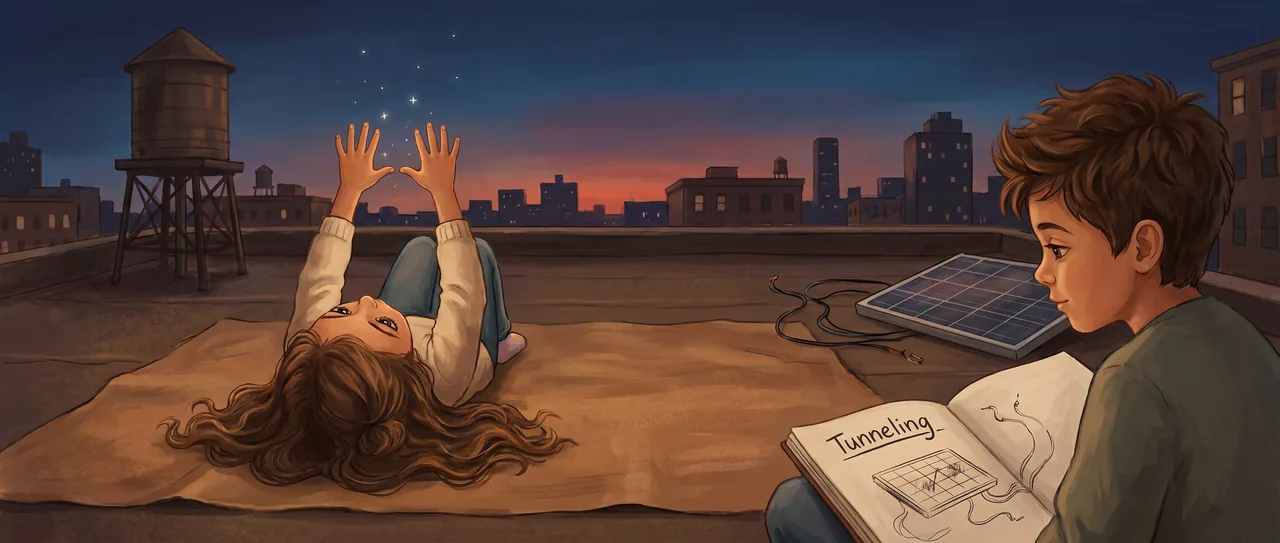
The Wall That Lets You Through
The little radio crackled, then died.
"It's the sun," Maya said. She tilted the solar panel toward the last orange light on the rooftops. "Going down means going off."
Soren held the wires and frowned at the panel. "It worked an hour ago."
"An hour ago the sun was higher." She lay back on the warm tar paper. "Less sun, less power. Obvious."
"Okay, but here's the thing I keep getting stuck on." Soren had his notebook open on his knee, a pencil behind his ear. "Where does the sun get the power in the first place?"
"Burning," Maya said. "It's on fire."
"It can't be on fire. Fire needs air. There's no air in space."
Maya turned her head and looked at him. "Then what is it doing."
"My dad said it squeezes. The middle is so heavy it crushes itself, and the crushing makes the hydrogen stick together into helium, and that gives off the light." He tapped the pencil against his teeth. "Stick together. Like, fuse."
"So squeeze hard enough and they stick."
"That's the problem." He sat up. "I read about it last week and the numbers were wrong."
"Wrong how."
"The bits that have to stick together both have a plus charge. Both positive. And two positives push apart, hard, the closer you bring them. Like trying to push two magnets together the wrong way."
Maya knew that push. She'd felt it in her hands, that invisible spring that got stiffer the closer the magnets came, until it shoved back so hard it hurt your wrist.
"So the sun shoves them," she said. "It's huge. It shoves harder."
"That's what I thought. But the book said even the sun doesn't shove hard enough." Soren looked almost angry about it. "They measured how hot the middle of the sun is. They worked out how fast the protons are moving. And it's not fast enough. Not even close. The protons should get near each other, feel the push, and bounce away before they ever touch. Every single time."
Maya sat up too. "Every time."
"Every time. So by the numbers, the sun shouldn't work. It shouldn't shine."
They both looked up. The first stars were coming out over the water tower, and the sun was a smear of red going down behind the buildings, and it was, very obviously, shining.
"But it does," Maya said quietly.
"It does."
She pulled her knees up. She had a feeling, the kind that came before the words for it. "Soren. The push. The magnet push. It's like a wall, right? A hill the proton has to climb. And it can't climb it. It rolls back down."
"Right."
"So there's a wall it can't get over." She was looking at the dead solar panel, at the gap between the two wires Soren was holding, the gap where the power had stopped. "What if it doesn't go over."
Soren went still. "What do you mean."
"I mean." She held up her two hands like the two protons, almost touching, the spring between them. "It can't get over the wall. There's no way over. But what if sometimes it's just. On the other side. Without going over."
"You can't be on the other side of a wall without crossing it."
"I know. That's why I'm asking."
Soren stared at her hands. Then he flipped back three pages in his notebook to a word he'd written and underlined and not understood. He turned it around so she could see.
Tunneling.
"I wrote it down because it was in the article and I hated it," he said. "It said the protons don't get over the wall. They go through it."
"Through a wall."
"Through the wall. Not a hole in it. Through the solid part. The book said a particle this small isn't really in one exact place, it's sort of smeared out, a little bit blurry, a little bit everywhere it could be. And the blur leaks. It leaks a tiny bit past the wall to the far side. And once in a while, the proton just turns up over there. Through."
Maya didn't say anything for a second. Then she laughed, one surprised sound.
"That's cheating."
"That's what I thought! That's exactly what I thought." Soren was grinning now. "It's cheating and it's real. The chance is unbelievably tiny. For any one proton, almost never. But the sun has so many protons, so many, that almost-never happens enough times every second to keep it burning. To keep it shining."
Maya looked up at the red smear going down. "So the light isn't from the shove being strong enough."
"No."
"It's from the wall not actually stopping them. Even though it should."
"Even though by every rule we can see, it should."
She lay back down on the warm roof. The tar paper held the day's heat under her shoulders. Somewhere a proton was on the wrong side of a wall it had never crossed, and the heat under her back was the proof, eight minutes old, having walked here across the whole emptiness of space.
"Soren."
"Yeah."
"The wall's still there. We didn't get rid of the wall."
"No. The wall's still there. It just doesn't always win."
Maya thought about every time she'd been told a thing was impossible, the door's locked, you can't, there's no way through. She thought about how the most ordinary thing in the sky, the thing that woke her up every morning through the curtains, only existed because the impossible happened anyway, quietly, trillions of times a second, in a place no one would ever see.
"The book said almost never," she said.
"Yeah."
"But it's enough."
"It's enough for a whole sun."
The radio was completely dead now. Neither of them reached for it. The last of the red went out behind the buildings, and the warmth stayed under their backs, and overhead the stars came on one after another, every one of them a wall that something kept passing through.
Maya held her two hands up against the darkening sky, almost touching, the gap between them no wider than a breath.
"Go through," she whispered to nothing, and watched the space between her fingers fill with stars.
Read the interactive version, listen to the narration, and earn a gold star →
A science-verified short story for curious kids · Curiosity Land