The Thing That Got Smaller
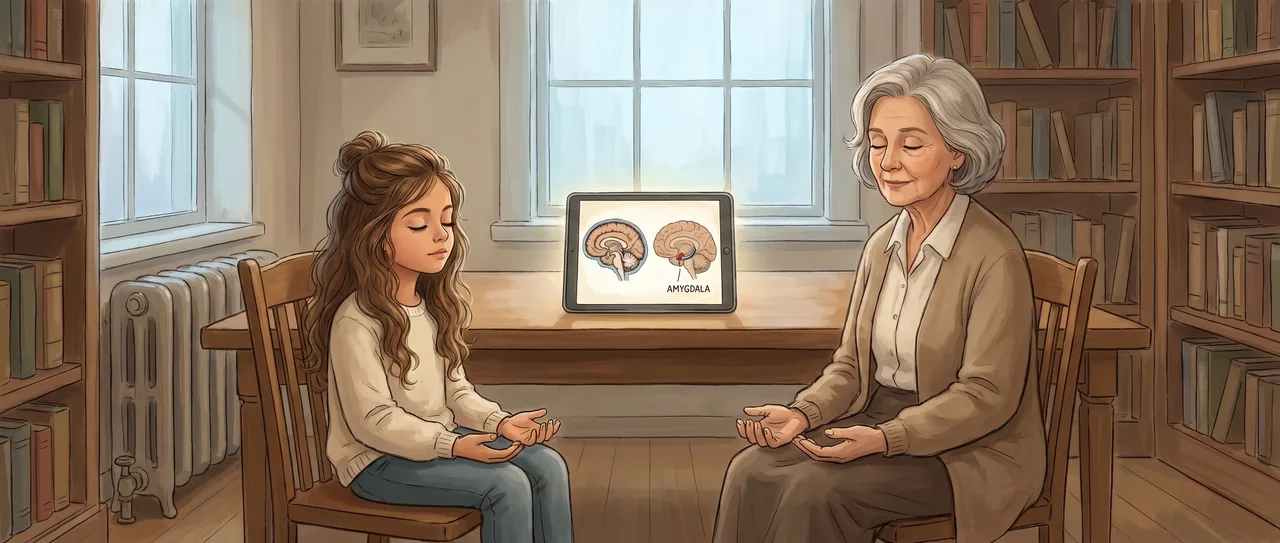
Maya's grandmother had been sitting in the same chair for nineteen minutes with her eyes closed and her hands open on her knees, and she had not fallen asleep, which was the part Maya could not get past.
The audiobook murmured from the little speaker. Notice the breath. When the mind wanders, bring it back. That was the whole instruction. Notice, wander, come back. Maya had listened to four minutes of it and decided it was the most boring thing a person could do on purpose.
She went back to the brain article on the library tablet, the one she was supposed to be reading for science. It had a picture of two brains side by side. One belonged to someone who had meditated for years. One belonged to someone who hadn't.
The caption said the meditator's brain had a thicker outer layer in the parts that handle paying attention.
Maya read that twice. Thicker. Not calmer, not happier. Thicker. Like a callus. Like the skin on the side of her finger from holding a pencil wrong.
She looked at her grandmother, who had gone very still, and tried to imagine the inside of that head getting physically different while the body did absolutely nothing.
"Grandma," she whispered. "Are you changing your brain right now?"
Her grandmother didn't open her eyes. "I'm trying not to chase the cat that just ran through it," she said, and went still again.
Maya scrolled. There was a second part to the article, and the second part stopped her hand.
There was a small region deep in the brain, the article said, almond shaped, called the amygdala. It was the part that screamed first. Fear, anger, the jolt before you knew why you were jumping. In long-term meditators, the article said, that almond was measurably smaller. Less gray matter. And the people whose almonds had shrunk the most were the same people who reported they could stay steady when things went wrong.
Maya put the tablet down.
In her experience, the things that got bigger were the things you used. Muscles. Vocabulary. The pile of socks under her bed. That made sense. Use a thing, it grows.
But here was a part of the brain that got smaller from being practiced with. That was backward. That was the kind of backward that made her sit up.
She thought about her own almond, somewhere behind her eyes, the one that made her stomach drop before a test, that made her snap at her brother before her mouth had asked permission. She had always thought of that part as the engine. The loud, fast, in-charge part. You didn't shrink the engine. You couldn't.
Except apparently you could. Not by fighting it. By sitting in a library chair noticing your breath and letting the cat run through and bringing yourself back, over and over, for years, until the screaming part had less to scream with.
Maya looked at her grandmother's open hands.
Nineteen minutes was not years. But years were made of nineteen minutes. That was just arithmetic.
The audiobook said, gently, when you notice you have wandered, that noticing is the practice. The wandering is not the failure. The coming back is the repetition.
Maya almost laughed, because that was the part she had gotten wrong four minutes ago. She had thought meditation meant emptying your head and keeping it empty, and she had thought, I can't do that, nobody can do that, my head is never empty. Her head was a room with forty things in it at all times.
But that wasn't the exercise. The exercise was the coming back. You weren't supposed to not wander. You were supposed to wander and return, wander and return, and the returning was the rep. Like a curl. Like the pencil callus.
The forty things in her head were not the problem. The forty things were the weight she'd be lifting.
She sat back in the hard library chair. She put her own hands open on her knees, palms up, feeling stupid, feeling like someone might walk past the glass door and see her.
She closed her eyes.
Breath in. The hum of the heater. A chair scraping somewhere in the main room. Her own thought, immediately, loud: this is dumb, how long has it been, probably ten seconds, I bet it's ten seconds.
That was the cat. She had noticed the cat.
Come back.
Breath in. Breath out. A car outside. Her brother's face when she'd snapped at him this morning, the surprised hurt of it, and the hot fast feeling rising up to defend her, he started it, he always.
That was the almond. That was the part lighting up. She could feel it, actually feel the heat of it behind her ribs, the engine turning over.
She didn't argue with it. She didn't tell it to stop. She just noticed it the way you'd notice weather. There it is. The screaming part, doing its job, screaming.
Come back to the breath.
It came back slower than she wanted. But it came back.
And somewhere under that, almost too quiet to catch, was the strangest feeling Maya had ever had. The part that screamed. And the part that watched the part that screamed. And the watching part was calm. The watching part had all the time in the world.
She had never met the watching part before. She hadn't known it was in there.
Breath in.
The almond was hers and the watcher was hers, and somewhere in the dark behind her own eyes one of them was very slowly, one nineteen-minute rep at a time, learning to be louder than the other.
Maya stayed in the chair with her palms open and her eyes shut, and brought herself back, and back, and back.
Beside her, the audiobook said, gently, you may open your eyes now. Neither of them did.
Read the interactive version, listen to the narration, and earn a gold star →
A science-verified short story for curious kids · Curiosity Land