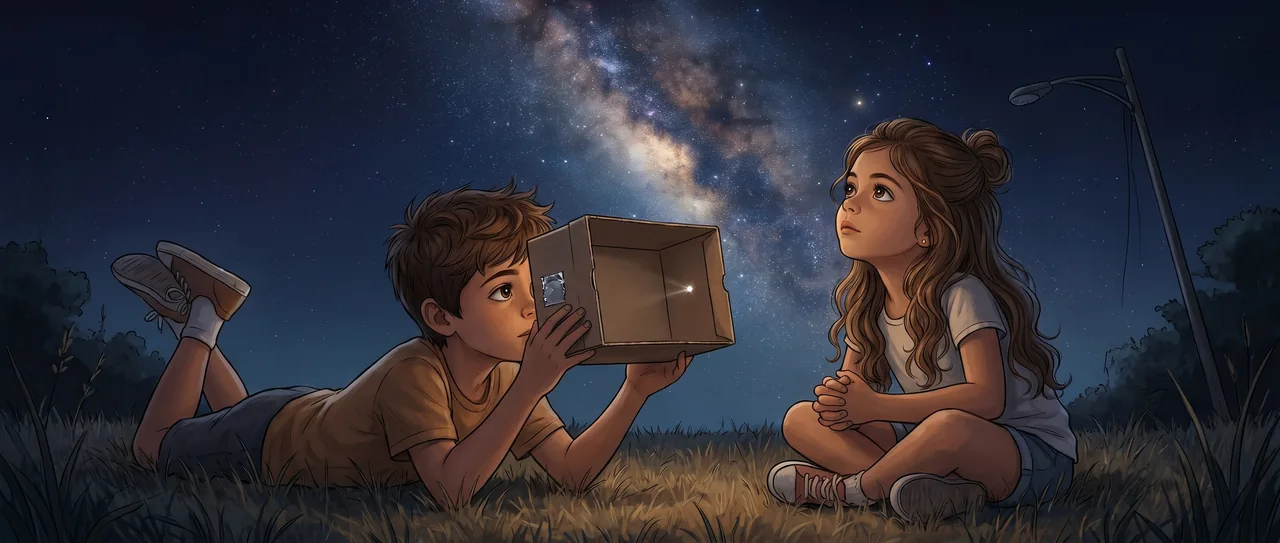
The Telescope as Big as the Planet
The power had been out since lunch, which was why Maya and Soren were in the backyard with a shoebox, a needle, and a square of foil instead of inside watching anything.
"Aim it at the sun," Maya said. "The hole makes a little picture on the back wall of the box. I read it works."
Soren made the pinhole and held the box up. On the cardboard inside there was a smudge of light. Round, maybe. Sort of.
"That's the sun?" he said. "It's a blur."
"Make the hole smaller."
He poked a tinier hole. The blur got dimmer but no sharper. He poked another. Worse.
"Okay," Soren said, sitting down in the dry grass. "So a small hole is too dark to see and a big hole is too fuzzy to read. There's no good hole."
"There has to be a good hole."
"There isn't. I've tried four." He turned the box over in his hands like it had insulted him. "The problem is the box is small. The sun is far. A small box can't ever make a sharp far thing."
Maya lay back on the grass and looked straight up, which she did when she was annoyed at a box.
"My uncle photographs birds," she said. "He has a lens this long." She held her hands a forearm apart. "He says bigger lens, sharper bird. Far birds especially."
"Right. So to see something really far and really small, you'd want a lens the size of a house."
"A lens the size of a house," Maya repeated. She wasn't laughing. She was holding the idea up to the light. "Soren. How big a lens would you need to see something at the actual center of the galaxy?"
He thought about that honestly. "I have no idea. The center of the galaxy is so far that the number wouldn't fit on this box. The lens would have to be enormous. Bigger than a house. Bigger than a city."
"Bigger than what, then."
"I don't know. Stop. Let me think." He put the shoebox down. "To see something that small, that far, the lens would basically have to be the size of a, of a planet."
The two of them sat with that. A streetlight tried to come on, failed, sputtered, stayed dark. Somewhere a generator coughed.
"That's impossible," Maya said. But she said it the way she said things that turned out not to be impossible. "You can't build a lens the size of a planet."
"No."
"You can't grind glass that big."
"No."
"So how do you do it."
"You don't," Soren said. "It's the box problem. There's no good hole." Then he stopped. He looked at his own two hands, which were a forearm apart, the way Maya's had been. "Unless."
"Unless what."
"Unless you don't need the whole lens. Maya. When your uncle photographs a bird, the light comes in across the whole front of the lens, right? The whole circle. But what if you only had the edges? The very rim of a giant lens, way out here and way over there, and nothing in the middle?"
Maya sat up fast. "Then the lens would still be giant."
"The lens would still be giant. You'd just be missing the middle."
"And the giant part is what makes it sharp."
"The giant part is what makes it sharp," Soren said, and his voice had gone careful and quick at the same time. "So you put one telescope here." He pressed a fingertip into the grass. "And one telescope way over there." He pressed another fingertip down an arm's length away. "And as far apart as you can possibly get them. And the distance between them, the empty distance, that's the size of your lens."
"How far apart can you get them," Maya said.
They looked at each other.
"As far apart as the Earth," she said.
"As far apart as the Earth," he said.
Maya was on her feet now, walking a tight circle around the shoebox. "So you'd need a telescope in, where. One place. And another telescope on the other side of the planet. A different continent."
"More than two. You'd want them everywhere. Different continents, so the gaps between them go in every direction."
"And they'd all have to look at the same exact thing at the same exact second."
"To the tiniest fraction of a second," Soren said. "Or the light from the different ones wouldn't line up. You'd need clocks. Insanely good clocks. And then you'd add it all together and it would be like one lens as wide as the whole Earth."
Maya stopped circling. "Has anyone done it."
And here is the thing they both felt at the same time, sitting in a powerless backyard with a broken cardboard box: the certainty that the answer was yes. That somewhere people had stood exactly where their thinking had just arrived, and then kept walking.
"They photographed it," Maya said slowly. "The middle. The thing at the center. They must have. If you can build a telescope the size of the planet, the first thing you point it at is the center."
"The black hole," Soren said. The words came out quiet. "There's a black hole at the center of the galaxy. Everybody says so. Nobody had ever seen it. You couldn't. No box is big enough."
"Until the box is the Earth."
"Until the box is the Earth."
The streetlight gave up entirely. The sky overhead was getting dark in the good way now, the outage way, with no city glow to wash it out, and the stars were coming in thicker than either of them had ever seen from this yard.
Maya tipped her head back and found the long faint smear of the Milky Way, brighter tonight than the broken streetlight had ever let it be.
"It's right there," she said. "The center. Behind all that."
"We can't see it."
"We can't see it," she agreed. "But somebody made the whole planet into one eye and looked."
Soren lay back down in the grass beside her and held up the shoebox so the pinhole lined up with the band of the galaxy, the smallest possible lens aimed at the largest possible dark, and through the little hole one faint star printed itself, sharp at last, on the back wall of the box.
Read the interactive version, listen to the narration, and earn a gold star →
A science-verified short story for curious kids · Curiosity Land