The Spoon That Remembered Which Way the Soup Went
The connector smelled like burnt sugar, which was wrong, because nothing on a drone is made of sugar.
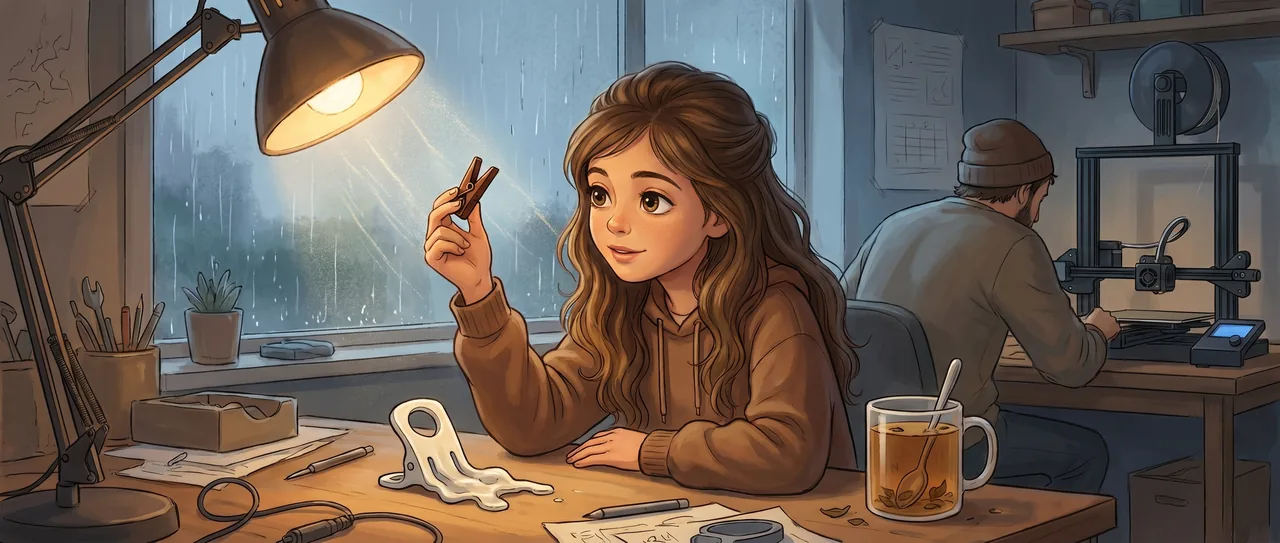
Maya turned it over near the lamp. The little white plastic clip that held the battery wires had gone soft and shiny on one side, sagging like a candle that had leaned too close to itself. Her brother's drone had come down in the field behind the center with smoke threading out of it, and this was the piece that gave up.
The parts bin smelled like dust and old solder. She dug through it for a clip the right shape and found one, almost. It was darker. Not white, not gray. A deep brown like strong tea, and heavier than it should have been for something that small. The corners were sharp. When she ran her thumb along the flat of it, the surface felt grainy in one direction and slick in the other, the way a cat feels right and then wrong depending on which way you pet it.
She turned it ninety degrees and stroked again. Slick. Turned it back. Grainy. The plastic had a grain, like wood. Like it knew which way it had been going.
There was a man across the room hunched over a 3D printer that kept jamming. He had been muttering at it for an hour and had not once looked up. Maya took the brown piece over anyway.
"Why does this have a grain," she said. "Plastic doesn't have a grain."
He glanced at it without taking it. "LCP. Liquid crystal polymer. We use those for the high-temp connectors." Then back to his jam. "Don't melt it for fun, it's expensive."
"Can you melt it?"
"Eventually. Hotter than your oven goes." He pulled a tangle of stringy filament out of the printer nozzle and held it up like he'd caught a fish. "This stuff, the normal stuff, it goes everywhere when it's hot. Molecules all knotted up like this. LCP doesn't knot. The molecules are stiff little rods. When it flows into the mold, they all line up the same way and they stay lined up. That's your grain."
"Stay lined up after it's hard?"
"Forever," he said, and the printer jammed again, and he forgot she was there.
Maya went back to the lamp.
Forever was a big word for a piece of plastic. She held the brown clip and thought about the white one, soft on one side. The white one had no grain. She'd checked. Smooth every direction, no slick, no rough, just plastic.
She stirred a cup of cold tea someone had left, watching the leaf bits swing around the spoon. They lined up while the water moved, all pointing the way the water went, and then the moment she stopped stirring they scattered every which way. Lined up only while it flowed. Stopped, scattered.
Unless something froze the water the instant she stopped stirring. Then the leaves would be stuck pointing the way they'd been going. The cup would remember which way she'd stirred.
That was the brown clip. It had been a liquid once, in a machine, rushing into a mold. All those stiff little rods getting shoved into a narrow channel, lining up nose to tail because there was no room to do anything else, the way logs line up in a fast river. And then it cooled before they could scatter. They were stuck. Not glued, not held. Just frozen mid-rush, pointing the way they had been pouring.
That was why it had a grain. The grain was a recording of the flow. The plastic was shaped like the memory of moving.
She pressed her thumbnail into the brown clip as hard as she could. Nothing. She pressed it into the soft white one and it dented like cheese.
The white plastic had melted because its molecules were a knotted tangle, and heat let the tangle slither loose and slump. But you cannot slump rods that are all lined up and locked. There is nowhere for them to slide. Three hundred degrees, the man had said for the connectors. Hot enough to ruin the drone, the wires, the battery. The brown clip would just sit in that heat, holding its line, remembering the river it had been poured from, not caring.
Maya looked at the soft white clip again, and for the first time it did not look like a failure. It looked like the obvious thing. Of course it slumped. It had no direction. Nothing in it agreed on which way to point, so when the heat came, every molecule went its own way at once.
She thought about being told, all the time, to settle down, to stop going off in six directions. The white plastic had settled down. It had relaxed into a comfortable knot, and the first hard thing that happened to it, it lost its shape.
The brown plastic never relaxed. Every rod in it had been caught in the middle of going somewhere and never let go of where it was going. That was the whole strength of it. The grain under her thumb was not a flaw. It was a thousand tiny things all still aimed.
She fitted the brown clip into the drone where the white one had melted. It seated with a sharp little click, corners crisp, and held the battery wires without sagging. She turned it under the lamp one more time and stroked the surface the slick way, then the grainy way, the river running one direction inside something that would never move again.
Across the room the printer jammed for the last time and the man pushed back his chair. "You get it working?"
Maya didn't answer right away. She was holding the clip up to the light, tilting it, finding the angle where you could almost see the grain catch, a faint dark current frozen in the brown. She tilted it the other way and the current vanished. She tilted it back and there it was again, still flowing, still pointing, going nowhere at three hundred degrees for as long as the plastic lasted.
She tipped it once more toward the lamp and watched the current come back.
Read the interactive version, listen to the narration, and earn a gold star →
A science-verified short story for curious kids · Curiosity Land