The Sound Before Words
Maya was supposed to be reading. Her aunt had handed her a book and pointed at a folding chair in the corner of the theater and said the meeting would be twenty minutes, which Maya already knew meant an hour.
So she watched the people on the stage instead.
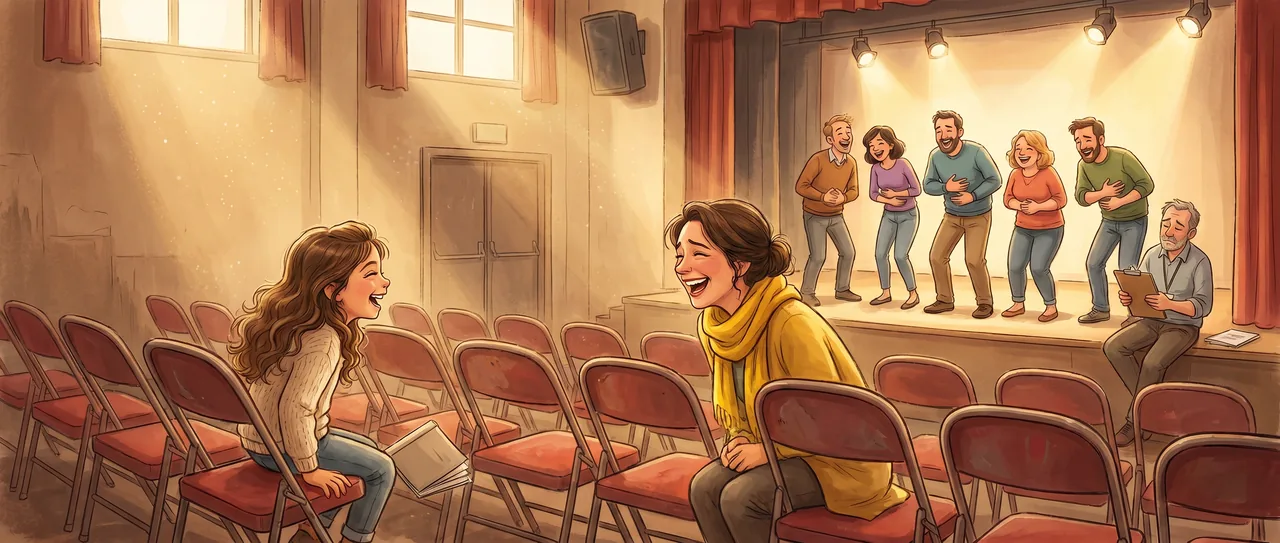
There were six of them, grown-ups, doing something her aunt called improv, which seemed to mean they made things up and then laughed about them. They were not very good. One man kept pretending to be a walrus. A woman in a yellow scarf kept forgetting her own joke halfway through and then laughing harder because she had forgotten it.
And here was the thing Maya could not stop noticing.
When the woman in the yellow scarf laughed, everyone laughed. Not at what she said. She had not said anything. She had just made the sound, this cracked, helpless, hiccuping sound, and within a second the walrus man was wheezing and the tall one was bent over a chair and even the bored woman by the lighting board snorted into her coffee.
Nobody had told a joke. The joke was already gone. They were laughing at the laughing.
Maya put the book down on the floor without marking her place.
She started counting. Not on purpose, exactly. She just wanted to know if it was real, the thing she thought she saw. So the next time someone broke, she counted the others. The yellow scarf woman went first, and Maya counted one, and by two there were three more going, and by three the whole stage was gone, all six of them, holding their stomachs, not one of them able to say what was funny.
It moved through them like something physical. Like a yawn but faster. Like the sound itself reached out and grabbed the next person by the chest.
Maya tested it.
She was eleven and alone in a corner and nobody was watching her, so she could afford to be wrong. She thought about the funniest thing she knew, which was her little brother falling asleep in his cereal, and she felt the corners of her mouth pull. But it stayed small. It stayed inside her. It did not jump anywhere because there was nobody for it to jump to.
Up on the stage the laughter died down, and then the walrus man caught the eye of the yellow scarf woman, and just from the look, just from the memory of it, they both went again. And the others, who had no idea what the look meant, went with them.
Maya felt something turn over in her stomach.
She had always thought laughing was a thing you did after you understood a joke. Like clapping at the end of a song. First the funny thing, then the words about the funny thing in your head, then the laugh. In that order. Joke, think, laugh.
But these people were laughing without the joke. They were laughing without the words. The laugh was not coming after the understanding. The laugh was coming first, and then traveling, person to person, faster than anybody could explain why.
She thought about her brother again, who was two, who could not say more than nine words, who laughed all day long. He laughed before he could talk. He had been laughing since before he could do almost anything. You tickled his foot and he made the sound and then you laughed and then he laughed harder because you did, the two of you bouncing it back and forth with no words in it at all.
The words came years later. The laughing was already there. Waiting. Older. The laughing had come first. Not just for her brother. For everybody. Before there were jokes. Before there were sentences to put the jokes in. Before there was a single word in any mouth anywhere, there had been people in the dark making this sound at each other, this helpless cracked hiccuping sound, and it had reached across the space between them and grabbed the next person by the chest and pulled.
That was what she was watching. Not a reaction to comedy. Something much older than comedy, wearing comedy like a coat.
Up on the stage the director, a tired man with a clipboard, was trying to get them to stop. He kept saying, okay, okay, focus, focus, and tapping his pen. He thought the laughing was the break between the work. He thought the scenes were the point.
Maya watched him fail. He tapped his pen and said focus and the yellow scarf woman looked at him and pressed her lips together to be good, and that was worse, because pressing her lips together made the sound come out her nose, and that finished everyone all over again, the director included, who put his clipboard down on the floor in surrender and laughed with his whole face whether he wanted to or not.
He did not choose it. None of them chose it. It went through him the way it went through all of them, the way it went through her brother, the way it must have gone through people who had no word for stage or scene or joke, people crouched around something a hundred thousand years ago with nothing in their mouths yet but this.
Maya thought: it is a way of saying we are the same, without saying anything.
She thought: that is why you cannot really do it alone.
She picked the book up off the floor. She did not open it. She watched the six strangers and the tired director, all of them undone, all of them synchronized to a signal none of them had sent on purpose, their brains lit up in the same shape at the same time, a circle of people connected by a sound older than the first word anyone had ever spoken.
The yellow scarf woman caught Maya watching from the corner.
She did not say anything. She just made the sound, one more time, right at Maya across the empty seats.
And Maya, in the corner, alone, holding a book she was not reading, felt it grab her by the chest and pull, and heard herself laughing back before she had decided to.
Read the interactive version, listen to the narration, and earn a gold star →
A science-verified short story for curious kids · Curiosity Land