The Quiet Tissue
Soren's grandfather had a knee that clicked when he walked, and today the clinic was going to teach him to make it click less.
While they waited, Soren read everything on the walls. There was a poster of a heart with red and blue rivers running everywhere, into the fingers, into the toes, into places he didn't know had names. There was a plastic arm you could open like a suitcase, and inside it the muscles were the same red as the rivers.
Then there was the knee.
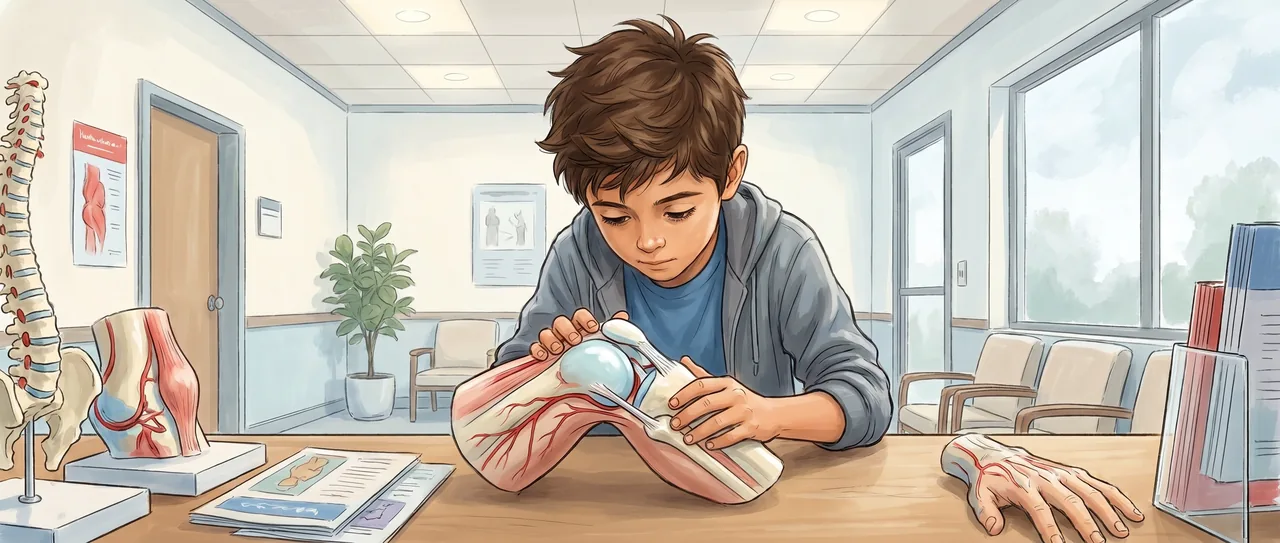
The knee sat on its own little stand on the counter, the size of a grapefruit, cut in half so you could see in. Soren leaned over it while his grandfather filled out a form with a pen that didn't work and then a pen that did.
The bones were yellowish. The ligaments were like rubber bands. And on the very ends of the bones, where they met, there were two smooth caps, pale and bluish-white, glossy like the inside of a shell.
Soren looked for the red rivers.
They weren't there.
Everywhere else on the model, even painted on, there were threads of red running close to the surface. The muscle had them. The bone had them, little channels drilled right through. But the two glossy caps had nothing. No threads. No channels. Just smooth, lonely white, sitting exactly where the bones pressed hardest against each other.
He thought it was a mistake in the model. A part they forgot to paint.
"You're going to wear a hole in it, staring like that," said a woman in scrubs, coming around the counter. Her badge said she was the therapist. She had a coffee in one hand and his grandfather's chart in the other, and she was clearly thinking about the chart.
"They forgot the blood vessels," Soren said, and pointed at the white caps.
"Forgot the what?" She glanced down. "Oh. The cartilage. No, they didn't forget. There aren't any."
She said it the way you say something you've said a thousand times, already turning toward his grandfather's name on the chart.
Soren did not move. "There aren't any blood vessels in it."
"Nope."
"How does it eat?"
That stopped her, a little. She took a sip of the coffee. "That," she said, "is actually a good question, and I have a leg exercise to teach, so. Short version. The fluid in the joint. The cartilage soaks food right out of it. Soaks it in, soaks the waste back out. Like a sponge that gets squeezed every time you walk." She tapped the model with one finger so the bones rocked. "Press, release, press, release. That's how it drinks."
Then she took his grandfather away down the hall, and Soren was alone with the knee.
He reached out and pressed the two caps together with his thumbs, the way the woman had rocked them. They were hard. They didn't squeeze, because they were plastic. But the real ones did. Somewhere down the hall, inside his grandfather's actual leg, two of these were pressing and releasing right now, drinking.
Soren took out his notebook. He drew the knee, and then he drew the heart-poster rivers, and then he drew a wall between them, because that was the true thing he had just learned: there was a part of his own body the blood never reached. A part that had to wait for its food to come drifting to it, slow, through fluid, the way a smell crosses a room.
He sat with that. He thought about a cut on his hand, how it scabbed in a day and was gone in a week, because the rivers rushed right up to it carrying everything it needed. He thought about how fast that was. How spoiled the skin was.
And then he thought about the white caps, with no rivers, waiting on diffusion alone.
He started to understand something, and he didn't like it, and he kept going anyway.
If the skin healed in a week because the blood came to it, then the cartilage, with no blood coming to it, would heal in. He didn't have a number. He just knew the word slow was not big enough.
When the therapist came back to get her water bottle, Soren was waiting for her.
"If somebody hurt this part," he said, and touched the white cap, "when they were a kid. Would it be better by the time they were old?"
She stopped. She actually looked at him this time, the chart down at her side.
"What's your grandpa in for, did he tell you?"
"His knee clicks."
"His knee clicks," she said, "because of something that happened to him playing soccer when he was about your age. He doesn't remember it. The joint remembers it." She set the chart on the counter. "That stuff doesn't come back the way skin comes back. It can't call for help. Nothing's connected to it. So a little crack you get at eleven can just. Sit there. For fifty years. Getting a tiny bit worse every time the bone leans on it."
"Because it can only drink," Soren said. "It can't call."
"Because it can only drink," she agreed. She picked the chart back up, but slower now. "Most people never think about it once."
Then she went to bring his grandfather out.
Soren stayed bent over the model. He put one thumb on each white cap and pressed, and held it, and felt how nothing happened, how patient the not-happening was.
He thought about every kid on every field right now, all of them eleven, all of them with these two quiet caps in each knee, drinking in the dark, keeping perfect score of every hard landing, planning to mention it in fifty years.
His grandfather came down the hall, walking carefully, the new way the therapist had shown him. The knee clicked once.
Soren listened to it the whole way to the door.
Read the interactive version, listen to the narration, and earn a gold star →
A science-verified short story for curious kids · Curiosity Land