The Other Suspect
The museum after closing was a different building. The lights dropped to half, the air went cool, and the dinosaurs in the main hall stood with their shadows pooled under them like spilled water.
Maya sat on the bench across from the extinction panel because her father had forty more minutes on his shift and she had read every other sign twice.
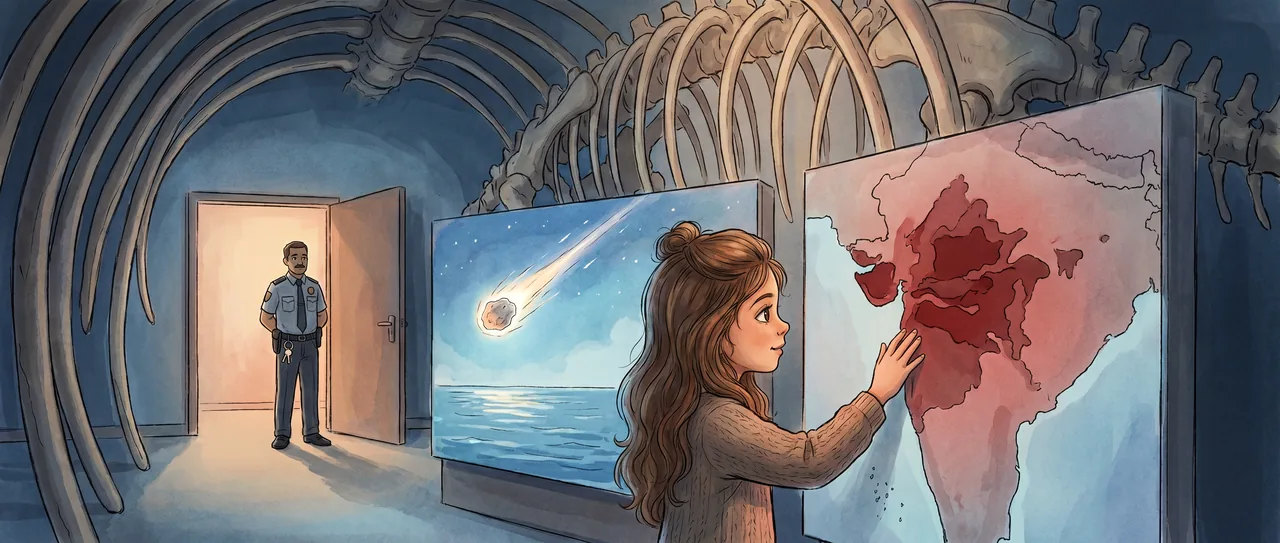
The panel had an asteroid on it. A bright streak coming down over a sea, and a cloud, and a date. Sixty-six million years ago. The word it used was suddenly. One day there were dinosaurs and the next day there were not, the rock fell, the sky went dark, the end.
She had liked that story when she was seven. Now something in it sat wrong, the way a drawer sits wrong when one thing inside is too tall to let it close.
"Dad," she said. "How fast does a rock kill everything?"
Her father walked the hall in a slow loop, keys ticking against his belt. He was not a science person. He was a man who liked quiet rooms and knew where every exit was.
"That's a strange question for a Tuesday," he said.
"The sign says suddenly."
"Then suddenly," he said, and kept walking.
Maya looked at the asteroid. One cause. One day. It was a clean story, and clean was the thing bothering her. She kept a list in her head of things that were too clean to be true, and this had just gone onto it.
She got up and went to the other panels, the ones near the back that the tour guides skipped because they were about rocks and not teeth.
There was a map of India. A huge stain across the western half of it, dark red, labeled with a name she sounded out. Deccan Traps. The text said it was lava. Not one eruption. A field of eruptions, layer on layer, basalt stacked two kilometers deep in places. And then the part that made her stop.
It had been erupting for hundreds of thousands of years. Before the asteroid. During the asteroid. After. The asteroid panel had a day on it. This panel had no day. It had a smear of time so wide that the asteroid's one terrible afternoon fit inside it the way a single raindrop fits inside a storm.
"Dad," she called. "Come look at this one."
He came, because she did not usually call twice.
"Two stories," she said. "They put them in two different parts of the room."
"They're both true, I'd guess."
"That's the thing," Maya said. "What if they're both true at the same time."
She pointed at the dark stain. "This was burning for ages. All that lava. You don't get lava without"—she searched for it—"without everything that's under it coming up. Gas. Smoke. Whatever's down there comes out."
Her father shrugged, friendly and unbothered. "So the volcanoes made smoke."
"Not smoke that goes away in a week." She was thinking out loud now, fast, the words not quite keeping up. "Carbon. The carbon that traps heat. The greenhouse one. If you pour that out of the ground for a hundred thousand years, the whole planet gets warmer. Not for a day. For longer than people have existed."
She walked back to the asteroid panel and stood between the two.
The room was suddenly the wrong shape. She had been picturing the dinosaurs alive and well and happy right up until the rock came down. She had been picturing a healthy world getting murdered in an afternoon.
But the volcanoes had already been burning. The air had already been thick and hot. The seas had already been turning over wrong. For longer than she could hold in her head, the world had been getting sicker by slow degrees, the temperature creeping up a few degrees at a time, every year a little stranger than the last, and nothing about it sudden at all.
And then, into a world already staggering, the rock fell.
"It wasn't one thing," Maya said. "It was a slow thing and a fast thing. And nobody knows how much was each."
Her father looked at the two panels, the bright streak and the dark stain, sitting in their separate corners of the room like two suspects who weren't allowed to talk to each other.
"Which one did it, then?" he asked. "In your version."
Maya did not answer right away. That was the part she could not close.
Because the truth was that scientists did not know either. Some of them stood with the asteroid. Some of them stood with the volcanoes. Some of them said the rock did its damage to a world the volcanoes had already half-broken, and the two together did what neither could have done alone. The eruptions had warmed the planet by several degrees all on their own, asteroid or no asteroid. That part was not a guess. That part was written in the basalt.
What nobody could say was how the blame divided. Whether the dinosaurs were killed in an afternoon or over a hundred thousand years with one bad afternoon at the end.
"I don't think anybody gets to know yet," Maya said. "I think that's still an argument."
It was the best thing she had heard all week.
The extinction was not a closed case in a sealed panel. It was an open room with two doors, and grown scientists were standing in it right now disagreeing, reading the rock, changing their minds. Somewhere people were measuring lava that was older than every human story to figure out exactly how hot the air had been the day the sky fell.
She looked up at the nearest dinosaur, the big one, its ribs arched over her like the inside of a ship.
It had not died in a day. It had lived its whole long life in a world that was already, slowly, quietly, becoming a different world. It just never knew.
"Forty minutes is up," her father said, jingling the keys. "Time to go."
Maya stayed where she was a moment longer.
Under the half-lights, she pulled the map of India closer with her eyes and traced the dark stain west to east, following the lava across a country, across an ocean of years, while her father held the door open and waited.
Read the interactive version, listen to the narration, and earn a gold star →
A science-verified short story for curious kids · Curiosity Land