The Drawer That Wouldn't Forget
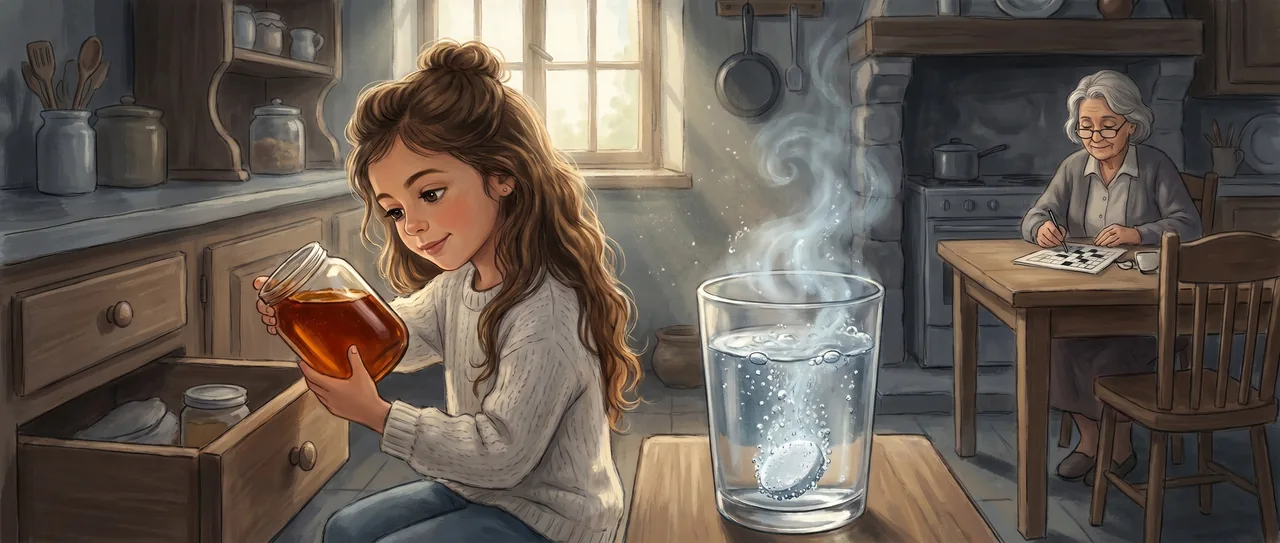
The kitchen smelled like cold stone and old honey. Maya's grandmother kept her good things in the bottom drawer, the heavy one that stuck, and pulling it open took both hands and a shoulder.
Inside were two jars.
One was honey, dark as a chestnut, with a paper label gone soft and brown at the corners. The lid had welded itself shut years ago. Maya tipped it sideways and the honey didn't move. It held its own shape like a tongue of amber glass.
The other jar was the fun one. Her grandmother had dropped a fizzing tablet in water for her cough, and the tablet was shrieking apart, throwing up tiny silver beads, hissing, shrinking, gone before Maya could count to twenty. Cold mist climbed the inside of the glass.
Gone. The honey, beside it, just sat there being honey.
"That honey," said her grandmother, not looking up from her crossword, "my mother put up. Before I was born."
Maya did the arithmetic on her fingers and stopped. The honey was older than everyone in the house added together.
She pressed her finger to the cold honey jar, then to the warm fizzing one. Same kitchen. Same air. One thing that would not change for a hundred years, sitting beside a thing that could not last half a minute.
That was the part that wouldn't sit still in her chest. They were both just stuff. Both just little pieces stuck to other little pieces. Why did one set of pieces hold on like grim death and the other let go the instant water touched it?
She thought about holding hands.
When she and her cousin held hands going down the steep part of the trail, they gripped. Knuckles white. You could yank and they wouldn't come apart. But when she held hands with her little brother to cross a parking lot, he held loose, ready to bolt the second he saw a pigeon. Same hands. Different grip.
Maya picked up the honey jar and turned it in the window light. The honey didn't shift. Sugar, her grandmother had said once, was just little rings of atoms. Maya imagined them holding on to each other, knuckles white, refusing to let go even when the years piled up on them like snow.
To come apart, the sugar would have to climb. She felt it The atoms would have to get over some hump, some ridge, before they could fall into being something else, and the ridge was so high and so steep that in a hundred years almost none of them had managed it. They sat at the bottom, white-knuckled, going nowhere.
She set the honey down and watched the fizzing jar. Whatever was in that tablet had no hill at all. Or barely a bump. Touch it to water and the pieces went sliding off the low edge before you could blink, tumbling down into gas and salt and cold, every one of them taking the shortcut because the shortcut was right there.
A ridge for one. A puddle for the other.
"Grandma," Maya said. "Why is the hill different?"
Her grandmother looked over the top of her glasses. "What hill?"
"The honey has a big hill the pieces have to climb to fall apart. So they don't. The fizzy thing has no hill, so it just goes. Why does one have a hill and one doesn't? They're both made out of the same kind of stuff. Tiny pieces stuck together."
Her grandmother thought about it longer than Maya expected. Then she said, "That, my love, is a question for someone smarter than a crossword."
Maya turned back to the drawer. That was the wrong answer, and she knew it was the wrong answer, but it left the right question lying open on the floor where she could pick it up.
Because the shape of the hill wasn't decided in this kitchen. It wasn't the cold, or the dark, or the heavy drawer. The hill came stamped into the pieces themselves, set before her great-grandmother was born, set before there was a kitchen or a honey or a her. Each pairing of atoms came with its own hill already built in, its own private rule about how hard it would be to let go, and nothing in the room could argue with it.
She thought: who built the hills.
Not her grandmother. Not the bees. The bees just gathered. The hills were there before the bees, smaller than the bees could ever see, written into the way the tiniest things were allowed to hold each other. Some grips were almost impossible to break. Some grips weren't really grips at all. And the difference wasn't anybody's choice. It was a law, running underneath the honey and the fizz and her own hand on the jar, a law about what was steep and what was flat, decided down where things were too small to have a color.
Maya looked at her own arm. Skin, blood, the warm weight of it. Hills, all the way down. Some of her was the honey kind, holding on for decades. Some of her was the fizzy kind, made and unmade a thousand times a second so she could be alive at all. Both, at once, in the same girl, set by the same hidden rule.
She pulled the notebook from her back pocket. She drew two hills. A tall one and a flat one. Under the tall one she wrote one hundred years and counting. Under the flat one she wrote twenty seconds. Then she drew a tiny stick figure at the bottom of the tall hill, white-knuckled, holding on, not going anywhere for a very long time.
"You'll want to tip that honey jar before you put it back," her grandmother said. "Lid's stuck."
Maya tried. The lid would not give. Her great-grandmother's hands had sealed it before there was a Maya to open it, and the honey behind the glass had simply decided, atom by atom, ring by ring, not to become anything else for a hundred years.
She slid the drawer shut. Behind the wood, in the dark, the fizzing jar went quiet and still at last, every piece arrived at the bottom of its hill, and the honey beside it stood exactly as it had, holding on.
Read the interactive version, listen to the narration, and earn a gold star →
A science-verified short story for curious kids · Curiosity Land