The Crooked Creek
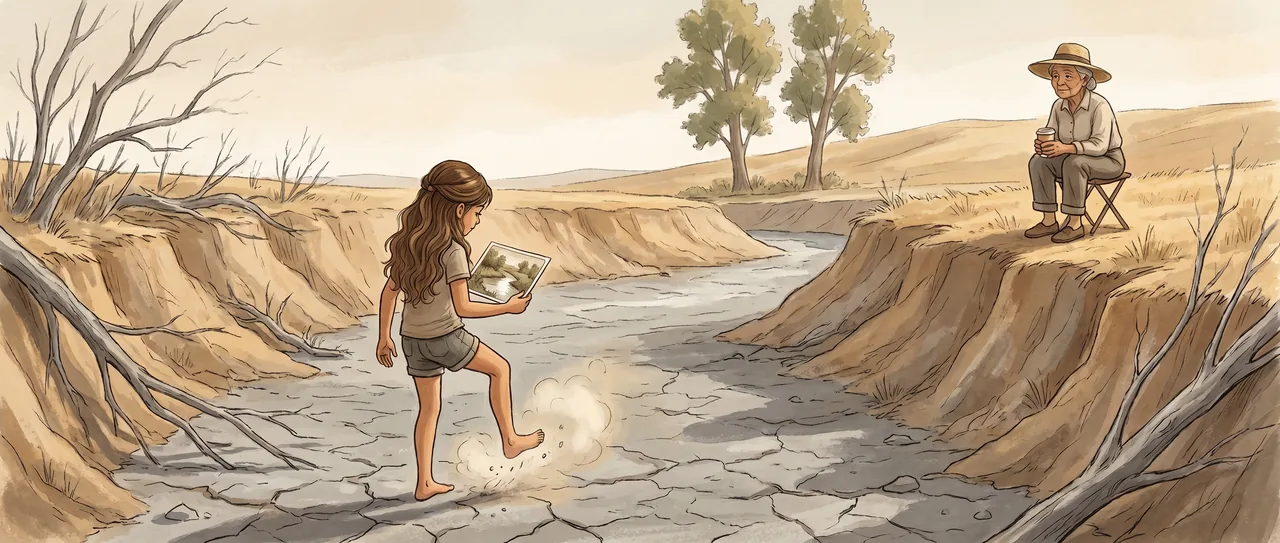
The creek was a scar now. Maya stood in the middle of it, where there should have been water, and the dust came up between her toes warm as flour.
Great-Aunt Rosa had handed her the photograph at breakfast without ceremony, the way she handed Maya everything, like objects were heavier than words. In the picture the same place was green. Not green like a lawn. Green like a sponge, water lying in flat silver sheets between the willows, a heron standing in it on one leg.
Maya turned in a slow circle. Same hill. Same two cottonwoods, taller now. Same bend in the channel. But the silver was gone, and the willows were gray sticks, and the heron was nowhere in a sky that pressed down hot and empty.
"What happened to the wet part," she asked.
Rosa was up on the bank, sitting on a folding stool with her coffee. "Creek dried."
"Creeks don't just dry."
"This one did. Year your grandmother left. We were glad of it, truth be told. Trappers came through and cleared out the beavers, and the swamp drained, and we could run cattle right down the middle. No more mud." She sipped. "Then the well got low. Then it got lower."
Maya crouched. Under the dust the dirt was cracked into plates, each one curling up at the edges like old bread. She pressed one with her thumb and it crumbled to powder. There was no give to the ground anywhere. Her heel left no mark deeper than a scratch.
She walked downstream, feeling with her feet. The channel was deep, cut hard and straight, the banks taller than her head in places. The water that did come now, she understood, came all at once and left fast. There was nothing to hold it. The dirt couldn't drink. It had forgotten how.
She climbed the bank to where a fence post stood and put her hand flat against the soil. Bone dry, and hot, and packed so tight it could have been a road.
"In the picture," Maya called back, "there's a lump. Across the creek. Like a wall made out of sticks."
"Beaver dam," Rosa said. "Whole mess of them along here once. Backed the water up into ponds. That was the swamp."
Maya looked from the photograph to the bare channel and back. In the picture the water spread out wide and shallow and slow. In front of her the channel was narrow and deep and empty. She thought about the difference between a thing spread out and a thing rushing through. Spread out, it had time. Time to soak down. Time to fill the cracks and feed the well and keep the willows alive so the heron had somewhere to stand.
The beavers had not just lived here. They had been holding the water still.
She felt the size of that the way you feel a step that isn't there in the dark. One animal, gone, and the silver sheets were gone, and the herons, and the willows, and the frogs that must have sung in the picture, and the fish under the herons, and the bugs the fish ate. And then the water itself, sinking away under the dirt because nothing was left to make it wait.
"How long," Maya said. "From the picture to now."
Rosa thought. "Four years to the swamp going. Faster than anybody figured."
Four years. Maya was eleven. She tried to fit a whole living, breathing wetland disappearing into four years and it would not fit. It was like watching a building come down in the time it took to eat lunch.
She walked back up the dry channel slowly, and now she was reading it. Here the bank had a notch where water used to spill sideways into the flat. Here a hump of older, darker dirt, richer than the dust around it, the buried floor of a pond that no longer existed. She knelt and dug at it with her fingers. Two inches down it was cooler. A little damp, even. The ground still remembered, just barely, that it had once been full.
She held the damp crumbs in her palm. They smelled green. Faintly, but green, the smell from the photograph, still down there under everything.
"Aunt Rosa." Maya stood. "If you put it back. The wall. The sticks."
"You can't just build a beaver dam, child. They keep at it. Day and night. They hear water running and they can't stand it, they have to stop it. That's the whole of them."
"So you bring them back."
Rosa laughed, but it trailed off. "People do, now. I've heard it. Truck them in. Build them a little start so they stay." She looked at the dry creek as if seeing it for the first time in years. "Hadn't thought it was for us."
Maya wasn't really listening anymore. She was looking at the notch in the bank, the spill point, and she could see it. Not the dam. The water. She could see exactly where it would back up, how far it would spread, which gray willows would have their feet in silver again first. She could see the flat sheets coming back, and the cracked plates of dirt softening, drinking, swelling shut. She could see, four years forward instead of four years back, a heron picking its way through the shallows on legs like wire.
The whole place had been built by something the size of a dog. Knock out the builder and it all came down. Put the builder back and it all came up. The land wasn't a thing. It was something being held, and someone had let go, and someone could take hold again.
She ran the damp soil between her fingers until it dried to nothing.
Rosa was up off her stool now, standing at the edge of the bank, looking down the empty channel the way you look down a road waiting for a car. "Where would you even start," she said. Not to Maya. To the creek.
Maya walked to the notch in the bank and stood in it, where the water used to go sideways, and she stamped her heel down hard into the packed dry dirt.
The dust jumped up around her ankle and hung there in the hot still air, and did not settle.
Read the interactive version, listen to the narration, and earn a gold star →
A science-verified short story for curious kids · Curiosity Land