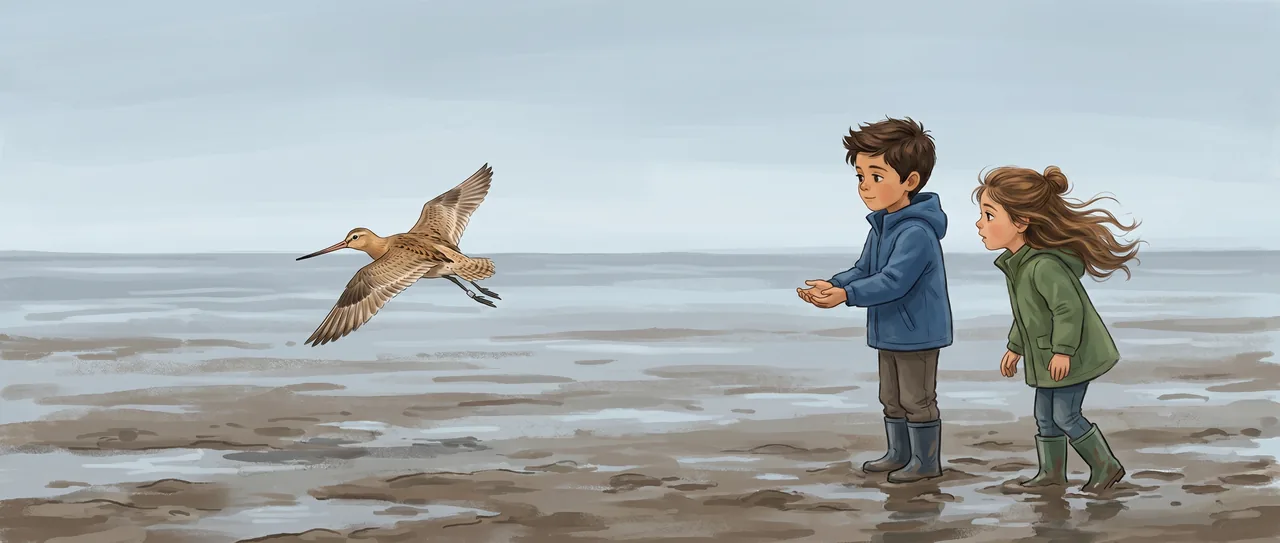
The Bird That Doesn't Stop
The mud smelled like salt and old rain and a little like something rotting, which Maya had decided was the smell of food if you were a bird with a long beak. She had her boots in it up to the ankle. The cold came through the rubber anyway.
Soren held the bird.
It was smaller than he expected and heavier than it looked, a warm weight in his cupped hands with a beak the color of wet bark. Its heart went so fast he could feel it the way you feel a phone buzzing in another room, a hum under everything.
"It's fat," Soren said.
"Don't call it fat." The biologist crouched beside them was named Reza, and she was certain about a lot of things, and most of them she was right about. "It's loaded. It nearly doubled its weight in the last few weeks. All fuel." She tightened the little flag on the bird's leg, the tag that would talk to a satellite. "This one's going to Tasmania."
"How far is that," Soren asked.
"Far," Reza said, the way adults say a number they don't want to argue about.
Maya was not looking at Tasmania. She was looking at the bird's chest, the way it pumped, fast and even, and at the gray water past the mudflat that went out and out until it stopped being water and became sky.
"When does it land," Maya asked.
"It doesn't," Reza said.
Maya turned her head. "For how long."
"Eight days. Nine. We had one go eleven." Reza was already looking at her clipboard. "Over open ocean the whole way. No islands on that route worth stopping for." "Eleven days," she said. "No stopping."
"No stopping."
"No eating."
Reza looked up. "No eating. Nothing to eat out there. No drinking either. There's no fresh water in the middle of the Pacific."
Soren felt the heart under his hands. Hum, hum, hum. He thought about flapping. He thought about flapping for one minute and how his arms felt after. He tried to multiply one minute by eleven days and his head refused.
"That can't be right," he said, not rude, just honest. "It would run out. Of everything. You can't flap for eleven days. You'd run out of fuel and run out of water and you can't sleep while you're flapping."
"It does," Reza said. "We've tracked it. The satellite doesn't lie." Then her radio crackled and she stood and walked off toward the truck, certain, leaving the part that mattered behind her in the mud.
Soren looked at Maya. "It can't," he said again. "Where does the water come from."
Maya wasn't listening to him. She was watching the bird breathe.
"Soren," she said. "When you burn the fat. What comes out."
"What?"
"You said it's loaded with fuel. When the body burns fat. What's left over."
Soren stopped. He felt it before he had the words, the way you feel the floor when the elevator drops. He knew this. They had done it in class with breath and a cold mirror, the way you fog glass with a sigh.
"Water," he said slowly. "When you burn it you get water. And carbon dioxide." He breathed onto his free hand and felt the warm damp of it. "That's why your breath fogs. The water comes out of the fuel."
Maya nodded, fast, like she'd been waiting for him to catch up so she didn't have to be right alone.
"So it doesn't need to drink," she said. "It's carrying the water. It just hasn't turned it into water yet. It's folded up inside the fat."
Soren stared at the bird. It didn't look like an animal carrying an ocean. It looked like a small brown thing with tired eyes. But the heart hummed and the chest was heavy and somewhere in that warmth was eleven days of water that hadn't happened yet.
"It makes its own water," he said, "out of itself, while it flies."
"And the sleeping," Maya said. She wasn't done. "It can't all the way stop. So it doesn't."
"It half sleeps," Soren said, remembering, the words arriving as he said them. "One side of the brain at a time. Birds do that. Half the brain sleeps and one eye stays open and the wings keep going."
The wind came off the water, cold and full of salt, and Maya turned her face into it and squinted out at the horizon, the gray seam where there was nothing, no island, no landmark, no light, just water under sky for thousands of kilometers.
"How does it know which way," she said quietly. "There's nothing out there. No roads. It's never been."
"Reza said magnetic," Soren said. "The Earth. And the stars. And maybe it can smell the way." He paused. "They don't totally know. She said it like she knew but the paper says maybe. They're still not sure how it does the steering."
Maya liked that better than the parts they were sure about. A bird the size of Soren's two hands, carrying its own water, sleeping half a brain at a time, pointing itself across an entire ocean toward a place it had never seen, and the smartest people with the best satellites still saying maybe about how.
"It's eleven," she said. "It's eleven and a half hands and it's about to do the biggest thing I've ever heard of and nobody fully understands how." She laughed, surprised at herself. "It doesn't even know it's amazing."
"Maybe it's tired," Soren said. "Maybe to it, it's just Tuesday."
Maya looked at the small heavy bird and then at the empty horizon and then back, and something in her chest went tight and wide at the same time, like a door she couldn't see the far side of.
Reza came back. "Okay," she said. "Open your hands."
Soren opened his hands.
For a second the bird stayed, a warm weight that didn't believe it was free yet. Then it dropped off his palms, caught the cold air, and beat low across the mud, out past the last gray water, until it was a speck, and then it was the place where a speck had been, headed straight for a horizon with nothing on it at all.
Read the interactive version, listen to the narration, and earn a gold star →
A science-verified short story for curious kids · Curiosity Land