Two Wrong Robots
The club had gone home and left Maya with two broken robots and a bin of buttons.
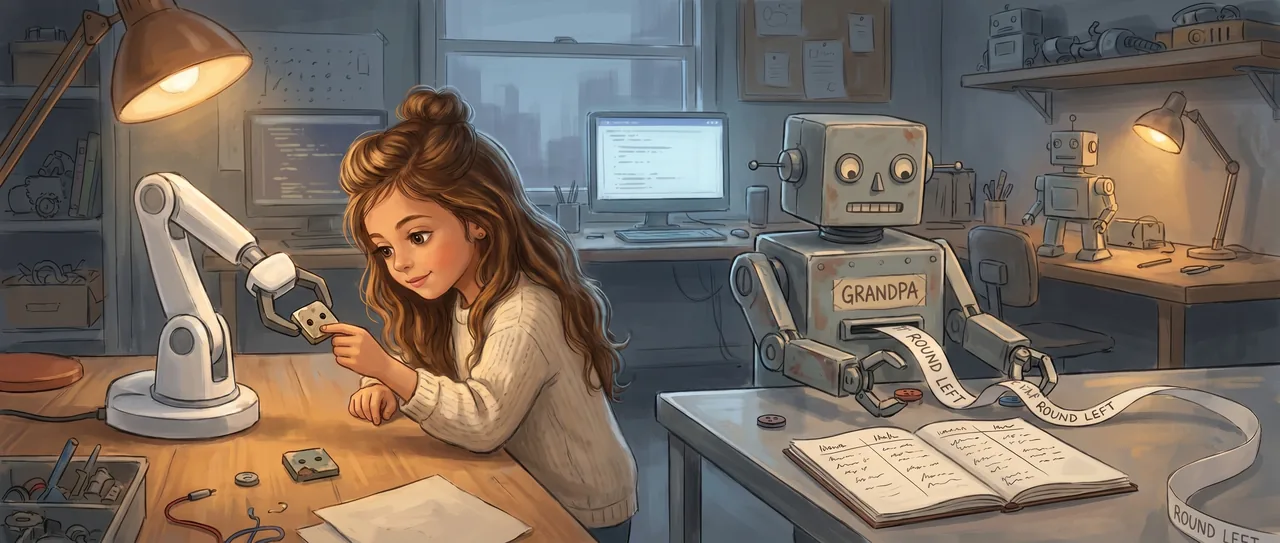
The old one was named Rulebot, though somebody had crossed that out on the label and written GRANDPA. It was a gray box with a claw, built by a club fifteen years ago, and it sorted buttons by following instructions a person had typed in. If round, put left. If square, put right. If more than four holes, put in the reject cup.
The new one had no name, just a camera and a soft rubber gripper. Somebody had trained it by showing it ten thousand pictures of buttons already sorted. Nobody had told it any rules. It had figured out its own.
Ms. Okafor had said, before she left to coach the swim team, that both were acting up and Maya could mess with them if she wanted. Maya wanted.
She poured a handful of buttons in front of Grandpa first.
Grandpa worked through them like a careful old man. Round left. Square right. Round left. Then it reached a button that was round but also had a tiny chip out of one edge, so the camera read the edge as a corner, and Grandpa froze. Not broken. Just stuck, claw hovering, waiting for the world to be one of the shapes it had been told about.
Maya nudged the button straight. Grandpa saw round again and dropped it left, content.
"You only know what someone said out loud," she told it.
She fed the same handful to the new robot.
The new one was fast. It did not hesitate at the chipped button. It did not hesitate at a button shaped like a star, which Grandpa had never been told about and would have stared at forever. The new one just gripped it and dropped it left with the round ones, confident.
Maya frowned. The star was not round. Why left?
She pulled a notebook from her bag and drew two columns. She fed the new robot twenty more buttons and wrote where each went. The mistakes had a shape to them, but not the shape she expected.
Every dark button went left. Every pale button went right. It did not matter if they were round or square.
She held a black square in front of the camera. Left. A white circle. Right. The robot had never once been sorting by shape. It had taught itself to sort by color, because in all ten thousand training pictures the round buttons had happened to be dark and the square ones pale, and nobody had noticed, and the robot had no reason to care which rule it found as long as the answer came out right.
Maya sat back.
Grandpa could tell you exactly why it did everything. If round, left. You could read its reasons. But it could not handle a button it had never been warned about.
The new robot could handle anything. Star, chip, smudge, it never froze. But if you asked it why, there was no why to read. It had a reason. The reason was just hidden somewhere inside numbers nobody had written and nobody could open.
One of them knew the rules and could not bend.
The other could bend anything and could not tell you the rule.
They were broken in exactly opposite directions.
Maya looked at the two of them for a long time.
Then she did the obvious thing, which is the thing nobody had done because the two robots were from different decades and lived on different tables and spoke through different cables.
She ran them together.
She let the new robot grip each button first, because the new one never froze. It picked up the chipped button, the star, the smudged one, things Grandpa could not even name. As it lifted each one, Maya turned it square to the old robot's camera and let Grandpa look.
Grandpa, who could not pick up a star, could still measure one once it was held still and flat in good light. Round or not round. Holes counted. And Grandpa, when it sorted, printed its reason on a little paper tape, the way it had for fifteen years.
New robot: never stuck.
Old robot: always able to say why.
The chipped button came through. The new robot lifted it without flinching. Grandpa measured it, ignored the chip, read it as round, and dropped it left. The paper tape chattered: ROUND. LEFT.
Now she knew the answer and the reason at the same time.
She ran the whole bin through. The star went left, and the tape said why, because Grandpa had been given a new line that afternoon by a girl who typed it in: if no corners, treat as round. The dark square went right, where it belonged, because the old robot measured shape and did not care about color, and the new robot's secret color habit could not sneak through, because the new robot was not deciding anymore. It was only lifting.
The two wrong robots, run together, were right.
Maya tore off a length of the paper tape. It was covered in reasons. ROUND LEFT. SQUARE RIGHT. FOUR HOLES REJECT. Every choice explained in a language a person could read, for buttons no rule had ever been written to handle.
She thought about the people building real thinking machines right now, somewhere, tonight. The ones who learn everything and cannot say why. The ones that can say why and cannot learn. She thought about how nobody had finished joining them yet. How that was a real unsolved thing, not a thing in a book with the answer at the back.
She pictured a machine that could surprise you and then turn around and tell you exactly what it had been thinking. Nobody had that. Nobody yet.
Grandpa's claw lifted, waiting for the next button.
Maya reached into the bin, found the strangest button she could feel, one shaped like nothing, with a chip and a smudge and a hole in the wrong place, and she set it down in front of the new robot's camera to see what the two of them would say together.
The gripper closed. The paper tape began to chatter.
Read the interactive version, listen to the narration, and earn a gold star →
A science-verified short story for curious kids · Curiosity Land