The Same and Not the Same
The two old women came in through different doors at the same time, and Maya knew before anyone said anything that they were the same person split in half.
"Twins," her grandmother said, pouring tea. "My sisters. Rosa and Lucia."
They did not look like twins. That was the first thing that didn't fit.
Rosa was small and brown as a walnut, with hands that looked like tree roots. Lucia was pale and soft and moved like she had never once been in a hurry. Rosa laughed loud. Lucia smiled with her mouth closed. One of them had a deep crease between her eyebrows and the other had smooth skin there, like a page nobody had written on.
Maya counted the differences while the grown-ups talked over her head.
"They were identical," her grandmother said, catching her staring. "When they were babies, I couldn't tell them apart. Nobody could. Our mother painted Lucia's toenail to keep them straight."
Maya frowned. "Identical means the same DNA."
"Look at you," Rosa said, delighted. "A scientist."
"You have the same DNA," Maya said. "You should be the same."
The kitchen went a little quiet. Lucia set down her cup.
"We started the same," Lucia said. "One egg. It split. Same everything."
"Then what happened?"
"Seventy years happened," said Rosa.
Maya did not let it go. She never let things go once they had stuck. She looked at Rosa's root hands and Lucia's smooth ones and tried to make the math work, and it would not work.
Same DNA. Same instructions. Different women.
"DNA is the recipe," she said slowly, working it out loud the way she did. "But you can make the same recipe two ways. You can leave out the salt. You can cook it longer."
"Rosa picked tomatoes in the sun for fifty years," her grandmother said. "Lucia taught piano in a dark little room."
"So the sun did the hands," Maya said.
"The sun, the work, the worry," Rosa said. "I had six children. Lucia had none. I smoked for a while. She never did. I went hungry one bad winter. She didn't."
Maya looked from one face to the other. The recipe was identical. But all of life had been reaching into the kitchen and turning some knobs up and some knobs down, on Rosa one way and on Lucia another way, every single day for seventy years.
"Your genes aren't different," she said. "But something is sitting on top of them. Telling them louder. Quieter."
Lucia tilted her head. "That's a strange thing for a child to say."
"It's a true thing, though," Maya said. "Isn't it."
Nobody answered, because nobody at the table knew the word for it. The same letters. A whole life writing notes in the margins.
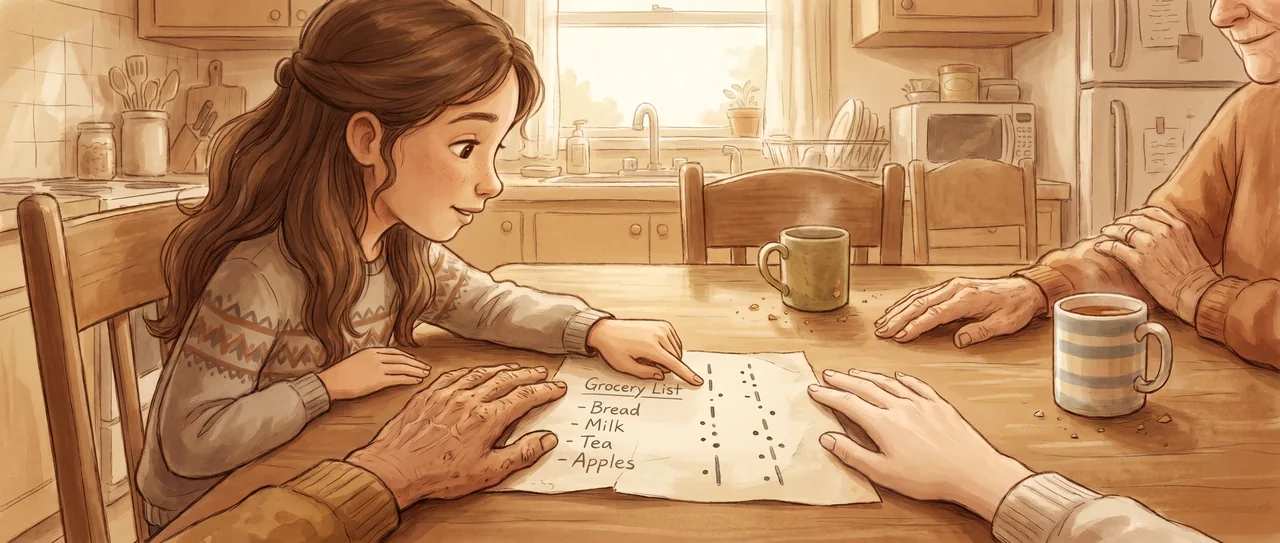
She asked for something to write with. Rosa found a pencil in a drawer full of rubber bands and old keys. On the back of a grocery list Maya drew two lines, identical, side by side. Then she drew little marks along them, dots and dashes, more on one line than the other.
"This is Rosa," she said, tapping the line with more marks. "This is Lucia."
"Why does Rosa have more?" Lucia asked.
"I don't know if she does. I'm guessing." Maya chewed the pencil. "The marks are everything that happened to you. The sun is a mark. The babies are marks. The hungry winter is a mark."
"And they change the gene?" Rosa leaned in. Her eyes were very bright.
"They don't change the gene. The gene stays the same." Maya was certain of this without knowing how she was certain. "They change which genes get listened to. Like turning some up and some down on a radio. Same radio. Different song."
The two old women looked at each other across the table, and something passed between them that Maya was not part of, that went back to before her grandmother, before any of them, all the way back to one cell deciding to become two.
"When we were young," Lucia said quietly, "people would say, you two are exactly the same. And it always felt like a lie. I knew we weren't. I just couldn't prove it."
"You can prove it now," Maya said. "If somebody read your whole self, not just the recipe but all the marks on top, they could tell you apart. They could probably guess which one of you picked tomatoes."
Rosa laughed, but Lucia did not.
"Read the marks," Lucia said. "They can do that?"
"Scientists can. Already." Maya had read it somewhere and it had stuck like a burr. "They can look at two twins and tell who's older, almost. Who smoked. The marks pile up. They're like rings in a tree. Your whole life is written there. Not in the recipe. On top of the recipe."
Lucia put her smooth hand flat on the table next to Rosa's rooted one. The two hands, that had begun as the same hand, in the same body, in the same single beginning.
"Seventy years," Lucia said. "Written down somewhere inside me."
"In both of you," Maya said. "Different books. Same first page."
The grown-ups had drifted back into their own talk. The tea had gone cold. But the two old women stayed bent over the grocery list with the marks on it, and Maya stayed too, and for a moment none of them were old or young, they were just three people looking at the strangest thing in the room, which was each other.
Rosa picked up the pencil. Without asking, she added one more mark to Lucia's line, near the end, and one to her own.
"What are those," Maya asked.
"Today," Rosa said. "This is today. It counts too."
She set the pencil down, and the two lines lay there on the paper, the same and not the same, still being written.
Read the interactive version, listen to the narration, and earn a gold star →
A science-verified short story for curious kids · Curiosity Land