The Stomach That Goes Outside
The mussel had been closed for twenty minutes, and Maya would not stop staring at it.
"It's clamped shut," she said. "Tight. I tried to open one yesterday and I couldn't even get a fingernail in."
"So the starfish can't open it either," Soren said. He crouched lower, knees in the cold sand at the edge of the pool. "It doesn't have fingernails. It doesn't have anything. It's just sort of lying on top of it."
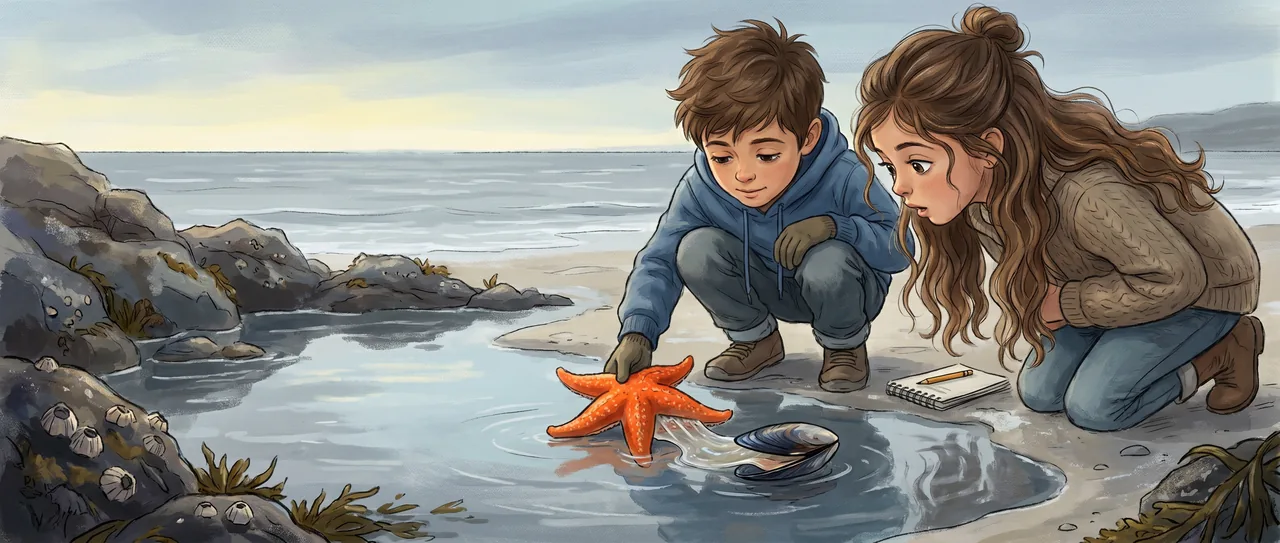
The starfish was orange, the color of an old traffic cone, and it had wrapped itself over the mussel like a hand over a stone. It was not moving. It had not moved in a long time.
"It's losing," Soren said. "The mussel's winning. It just stays shut and the starfish gives up."
"It's not giving up." Maya tilted her head. "Look at the arms. They're pulling."
They watched. The tips of two arms had curled under the lip of the shell, and there was the smallest steady tension in them, like a person leaning on a door that won't budge.
"Okay, it's pulling," Soren said. "But the mussel's stronger. A mussel can hold its shell shut harder than you can squeeze. We learned that. The starfish can't win a pulling contest."
"Then why's it still here." Maya said it flat, not really a question. "If it can't win, why hasn't it left."
Soren didn't have an answer for that. He pulled his notebook out of his jacket and balanced it on his knee and drew the starfish from above, five arms, the bump of the mussel underneath. He wrote a small time in the corner. 7:14.
"It only needs the shell open a tiny bit," Maya said. "That's the thing. It doesn't need it wide open. Just a crack."
"Why a crack."
"I don't know yet. But a mussel can't stay clamped forever. Its muscle gets tired. The starfish just has to wait it out and the second it opens a slice, the starfish does something."
"Does what." Soren looked at his drawing. "It doesn't have hands. It can't reach in. The opening would be like a millimeter. Nothing fits through a millimeter."
They were quiet. The pool was very still and you could hear the bigger water out past the rocks, breathing in and out.
"Something fits," Maya said.
"Nothing fits."
"Something soft fits. Something that doesn't have a shape." She was leaning so far over the pool her hair was nearly in it. "Like how you can push a balloon through a gap that's way smaller than the balloon, if the balloon's empty."
Soren stopped drawing. "There's nothing on a starfish that's like that."
"There has to be. Or it would've left."
They waited. Soren wrote 7:21. His feet had gone numb in his shoes and he didn't say so. Maya had stopped talking, which never lasted, and when it broke it broke quietly.
"Where's its mouth," she said.
"Underneath. In the middle. Face down on the mussel."
"So its mouth is pressed right against the crack."
They looked at each other. Neither of them said the next part because neither of them was sure of it yet, and saying a thing out loud made it have to be true.
"Lift it," Maya said.
Soren slid his fingers under the orange arm, gentle, the way you'd lift something sleeping, and tipped the starfish up off the mussel just enough to see underneath.
There was a film between them. A pale, wet, jellyish sheet, spread out flat against the shell, sliding into the thin dark line where the mussel had opened the smallest crack. It was not an arm. It was not a tongue. It came out of the center of the starfish, out of the mouth, and it was poured over the mussel like cling film over a bowl.
"That's," Soren started, and stopped.
"That's its stomach," Maya said. "It's the stomach. It's on the outside."
Soren put the starfish back down, exactly, carefully, the way it had been. He was not breathing very loud.
"It turned its stomach inside out," he said slowly, testing each word. "Through its mouth. And pushed it into the crack."
"Because the stomach's soft. It doesn't have a shape. It goes through the millimeter." Maya's voice had gone fast. "It doesn't have to open the shell. It doesn't have to pull the mussel out. It puts the stomach in and digests the mussel right there inside its own shell."
"It never swallows," Soren said.
"It never swallows." Maya sat back on her heels. "It eats it without picking it up. It just. Pours itself onto its food."
Soren looked down at the orange star, motionless, patient, dissolving a clamped mussel from the inside of the mussel's own armor, and he thought about every meal he had ever eaten, all of it going in, all of it down, and how he had never once questioned that this was the only direction food could go.
"I always thought a stomach was a bag you keep on the inside," he said.
"It's not a bag." Maya was grinning now, the wide one. "It's a thing you can send out. It's a tool. It put its stomach somewhere it couldn't put the rest of itself."
Soren picked up his notebook. He didn't write a sentence. He drew the crack, and the pale sheet sliding into it, and an arrow pointing the wrong way, from inside the starfish to outside, and he stared at the arrow for a while.
"There are probably animals that do all of it backwards," he said. "Things we'd never guess. Things that work in directions we don't even have words for."
"Probably loads," Maya said. "This one was just lying in a puddle the whole time."
The tide had turned without either of them noticing. A thin sheet of new water slid across the sand toward the pool, and the starfish, stomach out, did not move at all.
Read the interactive version, listen to the narration, and earn a gold star →
A science-verified short story for curious kids · Curiosity Land