The Bone That Wasn't Anyone
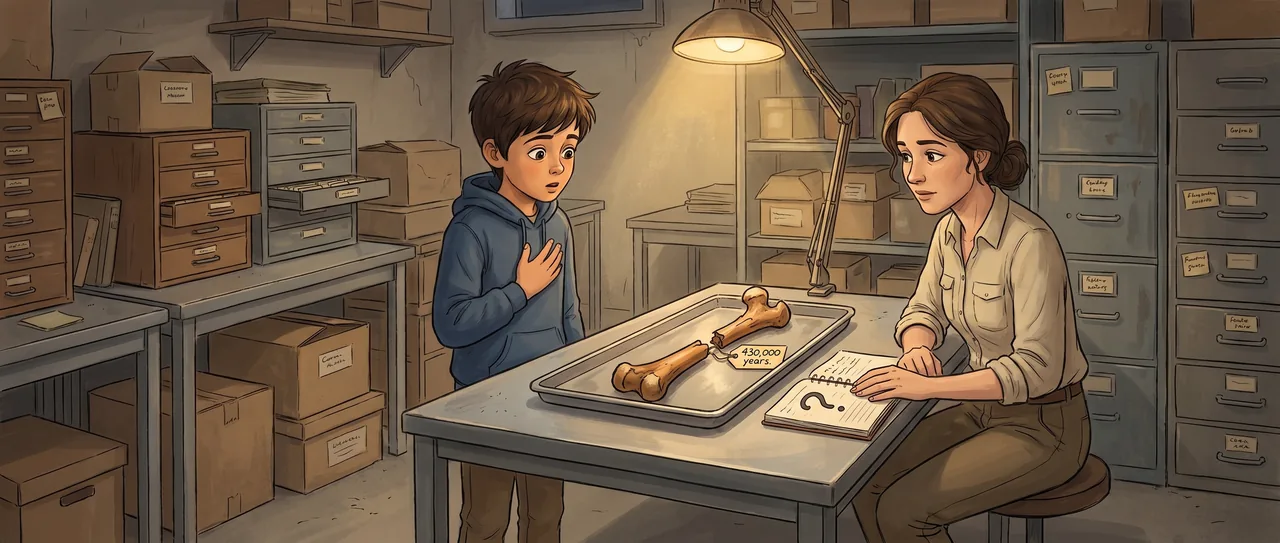
The rest of the class had gone up to see the whale. Soren stayed because the woman at the long steel table had not told him to leave, and because she was holding a bone the color of weak tea and frowning at it like it had insulted her.
"You can come closer," she said, not looking up. "Just don't breathe directly on the tray."
Soren came closer. He kept his hands behind his back, the way you do near things older than countries.
The bone was a chunk of thigh, broken at both ends. A small printed tag sat beside it. He read the number. He read the line under the number, which said four hundred and thirty thousand years.
"That can't be a typo," he said.
"It is not a typo." She turned the bone a quarter turn. "It came out of a pit in Spain. A cave shaft full of them. Twenty-eight people went down that shaft, more or less, a very long time ago."
Soren wrote the number in his notebook. His pencil pressed a little hole through to the next page.
"So you know what they looked like," he said.
"We know what the bones look like." She set the femur down with both hands. "Heavy brows. Big faces. For years everyone agreed they were early Neanderthals. The shape said Neanderthal. The teeth said Neanderthal. Everything you could measure with a ruler said Neanderthal."
"Everything you could measure with a ruler," Soren repeated. He liked the careful way she said it, like she was leaving a door open on purpose.
She finally looked at him.
"You caught that," she said.
"You said it like there was a but."
"There was a but." She pulled a stool over with her foot and sat. "Inside the bone, in the tiny bit of powder we can drill out of the densest part, there is sometimes still DNA. Broken into little scraps. Most of it gone. But a few of those scraps survive, even after four hundred thousand years, if it stays cold enough."
Soren stopped writing.
"DNA lasts that long?"
"Barely. It falls apart the whole time, like a wet newspaper. For ages everyone said anything past a hundred thousand years was hopeless. Then the cold ones, the cave ones, the deep ones, started giving up little pieces. And we learned to read the pieces."
"And it said Neanderthal," Soren said, because that was where the ruler had pointed.
She smiled with one side of her mouth.
"It did not say Neanderthal."
Soren set his pencil flat on the page so it would stop wanting to move.
"The shape of the bone was Neanderthal," she said. "The inside of the bone was something else. The oldest pieces lined up closer to a different group entirely. A people we'd only ever met as DNA. No skull anybody could point to and say, that one, that's them. We found them by their genes before we ever found them by their faces."
"A people you only know as DNA," Soren said slowly.
"There is a girl," she said. "Was a girl. In a cave in Siberia we found a single finger bone. A pinky tip. That is all. From that one chip of finger we read a whole new kind of human that nobody had ever named, because nobody had ever found enough of one to name. No jaw. No brow. No ruler measurements. Just the code."
Soren looked at the femur on the tray. He looked at the shape of it, the heavy honest shape that had fooled everyone with a ruler for years.
"So the bone can look like one thing," he said, "and be another thing."
"The bone can look like a cousin and be a stranger."
He thought about that. He thought about all the skulls in glass cases upstairs, each one with a confident little card. He thought about how a card could be sure and still be standing next to the wrong door.
"How many," he said.
"How many what?"
"How many kinds of people are there that you only know from a finger. Or a tooth. Or a smear of powder."
The paleontologist went quiet. "That," she said, "is the part I think about when I can't sleep."
Soren waited.
"There are gaps in the family tree that we have only filled with DNA," she said. "Ghost branches. We can see, in living people, in your cells right now, little stretches of code that came from a group we have never found at all. Not a finger. Not a tooth. Nothing in any drawer in any museum on earth. We know they existed because we are partly made of them. They left their genes inside us and then they left no bones we can recognize."
"Inside us," Soren said.
"Inside a lot of people. Including, statistically, you."
Soren put his hand flat on his own chest without deciding to. Under his palm his heart did the ordinary thing it always did. He thought about a person with no name and no face and no card in any case, who had walked somewhere cold a very long time ago, and who was, in some small unmeasurable way, still walking around inside him.
"You're allowed to find that strange," she said, watching him. "I have a doctorate and I still find it strange."
"I don't find it strange," Soren said. "I find it. I don't know the word."
"There might not be one yet," she said. "You can have first crack at it."
Upstairs a bell rang, the one that meant his class was supposed to gather by the whale. Soren did not move toward it.
He picked his pencil back up off the page. He looked at the broken femur, the color of weak tea, that had stood for years behind the wrong card. He did not write what it looked like.
He wrote the question instead, and underlined it twice, and the line under the line went a little crooked because his hand was not quite steady.
Read the interactive version, listen to the narration, and earn a gold star →
A science-verified short story for curious kids · Curiosity Land