The Wrong Fold
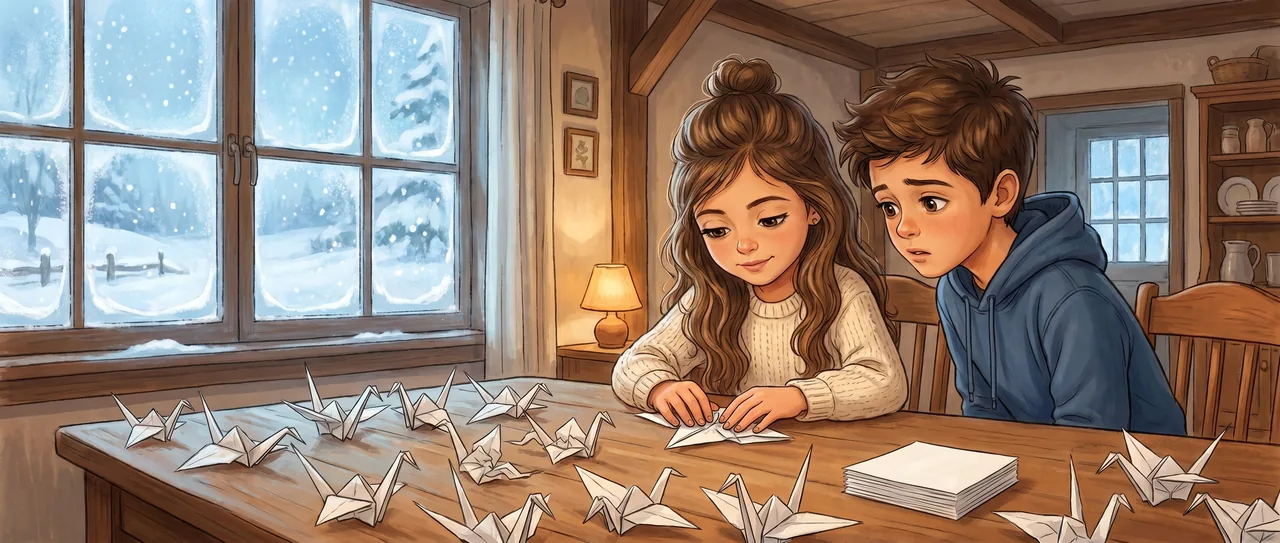
The snow had shut the road, so they were folding cranes at the kitchen table because Maya's grandmother said a hundred of them would help old Mr. Becker feel better, and they were on number nineteen.
"Yours is wrong," Maya said.
"It's a crane."
"It's a crane with a broken neck." She held up hers. "Look. The fold goes the other way."
Soren looked. His had a hard crease near the head that bent the wrong direction, so the beak pointed down instead of out. He flattened the paper to start over and the crease stayed, a white ghost line refusing to lie flat.
"It won't go away," he said.
"Once you fold a thing, the paper remembers."
He ran his thumb along the bad crease. "That's the part that's weird. The paper's the same paper. Same square, same size. The only thing different is the shape I put in it."
"That's not weird, that's just folding."
"No." He set it down. "My grandfather had a thing. In his brain. The doctors kept saying it wasn't a germ. Not a virus, not bacteria. They said it was a protein that folded wrong."
Maya stopped, crane half-built between her fingers. "A protein is like a string, right. A long string that folds up into a shape."
"And the shape is the whole point. Same string, fold it one way it works, fold it another way it's broken." He picked his bad crane back up. "Same as this."
"So he had one bent crane in his head."
"That's the part I never got." Soren frowned. "One wrong protein shouldn't matter. You've got billions of the right ones. One bent one out of billions. Why would the doctors even care."
Maya wasn't listening to him anymore, which he could tell because she had started folding fast, three cranes lined up in a row, all correct, all the same.
"Hold one of mine," she said. "A good one. Now watch." She took his broken crane and pressed its hard wrong crease against the wing of one of her good ones, and folded the good one along the same line, copying the bend exactly. "There. Now this one's bent too."
"You bent it. That doesn't prove anything. You just folded it wrong on purpose."
"I copied it. I used the bent one as the pattern." She held the two broken cranes side by side. They matched. The same ugly downward beak. The same ghost crease. "What if that's what a bent protein does. What if it doesn't just sit there. What if it touches a good one and makes it fold the same wrong way."
Soren went very still. "Then it wouldn't be one," he said slowly. "It'd be one, then two, then four."
"Then your billions of right ones are the problem. Not the safe part. The supply." Maya's hands were already moving. She took the two bent cranes and used them to bend two more good ones, then used those four to bend four more. "Every good one you've got is just a wrong one waiting for a pattern."
The table was filling with broken-necked cranes now, all identical, all wrong in exactly the same way, and the strange thing, the thing that made the back of Soren's neck go cold, was that nobody was teaching them the wrong fold. The wrong fold was teaching itself. Each broken crane became the instruction for the next.
"There's no germ," Soren said. "That's why the doctors kept saying it wasn't a germ. There's nothing alive doing it. It's just a shape that makes more of its own shape."
"A shape that copies," Maya said. "That's all it is. Not alive. Not dead. Just a shape that spreads."
They both looked at the heap of bent cranes. It had started with one wrong crease on one square of paper, and now most of the flock was ruined, and not one of them had been folded by a hand that meant to do it harm. The first one Soren had just gotten wrong. By accident. The way, he understood now, a real protein could just fold itself wrong one day for no reason at all, in a brain that had done nothing to deserve it.
"It can start by itself," he said. "That's the part nobody could explain to my grandfather. Why him. There's no why. A string folds wrong one time out of billions of times and that's enough, because then it copies."
Maya picked up a fresh square, perfect, uncreased, and held it up to the window light so the snow showed through it.
"Every one of these is fine," she said. "Right up until it meets a bent one."
"That should make it scarier," Soren said. "But it kind of doesn't."
"Because now you know what to look for." Maya turned the clean square over in the light. "People are learning to catch the bent shape before it copies. That's a thing that exists. Spotting the wrong fold early. If you know the bent one is the pattern, you know exactly what to hunt for."
Soren wrote that down too. He thought about all the people in labs right now whose entire job was watching for one wrong shape in a sea of right ones, the way Maya had spotted his broken neck across the table without even trying, before she understood why it mattered.
"You saw mine was wrong before you knew any of this," he said. "You just saw it didn't fit."
"That's the easy part," Maya said. "Seeing the one that doesn't fit. I'm always doing that."
"I know." He almost smiled. "It's the most useful thing about you."
They looked at the table. Maybe sixty cranes, and more than half were bent, all the children of one accidental crease.
"We can't fix the bent ones," Soren said. "The crease stays."
"No," Maya agreed. "But we've still got the clean squares." She slid the stack of unfolded paper to the middle of the table, away from the bent flock, a clear inch of distance between the ruined ones and the ones that hadn't met them yet.
Then she took the topmost clean square, kept it well clear of the others, and began, very carefully, to fold it right.
Read the interactive version, listen to the narration, and earn a gold star →
A science-verified short story for curious kids · Curiosity Land