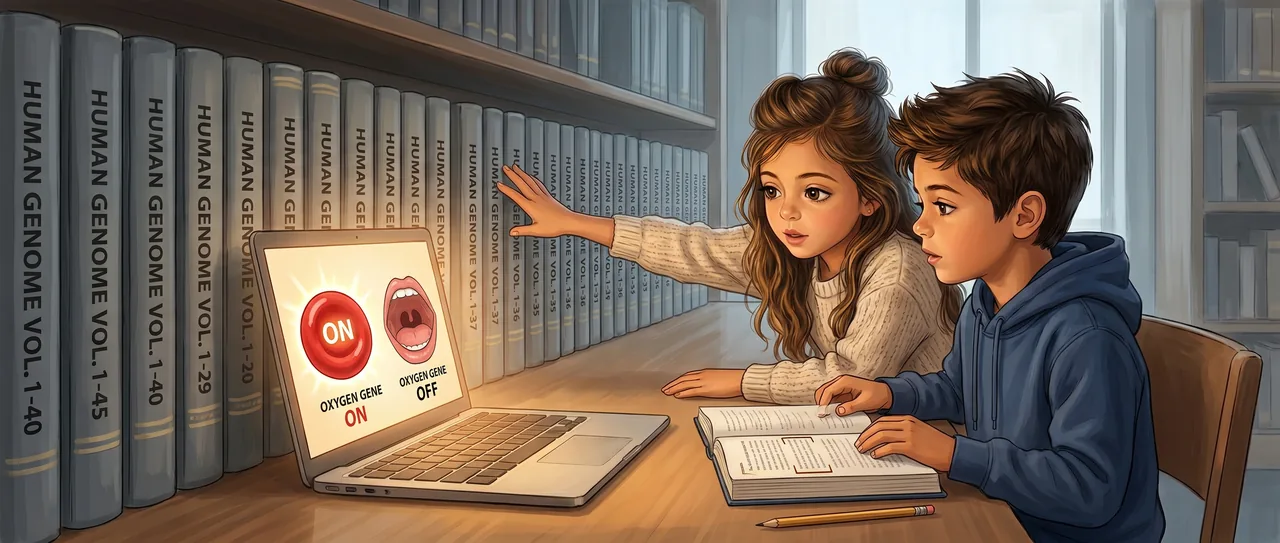
The Two Percent
The box from the museum was heavier than a box of paper should be.
"It's a book," said Soren, lifting the first volume out. "It's a hundred books."
There were forty of them, fat and gray, lined up on the library table like bricks. The card on top said: THE HUMAN GENOME, PRINTED. ONE CHROMOSOME PER VOLUME. CONGRATULATIONS, CONTEST WINNERS.
Maya opened the nearest one to the middle. Letters. Just letters, packed edge to edge, no spaces, no pictures. G and A and T and C, over and over, line after line, page after page.
"This is supposed to be a person," she said.
"It is a person," said Soren. "It's the instructions for one."
Maya turned a page. Then another. Then ten more, fast, the way you flip to see if a flipbook moves. The letters did not change into anything. They just kept being letters.
"Where are the genes?" she said. "The actual genes. The eye color one. The instructions."
Soren had the museum's pamphlet open. He read for a second. "Okay. It says the genes are in here. But it says only about two percent of all of this actually spells out a protein."
"Two percent."
"Two."
Maya looked at the forty gray bricks. "So ninety-eight percent of these books are nothing?"
"That's what people thought," said Soren. "The pamphlet has a word for it in quotes. Junk." He frowned at the page the way he frowned at a circuit that lit up when it shouldn't. "They called it junk DNA."
Maya didn't say anything. She was flipping again. She got like this, flipping and flipping, until her hand stopped on its own.
It stopped.
"Soren. Read me the first part. The very front. Where a protein is."
He found a marked section near the front of volume eleven, where someone at the museum had drawn a thin bracket in pencil. "Here. This little stretch. The bracket says this one makes a protein."
"How long is it?"
He measured with his thumb. "Like half a page."
"And then?"
"And then it just keeps going. Pages and pages of the other stuff before the next bracket."
Maya put her finger on the half page of bracket, then dragged it across all the unbracketed pages that followed. "So the recipe is this much," she said, holding up a pinch of air, "and then there's all of this." She spread her arms at the forty books.
"Right."
"That doesn't make sense."
"Why not? It's leftover. It doesn't do anything."
Maya shook her head slowly. "No. Think about your bike."
Soren blinked. "My bike."
"When your chain came off. You didn't have a chain problem. You had a problem with the little spring thing that decides where the chain sits." She tapped the table. "The spring isn't the chain. But the chain does nothing without it."
Soren went very quiet. "Okay," he said. "Say you're right. Then this stuff isn't the recipe. It's the part that decides whether the recipe gets cooked."
"When," said Maya. "And how much. And where."
"You can't know that from looking."
"So let's not just look." She spun the laptop around. "The museum gave us the search thing. Search for one gene in two places."
"What two places?"
"You. A cell from your mouth and a cell from your blood. They're the same person. Same forty books. Exactly the same letters in both."
Soren typed. The contest tool let you pick a cell type and watch which genes were switched on. He picked the gene for an eye-lens protein. In a mouth cell: off. In a blood cell: off. He picked a gene for carrying oxygen. Mouth cell: off. Blood cell: on, bright and loud.
"Same books," he said slowly. "Same letters in every cell in your whole body. But the blood cell is reading different pages than the mouth cell."
"Something is turning the pages," said Maya.
"Something is turning the pages," Soren repeated, and he set the pencil down.
They both looked at the wall of gray.
"It's the ninety-eight percent," Maya said. "It has to be. The two percent is the same in every cell. So the thing that makes a blood cell different from a mouth cell can't be in the two percent. It's in the other stuff. The stuff somebody called junk."
Soren found the next part of the pamphlet, the part nobody had bothered to put in big letters. He read it out loud, slowly, so the words would stay still.
"It says some of those long stretches are switches. They reach over and turn genes up or down. Some of them sit far away from the gene they control. The DNA folds so they can touch."
"Folds," said Maya. "So a switch on page nine hundred can fold over and turn on a gene on page two."
"In every single one of your cells, all the time, deciding what you are."
Maya pulled volume one toward her and opened it to the very first page. The letters were exactly the same kind of letters as before. G and A and T and C. Nothing about them looked different now. That was the part that made the back of her neck go cold.
"We were reading it like a story," she said. "Front to back. Looking for the words."
"It's not a story."
"It's a machine that reads itself." She put her hand flat on the open page, then took it off, because that wasn't the thing. The thing was the page. "And somebody looked at almost all of it and said it was nothing."
Soren laughed, one short surprised sound. "Imagine being the part everybody called junk."
"And the whole time you're the part that decides who the person turns out to be."
They sat there with forty open bricks and a laptop showing one gene blazing on in a blood cell and dark in a mouth cell, the same letters, the same book, read two completely different ways.
Soren reached over and turned a page in volume one. Then the next. Then the next, all the silent unbracketed pages, the ninety-eight percent, while on the screen the little gene held its light.
Read the interactive version, listen to the narration, and earn a gold star →
A science-verified short story for curious kids · Curiosity Land