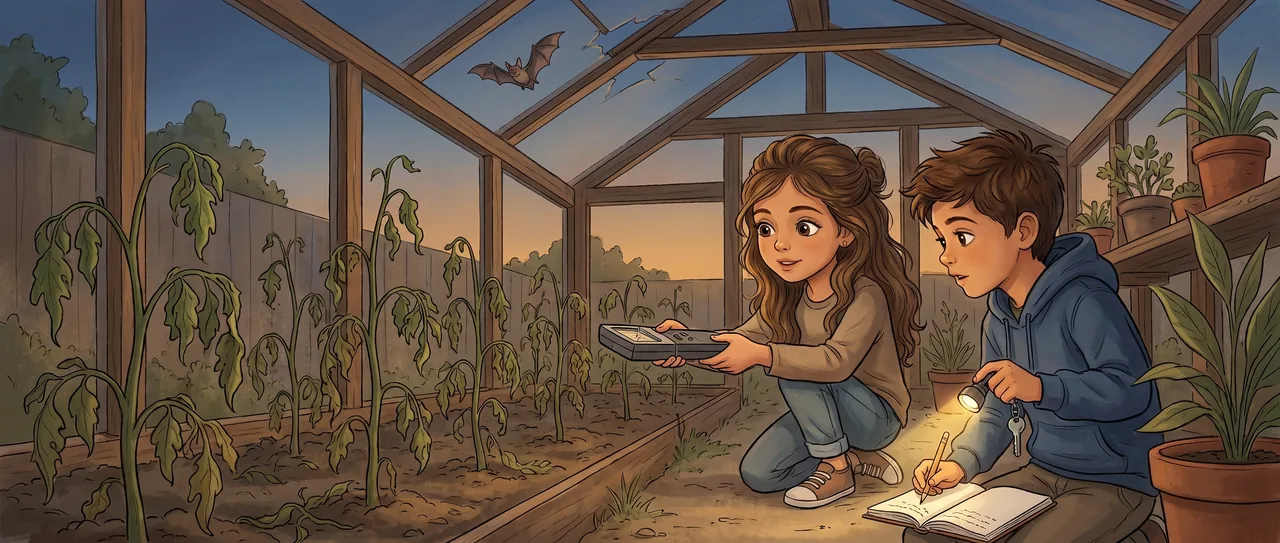
The Quiet Greenhouse
The bat detector was Soren's uncle's, and it came with one rule: do not drop it. So Maya was holding it like it was made of eggshell, both hands, elbows in.
"Bats come out when it gets dark," Soren said. "We have maybe twenty minutes of nothing."
"I hate nothing," Maya said.
They were sitting in the greenhouse because the mosquitoes were worse outside. It was the dry end of August. Soren's grandmother hadn't watered in days, said the well was low, said the tomatoes would survive on spite. The plants did look like spite. Curled leaves, drooping like they were tired of standing.
The detector hissed. It turned high sounds into low ones so human ears could borrow them. Right now it was just static, the sound of air not doing anything.
"Point it up," Soren said. "At the gap in the roof."
Maya pointed it up. Static.
Then she got bored, the way she did, and swung it down toward the tomato plants, not for any reason.
Click.
They both stopped.
"What was that," Maya said. It wasn't a question yet.
Click. Click.
"Move it back to the roof," Soren said.
She moved it. Static.
She moved it back to the plants. Click. A pause. Click-click.
"It's the plant," Maya said.
"It's not the plant." Soren leaned in. "Plants don't make sounds. It's a bug. There's a bug in the leaves."
"Show me the bug."
He couldn't show her the bug. He got the little flashlight off his keychain and went leaf by leaf, slow, the way he checked things. No bug. No cricket. No moth folded up sleeping. Just the dry curled tomato leaves and that smell tomato plants have, green and sharp.
Click.
"That one," Maya said, swinging the detector. "The droopy one in the corner. It's louder there."
Soren went and stood by the droopy one. Maya stayed where she was, pointing the detector at the healthy plant near the door, the one his grandmother had watered yesterday because it was her favorite.
"Mine's quiet," Maya said. "Almost nothing. Come point it at yours."
He took the detector. Held it four inches from the droopy plant, the way Maya had been holding it, careful. The clicking came in little runs. Not steady, not random either. Like popcorn at the very start, when it's deciding to go.
"Okay," Soren said slowly. "The thirsty one is loud. The watered one is quiet."
"The thirsty one is loud," Maya repeated. She wasn't looking at the plant. She was looking at nothing in particular, and then she said, "Do it again but tell me when each click happens. I want to know if it's the same plant making all of them or different ones."
They took turns. One held the detector, the other called out the plants by where they sat. The droopiest tomato, the one nobody had watered and nobody had moved, popped the most. Twenty, thirty little clicks while they counted. The watered one gave them three.
"So it's not a bug," Maya said. "Bugs don't care if a plant is thirsty."
"Some bugs do." Soren was being honest, not stubborn. "But not like this. Not in a line like this. Watered, quiet. Dry, loud. That's the plant, Maya. The plant is the difference."
Maya sat back on her heels. "Then what's clicking. It doesn't have a mouth."
Soren thought about it the way he thought about a leaky pipe. "It's drinking. All day. It pulls water up from the roots through these tiny tubes, all the way to the leaves. My uncle told me that. The whole plant is straws."
"Straws," Maya said.
"And when there's not enough water," Soren said, and he was talking slower now, finding it as he said it, "the straw doesn't have enough to pull. So you get a gap. A little bubble. An empty spot in the water where there should be water."
Maya looked at the droopy plant. "And the bubble pops."
"The bubble snaps. Inside the tube." He held the detector closer, and it clicked, and this time the click meant something. "That's it. That's the pop. It's so small and so high we can't hear it. But it's happening. It's been happening this whole time."
Maya was quiet for a second. Then: "Turn it off."
Soren turned it off. The greenhouse went silent. Completely silent. The kind of silent where you can hear your own ears.
"It's still happening," Maya said into the silence. "Right now. Every plant in here. The dry ones are popping like crazy and we're just sitting in it and it sounds like nothing."
"We don't have the ears," Soren said.
"Nobody has the ears." Maya's voice did a thing it did when something got big on her. "People have walked through gardens for the whole history of people. Through forests. Whole forests, Soren, in a drought, every tree screaming up in that range, and everyone thought it was quiet. Everyone said, oh, how peaceful."
Soren had taken out his notebook. His pencil moved down the page, watered three, droopy thirty-something, and then a row of little dots for the clicks he hadn't counted.
"My grandmother said the tomatoes would survive on spite," he said. "They're not. They're telling her. She just can't hear them."
Maya turned the detector back on and held it out flat over the whole row, slow, left to right, like she was reading a sentence. Click from the corner. Click. Click from the middle. The watered one, almost nothing. The dry ones, going and going.
"There's a whole channel," she said. "Up above us. All the time. And we found the dial."
A real bat came through the gap in the roof then, fast and small, and the detector caught its call and laid it down over the plant clicks, a high stuttering chirp riding on top of the popping. Two different things, both invisible, both there the whole time, and the little machine in Maya's hands turning them down low enough to borrow.
Soren reached over without a word and tipped the detector a few degrees toward the corner, toward the thirstiest plant, the loudest one.
Maya didn't move to water it. She just held the detector steady and let it pop, and pop, and pop, listening to the plant say the one thing it had been saying all summer to no one.
Read the interactive version, listen to the narration, and earn a gold star →
A science-verified short story for curious kids · Curiosity Land