The Fast Stone
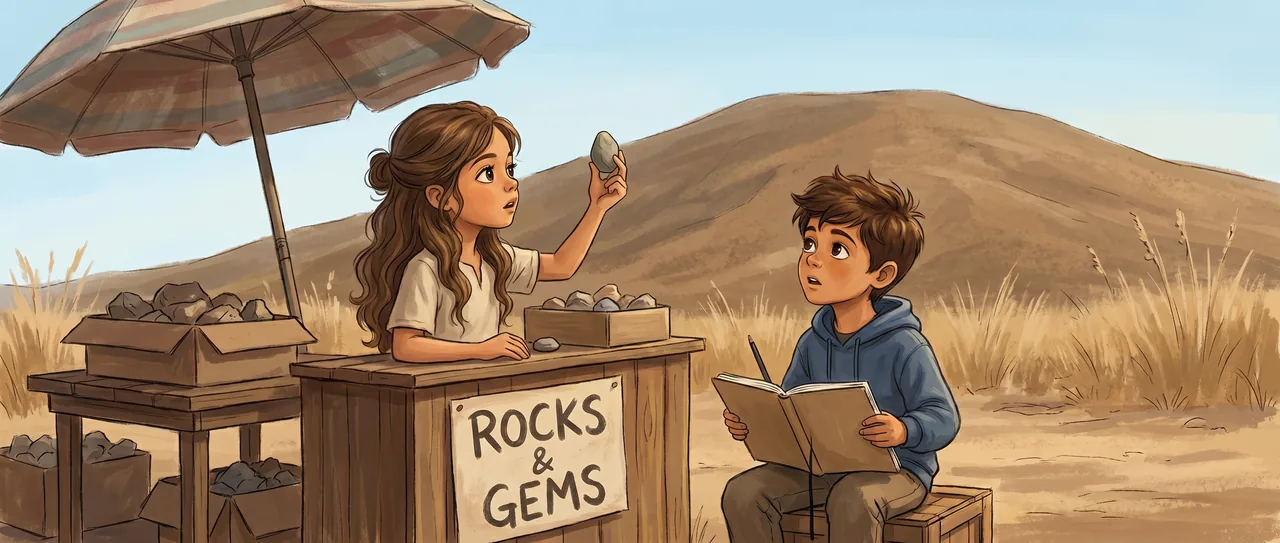
The sign over the stand said REAL ROCKS DIG YOUR OWN, and the woman running it was not paying attention to them at all. She was on a folding chair under an umbrella, reading a paperback, while Maya and Soren dug through a plastic bin of stones with sand still on them.
The spare tire was on the car now, but the bolts needed tightening at a real shop, so they were waiting. Maya held up a dull greenish lump.
"This one's heavy," she said.
"Everything's heavy in there," said Soren. He had a little card from the front of the bin. He read off it. "It says some of these came from a kimberlite pipe. Right here. The hill behind us."
"What's a kimberlite."
"A kind of rock. The card says diamonds come up in it." He turned the card over. "There's nothing on the back."
Maya looked at the hill. It was a regular hill. Brown grass, a few rocks, a fence.
"There's diamonds in that," she said. Not a question. A test of how it felt to say it.
"There were. They dug them out a long time ago."
Maya put the green lump down and picked up a smaller, harder stone. She rubbed the sand off with her thumb.
"Where do they come from before the hill," she said.
Soren checked the card again, though he already knew it wouldn't help. "Deep," he said. "That's all it says. Deep."
"How deep is deep."
"I don't know. Like, a mine. A few kilometers?"
Maya shook her head before he finished. She wasn't arguing. She just had a feeling the number was wrong.
"Ask her," she said, tipping her head at the woman.
Soren walked over. "Excuse me. How deep do diamonds form? Like the ones from your hill?"
The woman didn't look up from her book. "Deeper than anybody's ever dug," she said. "My granddad worked the pipe. He used to say the diamonds were older than the dirt and ruder than the weather." She turned a page. "That's all I got, hon."
Soren came back. "Deeper than anybody's ever dug."
Maya frowned at the hill. "Then how'd they get up."
That was the part. That was the thing that didn't fit. They both felt it at the same time, the way you feel a step that isn't there.
"If they form way under the deepest mine," Maya said slowly, "way under, then nobody carried them up. Nobody dug down to them."
"So they came up by themselves." Soren had his notebook out. His hand was moving. He drew the hill, then drew a line going straight down from it, and kept drawing, off the bottom of the page, onto the cardboard cover.
"How far down does it go," Maya asked.
"I'm guessing." He looked at the line. "The card says pipe. Pipes are skinny and long. If it's a pipe shape all the way down, and the diamonds are deeper than the deepest mine, the pipe has to be way longer than the hill is tall."
Maya crouched and put her hand flat on the ground. The dirt was warm from the sun, ordinary.
"Hundreds of kilometers," she said. She didn't know why she said hundreds. It just came out as the right size of number. "Like, more than you could drive in a morning. Straight down."
"You can't know that," Soren said. But he was writing it.
"I don't know it. It feels like it." She pressed harder, as if she could feel the bottom. "Something that deep is hotter than anything. And there's all the rock on top pressing it. That's what makes a diamond, right, squeezing?"
"Pressure and heat," Soren said. "That's the only way I've ever heard." He stopped writing. "But here's the problem. If it's that deep, that hot, that squeezed, how does the diamond get out without melting on the way? It's a long way up. Things melt."
They both looked at the hill again. The fence. The grass.
"Fast," Maya said.
"What?"
"It came up fast. If it came up slow it'd cook into something else. It has to come up so fast it doesn't have time to change." She stood up. "How fast does rock even go."
Soren wrote the word fast and then sat looking at it, doing the kind of arithmetic he didn't have numbers for. "To bring something solid up from hundreds of kilometers without it turning into mush," he said, "it'd have to come up faster than I think rock is allowed to go."
"How fast is rock allowed to go."
"I don't know. But there has to be a fastest. There's a fastest for everything."
Maya looked at the quiet hill, and her mouth was open a little. "Faster than sound," she said.
Soren laughed, the short surprised kind. "You can't just say faster than sound."
"Why not. You said there's a fastest. Sound's pretty fast." She pointed at the brown grass. "Right there. A skinny pipe, hundreds of kilometers down, and one time, the whole thing came up through it like a gun. Older than the dirt. The diamond's just sitting in the rock the whole way, holding still, while everything around it screams up faster than sound."
Soren stopped laughing.
He looked at the hill, and then he did the thing he does, which is check. He picked up the small hard stone Maya had cleaned. He turned it in the sun. It wasn't a diamond. It was just a stone.
But it had come up the pipe. Whatever it was, it had ridden that.
"The card says deep," he said quietly. "That's such a stupid word for it."
The woman turned a page under her umbrella. Somewhere down the road a tow truck was finally coming, but neither of them was listening for it.
Maya picked the stone out of his hand and held it up between two fingers against the brown hill, the way you'd hold up something that had just gotten off a train you couldn't see the end of.
Read the interactive version, listen to the narration, and earn a gold star →
A science-verified short story for curious kids · Curiosity Land