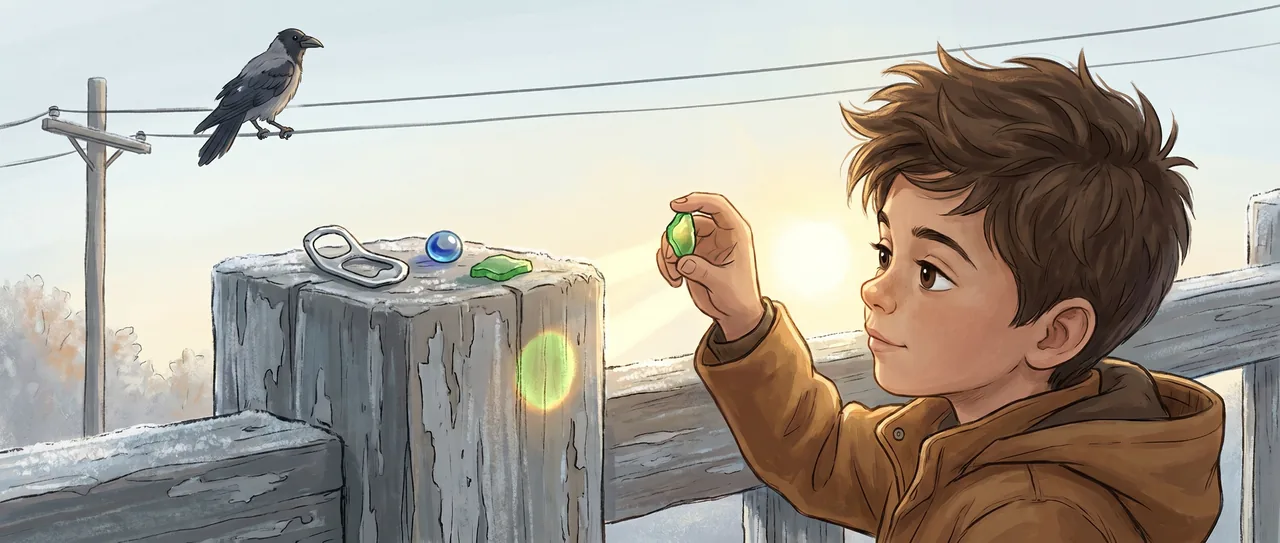
The Debt
The crow started screaming at Soren in September, and it did not stop.
It was one crow, he was almost sure. There was a notch in the left wing, a missing feather that made the edge look bitten. Every morning when he wheeled his bike out the side gate, the crow was on the power line, and it dropped its voice on him like a bucket of gravel. Other crows joined in. Six of them, then nine. They followed him to the corner. They did not follow his mother. They did not follow the mailman. They followed Soren.
He wrote down the dates. He wrote down the count. He could not write down why, because he did not know yet.
His mother said birds were just like that in fall. His mother was wrong, but she said it kindly, and she was busy, so he let it go.
What Soren did instead was think backward. The screaming started in September. So something had happened before September. He went through August in his head the way you go through your pockets when you have lost a key.
And he found it.
In August he had been clearing the gutter for his father, up on the aluminum ladder, and there had been a nest in the maple, low and sloppy, and a young crow half out of it making a racket. He had not touched the bird. But he had shaken the branch to see it better, and the fledgling had tumbled, and flapped, and an adult crow had come down at his head so fast he dropped the trowel and nearly fell. He had swung the trowel at it. Once. To get it away. He remembered the notch in the wing now, the bitten edge, going up past his ear.
He had not thought about it again. The crow had thought about nothing else.
Soren read for three nights. The library book said crows know faces. Not shapes, not clothes. Faces. Scientists had proven it by wearing masks, the same mask every time they bothered a crow, and years later, in different cities, crows still dive-bombed the mask. They told their children about the mask. Their children, who had never seen it happen, hated the mask too.
So it was not nine crows who were angry. It was one crow, and eight crows who trusted the first one enough to be angry on its behalf.
That was the part that kept Soren awake. The crow had a story about him. In the story, Soren was the danger. The crow had told it well enough that strangers believed it.
He could not explain himself. You cannot apologize to a bird. There was no sentence that would cross.
But the book said something else, near the end, in a paragraph he read four times. People who fed crows, regular people, ordinary backyards, sometimes got things back. A bottle cap. A button. A bent paper clip. A bead. Left on the railing, on the feeder, where a hand would find it. Nobody made the crows do it. They just did.
So there were two stories a crow could hold about a person. And maybe, Soren thought, the second one could be written over the first.
He started in October. Every morning, before the bike, before the screaming really got going, he put peanuts on the fence post. Unshelled. He did not look at the crow. He had read that too, that staring is what a hawk does, and he did not want to be a hawk. He set the peanuts down, kept his face soft and turned away, and walked back inside.
The first morning the crow screamed and did not come down.
The fourth morning it screamed less.
The ninth morning it took the peanuts after he left, and he watched from the kitchen window, and it watched the window the whole time it ate, the notched wing held a little open, ready.
The screaming did not stop. He wanted to be honest about that in his notebook, so he wrote the truth. Less. Not gone. The crow still announced him at the gate. But it announced him the way you announce someone you are keeping an eye on, not someone you want gone. The other eight stopped coming. Their part of the story had run out. Only the one with the real memory stayed, because only it had really been there.
November got cold. The peanuts kept going out. Soren stopped expecting the screaming to end and started simply living alongside it, the way you live alongside a clock.
Then one morning the fence post was not empty when he came to fill it.
There was already something on it. Right on the flat top of the post, in the center, where his hand would go.
It was a pull tab from a can, the old kind, bent into a rough circle. Beside it, a chip of green glass, worn smooth at the edges, the kind the ocean makes but there was no ocean for two hundred miles. And a single blue bead. Up on the line, the crow with the bitten wing watched him. It did not scream. It made a low sound he had not heard before, a soft knocking in the throat, almost private.
He did not take the gifts right away. He understood that taking them was a sentence too, and he wanted to say it correctly. He set down the peanuts first, beside the bead, the glass, the bent tab. Then he picked up the green glass and held it where the crow could see it, where the morning light went through it and threw a small green coin onto the gray wood.
The crow shifted its feet on the wire.
Somewhere two streets over, another crow called, and his crow turned its head a quarter turn to listen, then turned it back to Soren, and Soren realized he had no idea what it was saying about him now, in the language he would never have, to birds he would never meet.
He put the glass in his pocket. He left the bead on the post.
The crow dropped down the moment he stepped back, landed beside the peanuts, and for the first time in two months it ate while Soren was still standing there, both of them in the cold, neither one looking away.
Read the interactive version, listen to the narration, and earn a gold star →
A science-verified short story for curious kids · Curiosity Land