The Number That Won't Come
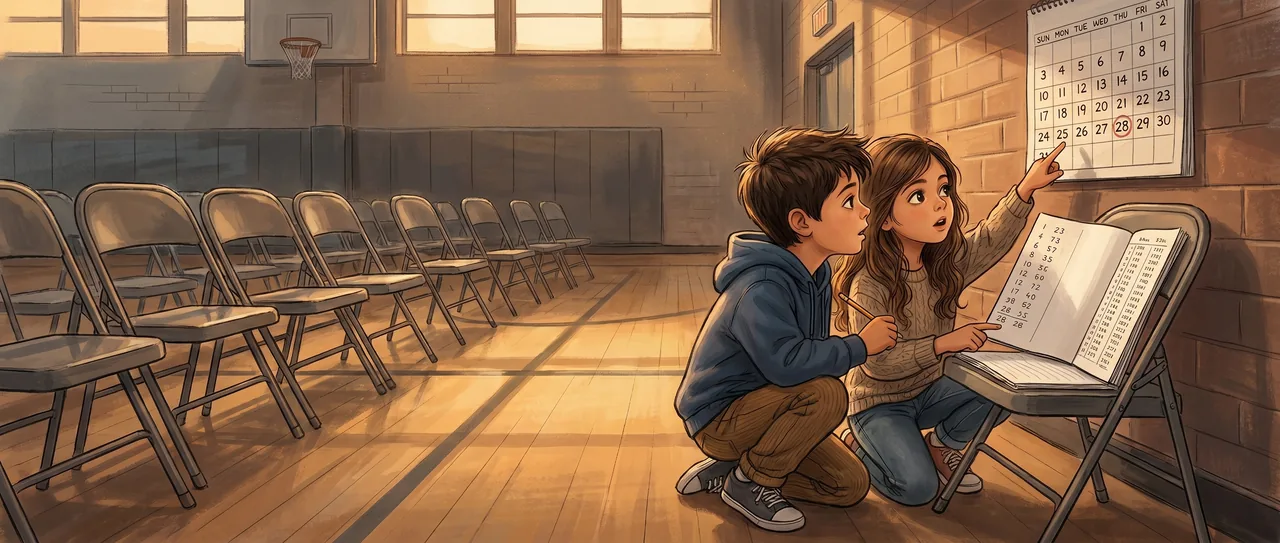
The gym was empty except for two hundred folding chairs and the two of them, and Soren had stopped working.
"You stopped," Maya said. She had a stack of chairs leaning against her hip.
"Look at the date. Twenty-eight."
"It's the twenty-eighth. That's why the show is on the twenty-eighth."
"Twenty-eight is special," Soren said. He set down the chair he was holding. "Add up everything that divides into it. Not itself. Just the smaller ones."
Maya was already doing it. "One, two, four, seven, fourteen." Her lips moved. "Twenty-eight."
"It adds up to itself."
"That can't happen a lot."
"It doesn't," Soren said. "Six does it too. One plus two plus three."
Maya sat down on the chair she was supposed to be carrying. "Okay. Six. Twenty-eight. What's next?"
"That's the thing. They jump." Soren had his notebook out and his pencil was already moving down the page. "After twenty-eight the next one is four hundred ninety-six."
"You memorized that?"
"The Greeks memorized that. It's old. People were doing this thousands of years ago." He wrote the divisors of four hundred ninety-six in a column and started adding. Maya leaned over to watch.
"One, two, four, eight, sixteen," she read. "Then it goes weird. Thirty-one."
"Thirty-one, sixty-two, one twenty-four, two forty-eight." Soren's pencil reached the bottom. "Four hundred ninety-six."
Maya laughed, surprised. "It does it again."
"They're called perfect numbers. That's the actual name."
"Six, twenty-eight, four ninety-six." Maya counted them on her fingers like they were a small rare set of animals. "All even."
Soren stopped.
He didn't say anything for a second, which made Maya look up from her fingers.
"What," she said.
"They are all even."
"So?"
"So is the next one. And the next one." He flipped back a page where he'd written more of them, longer ones, a number with three digits and then one with four. "Every single perfect number anyone has ever found is even."
Maya put her feet up on the chair in front of her. "Then find an odd one."
"That's the thing," Soren said again, slower this time. "Nobody has."
"Nobody's looked?"
"Everybody's looked. For two thousand years. With paper and with computers that check numbers so big you couldn't write them down in your whole life." He turned the pencil over in his fingers. "And nobody knows if there is one."
Maya took her feet down.
"Wait," she said. "Not nobody's found one yet. Nobody knows if it's possible."
"Right."
"Those are different."
"Really different," Soren agreed.
Maya stood up. She walked three chairs down the row and turned around, the way she did when an idea wouldn't sit still in her body. "Okay. So either there's an odd perfect number out there, hiding, bigger than anything anybody's checked. Or there isn't one, ever, and there's a reason, and nobody's found the reason either."
"That's the whole question. That's it exactly."
"And it's just sitting here." She pointed at the calendar on the wall like it had been keeping a secret. "On the gym wall. The twenty-eighth."
Soren wrote down something. Maya watched his hand cross the page.
"Try it," she said. "Try to make an odd one. Just see."
"You can't just try, there's infinite numbers."
"Try a small one. Try the small odd numbers. Maybe everybody missed something obvious."
Soren looked at her, and she could tell he knew everybody had not missed something obvious, and she could also tell he wanted to do it anyway. He started a new column.
"Nine," he said. "Divisors are one and three. Adds to four. Too small."
"Fifteen."
"One, three, five. Nine. Too small."
"Twenty-one."
"One, three, seven. Eleven. Too small." His pencil was going faster now. "Odd numbers keep coming up short. The pieces don't add up to enough."
"So make a bigger odd one. One with lots of divisors."
"Forty-five. One, three, five, nine, fifteen." He added. "Thirty-three. Still short."
"It's always short."
"Not always. Some odd numbers go over. Like, way over." He scratched out a number. "They just never land exactly on the number itself. They miss. High or low. Never the middle."
Maya came back and sat down next to him, close, looking at the columns of numbers that came short and the columns that went long.
"That's so strange," she said quietly. "It's like there's a gap that an odd number can't stand in. But nobody can prove the gap is really there."
"Right."
"Maybe it's there. Maybe right past the part anyone's checked, an odd one is standing in the gap, waiting."
Soren put his pencil down.
"You know what gets me," he said. "Six and twenty-eight are so small. A kid can find them. They were found before anybody had a single machine. And then there's this question hooked onto them that the smartest people who ever lived couldn't answer."
"On the same numbers."
"On the same numbers. The easy thing and the impossible thing are the same thing."
Maya was quiet. Then she said, "I always thought the hard questions were the big complicated ones. The ones you need a lab for."
"This one you need a pencil for. And it's still open."
"It's still open," she repeated. She liked the words. They didn't sound like a wall. They sounded like a door someone forgot to close.
The gym doors banged. Mr. Avery, who ran the talent show and worried about everything, leaned in.
"Chairs," he said. "We have forty minutes. Why are you sitting?"
"We found something," Maya said.
"You found chairs, I hope." He looked at the half-empty rows, sighed, and pointed at the stacks. "Twenty-eight more in row C. Go."
He ducked back out. He had not asked what they found. He had a show to run, and to him the twenty-eighth was just the day it happened on.
Maya stood and picked up a chair. Soren picked up the notebook instead.
"Twenty-eight more in row C," she said, and started counting them out under her breath. "One, two, four, seven, fourteen."
Soren laughed.
"That's only five," he said.
"I know." She snapped open another chair and set it in the row. "Add them up."
She kept setting out chairs, one perfect divisor at a time, while Soren wrote down the odd numbers that came short and the odd numbers that went long, leaving a clean space in the middle of the page where, so far, no number on Earth had ever been allowed to stand.
Read the interactive version, listen to the narration, and earn a gold star →
A science-verified short story for curious kids · Curiosity Land