The Borrowers in the Drainpipe
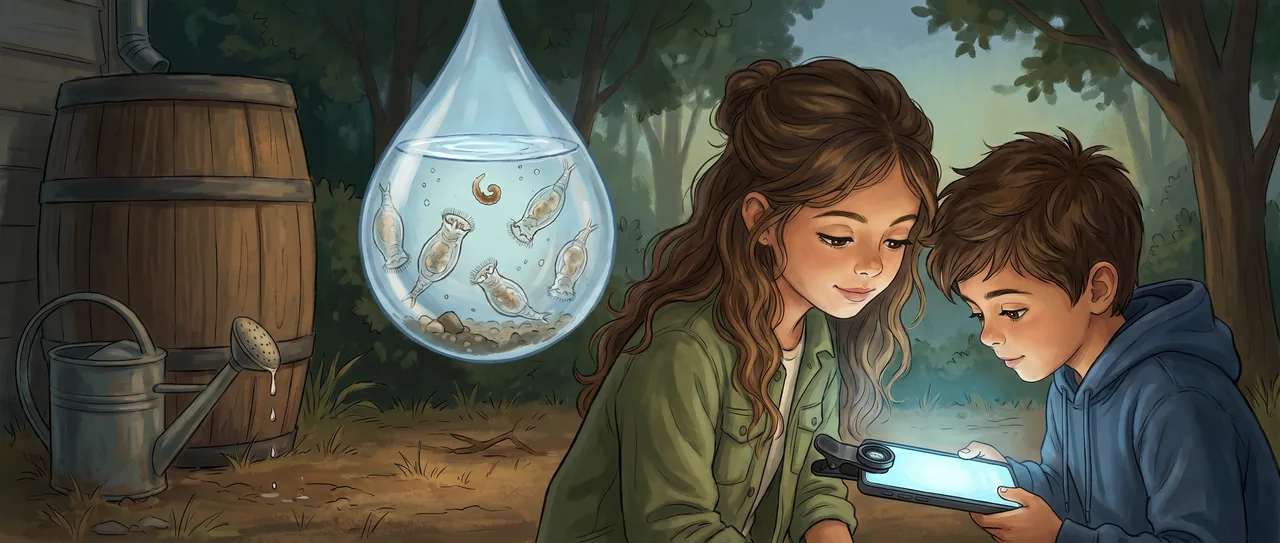
The gutter had been dry for six weeks. Soren scraped a flake of the brown crust into a jar lid and added a drop from the watering can.
"It's basically dead," Maya said. "Nothing lives in dust."
"Then we wasted a Saturday." Soren clipped the little plastic microscope onto his phone and held it over the lid. "Hang on."
They waited. Maya watched the screen over his shoulder, breathing on his neck.
"There," she said. "That. The little log that's bending."
Something wormed across the screen, fat in the middle, with what looked like two spinning wheels on its front end. The wheels weren't really wheels. They were rings of tiny hairs whirling so fast they only looked like they turned.
"It was dead a minute ago," Soren said. "It was a crumb of dried gutter. We added water and it just. Started."
"More than one." Maya pointed. Three of them now, then five, churning through the drop. "They're everywhere in there."
Soren pulled out his notebook and drew the wheels, then the fat body, then a line where the foot anchored to a speck of grit.
"Rotifer," Maya said. She'd seen the name somewhere. "Wheel animal. My cousin's biology poster."
"How does a thing dry out completely and come back?"
"It doesn't die. It just pauses." She frowned at the screen. "Okay, but watch them. Do you see a difference between any two of them?"
Soren looked. He looked for a while. "No. They're identical."
"Not similar. Identical. Same size, same shape, same everything." Maya straightened up. "That's weird. Look at us. Look at any two people. Two dogs. Two of anything that has babies the normal way. They don't match like that."
"Maybe it's the same one swimming in circles."
"No, there's five. There's six now." She chewed her thumb. "Where are the males?"
Soren scrolled the drop slowly, hunting the way he hunted for the one broken Christmas light. Fat one. Fat one. Fat one. Smaller one, same shape. Fat one.
"I don't see two kinds," he said. "With ladybugs you can see two kinds if you look. Frogs. Everything's got two kinds."
"What if there's only one kind."
"There has to be two. That's how you get eggs." Soren said it and then heard himself say it. "I think. That's how I thought it worked."
Maya was already somewhere ahead of him. "What if they're all girls. Every single one. And they just lay eggs that hatch into more girls. Copies."
"Then they'd all be exactly the same." Soren looked at the screen again, at the six identical wheel animals. "Which they are."
They sat with that. A bird argued in the maple. The watering can dripped.
"Okay but that's broken," Soren said finally. "That doesn't work. My dad explained this once. When you only copy yourself, the copies pick up mistakes. Little typos in the DNA. And there's no second parent to cover the typo with a good version. So the typos pile up, copy after copy, and eventually the whole line falls apart. He said that's basically why there are two kinds of anything. To fix the typos."
"So a thing that's all girls should have died out."
"Long ago. Like, immediately ago."
Maya looked at the six of them spinning, fat and patient, pulling specks toward their mouths. "But they didn't. They're right here. In our gutter."
"Maybe they invented them. Maybe it's a new thing."
"They don't look new." She didn't know why she said it. But the shape of them, the worn-down ordinary efficiency of them, didn't feel like an experiment. It felt like something that had been getting it right for a long, long time.
That night Soren looked it up, and called her, and read it out loud with his voice going strange in the middle.
"Bdelloid rotifers," he said. "All female. Every one that anyone has ever found. For sixty million years."
"That's not possible. The typos."
"That's the part. Listen. They fix the typos. But not with a second parent. They steal."
"Steal what?"
"DNA. When they dry out and crack open a little, and then come back, bits of DNA from other things get inside them. Bacteria. Fungus. Other rotifers. And they keep it. They patch their own instructions with pieces of whatever they meet." He was reading faster now. "Almost a tenth of their genes came from completely different kinds of life. They're stitched together out of the neighborhood."
Maya stood up in her dark room. "So the one we watched."
"Has bacteria in it. Has fungus in it. Has bits of who knows what, glued into a creature that should not still exist, that is older than almost anything, that figured out a completely different way to keep going."
"It didn't need a second parent." Maya was walking circles now, the way she did. "It used the whole world as the second parent."
Neither of them said anything for a second.
"There's a girl in my class," Maya said. "Priya. People say she copies. Off the internet, off books, off whoever. Like it's the worst thing."
"Yeah."
"But that's the same thing. That's exactly the thing. You take a good piece from over here and a good piece from over there and you make something that lasts because of all the places it came from." She stopped walking. "That's not broken. That's the trick. That's the actual trick for staying alive sixty million years."
Soren was quiet on the other end. She could hear him writing.
"We added one drop of water," he said. "To a crumb of dead gutter."
"And it had bacteria genes in it. From some bacteria that's probably dead now. That little log is carrying around a piece of something that lived and died before we were born and gave it away without knowing."
The next morning Maya rode over before he'd finished breakfast. They went straight to the jar lid. Soren had left it out. It had dried solid overnight, brown and cracked and lifeless again.
"They're paused," Maya said.
Soren filled the dropper from the watering can. He held it over the dead crust, looked at her, and she nodded.
The drop fell, spread into the cracks, and went dark as it soaked in. Through the little lens, in the wet, a curled brown speck slowly unbent itself and began to turn its wheels.
Read the interactive version, listen to the narration, and earn a gold star →
A science-verified short story for curious kids · Curiosity Land