The Booting
Soren got to the lab forty minutes before anything happened, which was the part nobody else wanted to watch.
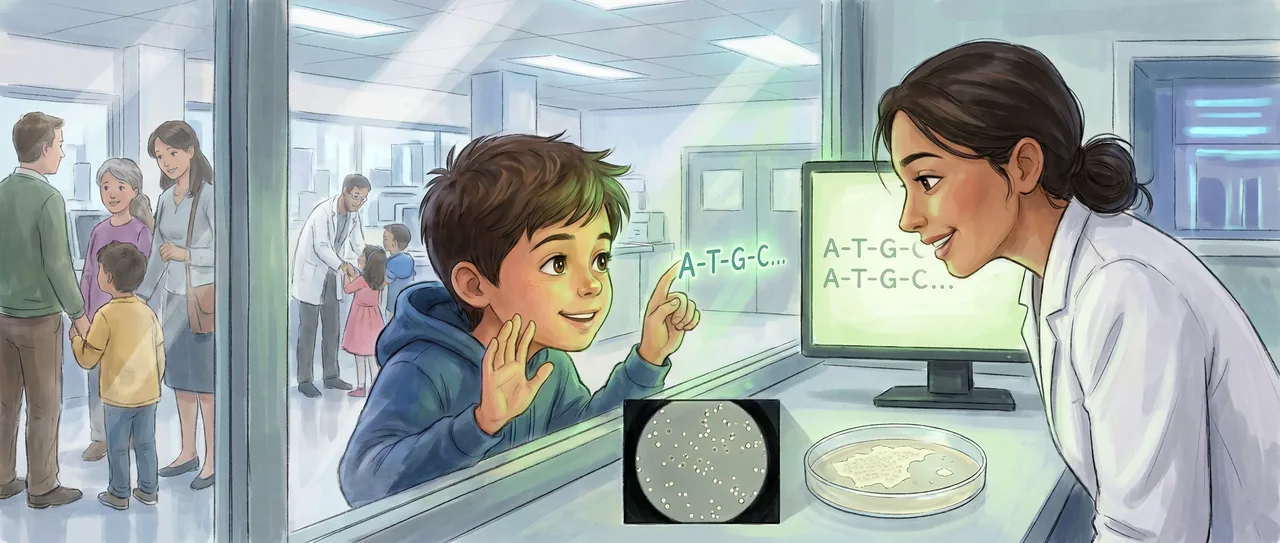
His aunt Reka was on the other side of the glass in a white coat, doing something slow with a tray of tiny tubes. Everyone else in the family room had drifted toward the snacks and the screen that played a cheerful video about the future of medicine. The video had a soundtrack. Soren turned his back on it.
On the bench, under a camera, sat a dish. Reka had pointed at it on her way in. That one, she said. Watch that one.
Soren wrote down the time. Then he wrote down what the dish looked like, which was nothing. Clear jelly. A pale smear near the center, so faint he wasn't sure he wasn't inventing it.
Reka came to the speaker by the glass. "You found it," she said.
"There's nothing in it," Soren said.
"Not yet."
"What's supposed to be in it?"
Reka smiled the way she did when a question was better than she expected. "A genome we typed," she said. "On a computer. Every letter. Then a machine built the actual DNA to match, one chunk at a time, and we stitched the chunks into one whole loop. A whole chromosome. Nothing alive made it. We did."
Soren looked at the faint smear. "So it's a recipe."
"It was a recipe," she said. "This morning it was a file. Then it was a chemical. We put it inside an empty cell, one we'd hollowed out, and took its old instructions away."
"And then?"
"And then nothing, for a while. That's where we are. The waiting part."
She went back to her tray. Soren stayed at the glass.
He knew the fact already. He'd read it months ago, the headline about a cell running on a synthetic genome, and he'd thought, all right, that's amazing, and filed it. Knowing a thing and standing in front of it turned out to be different jobs.
Because here was the part the headline hadn't made him feel. The dish was not a machine. Nobody was going to flip a switch. If anything happened, it would happen because the written-down instructions, the ones that started as letters someone chose on a keyboard, were now being read. Read by what? There was no reader in there. There was just the loop of DNA and the empty cell around it and chemistry doing what chemistry does when the right molecules touch.
The code didn't need a mind to run it. It ran itself. That was the whole trick. That had always been the whole trick, in him too, in the cells making his fingers grip the pen, except those instructions had been copied from a parent, copied from a parent, back and back for billions of years, never once written fresh.
This one had been written fresh.
Soren put his face close to the glass and watched the smear.
A cousin wandered over, chewing. "What's it doing?"
"Maybe nothing," Soren said.
"Boring." The cousin wandered off.
Soren checked the time, wrote it, checked the smear. He did this six separate times, the way he did things when he didn't trust himself yet. The first three times he could have argued it was the same. The fourth time he couldn't.
The smear had an edge now. A definite edge, where before there had been a guess.
"Reka," he said into the speaker. He kept his voice flat so he wouldn't be wrong loudly. "The edge is sharper."
She came over fast, not slow this time. She looked at the dish, then at the camera feed on the monitor beside it, which showed the same smear blown up huge, a continent of pale dots where this morning there had been clean nothing.
"Those are cells," she said quietly.
"From the recipe."
"From the recipe." She let out a breath. "Each one of those dots is a colony. Millions of cells. And every single one is descended from the cells that booted up off the loop we typed. They've been dividing for hours. That's what made the edge you saw. That's them eating and splitting and making more of themselves."
Soren looked at the continent of dots.
"So they're copying it now," he said. "Our letters. They're copying the file by themselves."
"Every time one divides, yes. It reads the loop, builds a second loop, splits in two."
"Forever?"
"As long as we feed them. They don't know they were written. They just are."
Soren stood very still in front of the glass. Behind him the cheerful video reached its swelling music part, the part about a brighter tomorrow, and it sounded thin and far away, like something playing in another building.
Because the thing in the dish was not in a tomorrow. It was now. Somebody had sat at a keyboard and decided, letter after letter, what a living thing would be, and the living thing had agreed to be alive about it. The line he'd always half-believed in, the line between the written and the breathing, between instructions and the thing the instructions made, that line had a dish sitting on top of it, and the dish was getting cloudier while he watched.
He thought about his own loops. The ones copied down through everybody who had ever been his family, never typed, only inherited. And these, typed once, that would now be inherited forever by cells that had no ancestors, only an author.
"Can I see the file?" he asked. "The actual letters. The ones you typed."
Reka pulled it up on the monitor. It scrolled. A, T, G, C, A, A, T, on and on, faster than he could read, a river of four letters that did not stop.
"How long is it?" Soren asked.
"Longer than you'd want to read aloud."
He read it aloud anyway, the first line of it, quietly, under the music. His finger moved along the glass over the letters as they climbed.
In the dish below, without anyone telling them to, the cells kept saying the same thing back.
Read the interactive version, listen to the narration, and earn a gold star →
A science-verified short story for curious kids · Curiosity Land