The Blue Smoke That Holds
The box said FROZEN SMOKE in a dead man's handwriting.
Maya had it open before Soren finished reading the label. Inside, packed in cotton, sat a blue-gray brick the size of a sandwich. It did not look like a brick. It looked like a piece of the sky had thickened and someone had cut a corner off.
"It's your great-uncle's," said Soren. "You should ask before you pick stuff up."
"He's not going to mind." Maya lifted it. Then she stopped. "Soren."
"What."
"It doesn't weigh anything."
"Everything weighs something."
"Hold it."
He held out both hands the way you hold something heavy, braced. She set it down. His hands jumped up an inch because his muscles had guessed wrong.
"Okay," Soren said quietly. "That's wrong."
"It's like holding a held breath."
They turned it in the light from the garage window. It had no edges, exactly. It went hazy where it ended, like fog deciding whether to be a thing.
"Look through it," Maya said.
He looked. The wall behind it went faintly blue, the way a far-off mountain goes blue when there's a lot of air between you and it.
"It's doing that on purpose," he said. "The blue. There's something about the way light scatters." He set it on the workbench and got out his notebook. He drew the brick, then drew an arrow to the blue and wrote scatters short colors, like sky?
"If it's that light," Maya said, "it's basically nothing. So it should squish." She pressed one finger on top, gently, the way you test a cake.
It did not squish.
She pressed harder. Her whole hand. She leaned.
"Maya."
"It's holding me." She lifted her hand and stared at it. "It's holding my whole arm and it weighs less than a marshmallow. That's two wrong things. Lightest thing in the box and it won't break."
Soren wrote down two wrong things and underlined it twice. Then he stopped underlining.
"What if it's the same wrong thing," he said.
"What do you mean."
"I mean." He picked up the brick again, carefully, and this time he wasn't braced and his hands didn't jump. "What's it made of?"
"Glass, kind of? It feels like glass dust."
"Right. So imagine glass. Now imagine almost all of it is gone and what's left is just the skeleton. Like a sponge but the holes are way smaller. And the holes are full of "
"Air." Maya said it before he got there. She did that. "It's mostly air. It's a brick of air with a tiny bit of glass holding the air still."
"That would make it light."
"And the glass skeleton makes it strong." She put her hand back on top and pressed and watched it not move. "The air does the floating, the glass does the holding. Same wrong thing. You were right."
Soren felt the thing he always felt when she got there first and was glad about it instead of sour, which some kids never understood about him. "It's barely anything," he said. "It's almost not here. And it's the strongest thing in this whole garage."
They both looked at it differently after that.
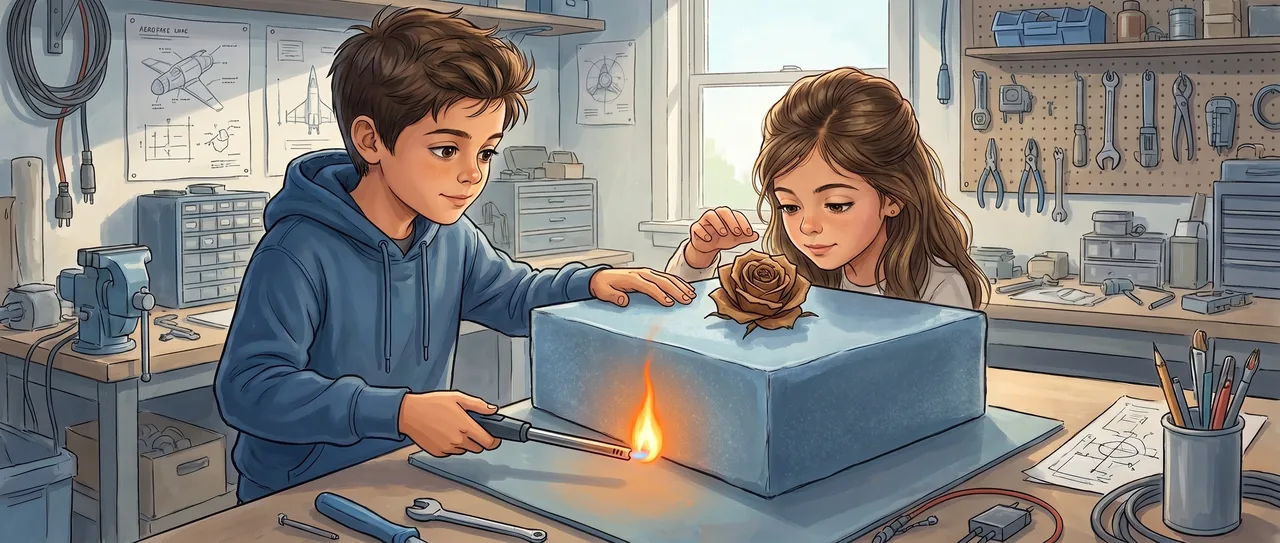
There was a smaller box behind the first one. Maya found a butane lighter in the workbench drawer, the long kind for grills, and a dried rose somebody had saved, brown and crisp.
"No," said Soren.
"There's a note." She held it up. It was the dead man's writing again. It said: flame one side, flower the other. don't be afraid.
Soren read it three times. "He wrote that for whoever opened the box."
"He wrote it for us."
"He didn't know it'd be us."
"He knew it'd be somebody who opened the box marked FROZEN SMOKE instead of throwing it out," Maya said. "That's us. That's exactly us."
Soren didn't argue, because she was right, and because something in his chest had gone tight in a good way.
They set the brick on the bench. Maya laid the dried rose on top, dead center. Soren clicked the long lighter and held the flame under the bottom, the way the note said. His hand shook a little.
"The flower's going to burn," he said.
"He said don't be afraid."
"He's dead, Maya, that's easy for him to say."
But he held the flame steady. The blue brick glowed orange where the fire touched it. The orange did not climb. It sat at the bottom like the fire had run into a wall it couldn't see.
Maya put her face down level with the rose. "Soren. Touch the top. Next to the flower."
He kept the flame going and reached up with his other hand and touched the top of the brick, an inch above where fire was roaring against the bottom.
It was cool.
Not warm. Not even room temperature. Cool, like the shady side of a stone.
"The heat isn't coming through," he said. His voice did something funny. "There's a fire right there. I can see it. And the heat just. Stops."
"The air," Maya said. "The heat can't get across all that air. It has to crawl through the little glass threads and there's almost no glass to crawl through." She reached out and touched the rose. The dried petals were dry and cool and exactly as dead as before. "It's the same wrong thing again. Third time. The air holds the heat back the way the glass held my hand up."
Soren let the flame go out. The orange faded out of the brick. The rose sat there, unburned, on top of fire that had already stopped existing.
"He knew," Soren said. "He spent his whole life on this, probably, and he knew the only thing to tell us was don't be afraid, and then just let the fire prove it."
Maya picked up the rose. Under it, where the flame had been seconds ago, the top of the brick was cool enough to rest her palm on flat, and she did, and her hand stayed there, on a piece of the sky that weighed nothing and held everything and would not let the fire across.
Soren looked at the empty box and the cotton and the careful handwriting, and then he picked up the lighter again to do it one more time, because once was not enough to believe it.
Read the interactive version, listen to the narration, and earn a gold star →
A science-verified short story for curious kids · Curiosity Land