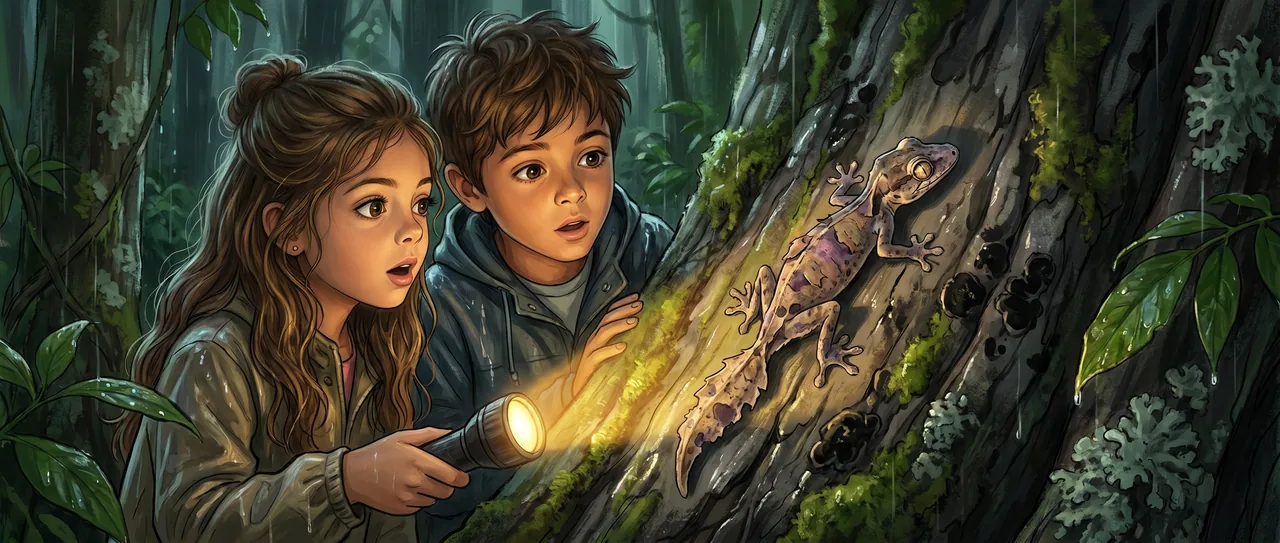
The Tree That Wasn't All Tree
The torch made a yellow coin of light on the bark, and Maya kept moving it because moving it felt like doing something.
The trunk was wet. Not raining, but everything in this forest held water the way a sponge does, slow and patient, and the air smelled like green things breaking down into other green things. Maya's mother stood ten steps back, talking quietly into a recorder about moth counts. She had said, before they came out, do not touch anything, and look with your eyes first. That was the whole of her help. She was here for moths.
"The guide said this tree," Soren whispered. "This exact one. He marked it."
There was a smear of pink chalk on the bark, already half washed away. Above it, nothing. Bark and lichen and a black crusty patch that looked like a bruise on the wood. A line of pale fungus. A torn place where something had chewed the bark long ago.
"There's nothing here," Maya said.
But she did not move the torch.
She had a list in her head of things that were not adding up, and at the top of it was this: the guide did not seem like a man who got lost. He had pointed at this trunk the way you point at a thing, not the way you point at where a thing used to be.
Soren leaned close. His breath fogged a little in the torchlight. "Where would you be," he said slowly, "if you were the size of my hand and you did not want a bird to eat you."
"Flat," Maya said. "Pressed flat."
"And the part of you that gives you away is your edge."
"Your shadow," Maya said. "The little dark line where you stop and the tree starts."
They both looked at the bark for the place where something stopped and the tree started. And the trouble was, the bark did not seem to have edges. It had the bruise. It had the pale fungus. It had the chewed place, the torn place, the lichen in grey-green coins.
Maya put her finger near the chewed place, not touching, just hovering, the way you hover a hand near a candle to feel if it is still warm.
"Don't," Soren said, but soft, not a warning, more like he was holding his own breath for her.
The chewed place was breathing.
It was so small a movement that Maya thought the torch had shaken. She steadied her wrist against the wet trunk and watched the spot where the bark looked torn, and it rose, and it fell. The bruise rose and fell with it. The pale fungus rose and fell. The whole patch of tree, an arm's length of it, was going in and out like a chest.
"Soren," she breathed.
"I see it."
He did not see it. She could tell by his eyes that he was looking at the breathing and still not finding the animal, because there was no line, no edge, no place where the gecko ended. She moved the torch sideways so the light came in low and skidded across the bark, and that was when the shadow appeared, a thin fringe of skin all along the thing's body, pressed so close to the trunk that it threw no shadow at all when the light was straight, and threw a hair-thin one now.
"The fringe," Soren said. The word came out cracked. "It's a fringe. All around it. It fills in its own outline. It doesn't have an edge because it erases its edge."
Now that they had the fringe they had the rest. The bruise was the gecko's flank. The torn chewed place was a flap of skin that hung loose exactly like damaged bark hangs loose. And the dark patches down its tail, the ones that had looked like the black crusty fungus on every other trunk in the forest, sat in the same blotched shapes as the real fungus an arm's length away.
"It's copying the fungus," Maya said. "Not bark in general. That fungus. The kind that grows here."
Soren had gone very quiet.
"Maya. The bird it's hiding from has been looking for millions of years. A bird whose whole job, whose whole family forever, was finding geckos. And it can't find this. We're standing here knowing it's here and pointing the light right at it, and we still nearly walked away."
Maya thought about the bird. A bird with eyes far sharper than hers, eyes built across an unimaginable stretch of time for the single purpose of seeing through exactly this trick. And the gecko had answered the bird's eyes with the chewed flap, the false fungus, the edge that wasn't an edge, building a counterfeit tree out of its own skin, detail for detail, until the sharpest hunter in the canopy looked straight at dinner and saw lumber.
"It's not hiding from us," she said. "We're easy. It's hiding from something that can really see."
The enormity of that sat on her chest. Every fleaf and bruise and torn patch and crust of fungus on this whole tree, on every tree, suddenly might not be the tree. The forest doubled. Half of it was bark and half of it was things that had spent forever learning to be bark, so well that the very best eyes in the world had given up.
"How many," Soren whispered, and did not finish, because the answer was on every trunk in every direction, breathing or not breathing, and there was no way to know which.
Maya's mother called softly that she had her moths, that it was time.
Neither of them answered. Maya lifted the torch and ran its yellow coin slowly up the trunk above the gecko, across a patch of pale fungus, a bruise, a torn place where something had chewed the bark long ago.
The torn place rose, and fell, and rose.
Read the interactive version, listen to the narration, and earn a gold star →
A science-verified short story for curious kids · Curiosity Land