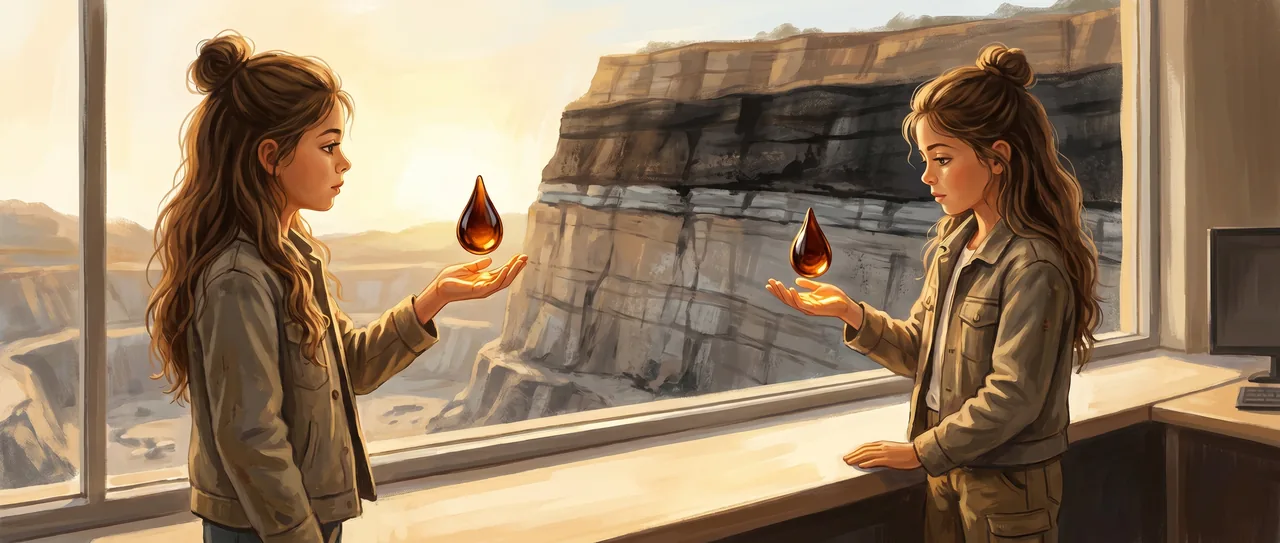
The Glass That Fell Up
Aunt Reza ran the quarry office out of a metal shed that smelled like cut stone and burnt coffee. She was always behind on labeling, always saying she would catch up Sunday, and it was already Sunday.
"Touch nothing in the drawers," she said, which Maya understood to mean the drawers were the interesting part.
Maya opened the bottom one first. Inside, in a cracked plastic tray, sat a handful of black beads. Round. Some teardrop-shaped, with little tails, like frozen drips. They were too smooth to be gravel and too dark to be anything that had grown.
"Those came from the gray seam," Aunt Reza said without looking up. "The thin one. Customers think it's just a clay layer so I price it as fill dirt."
Maya rolled one bead between two fingers. Glass. It had the cool slide of glass. But glass came from furnaces, and nobody had built a furnace under a hill.
"How does glass get into the ground," she asked.
"It melts and cools," said Aunt Reza, stamping a label crooked and not fixing it. "Volcano, lightning, that kind of thing. Now stop interviewing me."
Maya took three beads to the window. A teardrop one had its tail pointing the same way as the others when she lined them up. She lined them up again. The tails wanted to point one direction.
Lightning glass, she had read, was rough and branched, like roots. These were not roots. These were drops. A drop got its shape from falling. From falling through air, fast and hot, pulling itself into a tear.
But a volcano threw rock up and the rock fell back down close by. The gray seam ran for miles. Aunt Reza had said so, complaining about it.
Maya carried the tray outside to the cut face of the hill, where the layers stacked up like pages in a wet book. Yellow stone. Pale stone. Then a thin gray line you would miss if you weren't already annoyed by it. Above the gray, more pale stone, but the first inch above the line was rusty and dark, almost burnt.
She pressed her thumbnail into the burnt inch. It smudged sooty. Like a thing that had been on fire.
The gray seam. The burnt inch right on top of it. The glass drops inside it, all their tails combed the same direction, as if they had fallen out of one sky at one moment everywhere at once. "How long is the gray seam," she said. "The whole thing. Not just here."
Aunt Reza sighed, but she came. "It's in every quarry I've worked. State over. My friend in another country sends me pictures of the same gray nothing. We joke it's the world's least valuable rock." She squinted at Maya. "Why."
"Because it can't be a volcano," Maya said. "A volcano is one place. This is everywhere."
Aunt Reza stopped joking.
"And it's glass," Maya went on, faster now, holding up a teardrop. "Drops. They fell. They were soft when they fell, soft and hot, so they made tails. And the line on top is burnt. The whole inch." She looked at the seam running off into the hillside, into the next hill, into the rumor of every quarry in the world. "What's big enough to throw burning glass at every country on the same day?"
Aunt Reza didn't answer, because she didn't have the answer, and Maya could tell she didn't, and that was somehow better than if she had.
Maya sat down in the quarry dust and worked it out the way you work out a problem you already half know.
Glass meant heat. Drops meant flying through air. Tails combed one way meant they all came from a single throw, a single place, hurled so hard the pieces went up past the air and then fell back down spread across the planet. The burnt inch meant that when they landed, glowing, the whole sky was raining fire, and everything that could burn, burned.
And then. The gray. The thick boring gray nobody would buy.
Gray was after. Gray was the dust that doesn't burn, the dust that just hangs. Ash and rock crumbled to powder, thrown so high it covered the sun. Not for a day. The seam was too thick for a day. Years of gray. Years of a sky with no light getting through.
Maya picked up a pinch of the gray and let it run out of her hand. Years of cold in one pinch of dust.
"Reza," she said. "The whole world held its breath in this seam."
"That's the layer," Aunt Reza said slowly, and Maya could hear her doing the same math, arriving late and a little shaken. "The dinosaur layer. There's a name for it. I knew that and I never. I sell it as fill dirt."
Maya looked from the black beads to the gray powder to the burnt inch between them. She was reading it bottom to top, the way you read pages: the throw, the falling fire, then the long gray dark, then the pale clean stone above where, eventually, the light came back and something started over.
Something had to be standing here, after, to start over. Something small. Something that could wait out the dark on almost nothing. Not the big ones. The big ones were in the burnt inch.
"The things that lived," Maya said, "were the ones nobody would have picked."
Aunt Reza put a hand on the cut face, then took it away with dust on her palm.
Maya didn't write anything down. She lined the three teardrops up on the windowsill instead, tails all pointing the same way, and turned the tray so the morning light came through behind them. The black beads weren't black. Held to the sun they were the deepest brown, the color of something that had once been molten and had flown.
She took the crooked label off the drawer. Under fill dirt, in pencil, she wrote nothing about price.
She wrote: this fell out of the sky on the worst morning Earth ever had, and we are the small things that came after.
Then she set one teardrop on her own palm and let the sun through it, watching the brown light pool in the lines of her hand, and she did not put it back in the drawer.
Read the interactive version, listen to the narration, and earn a gold star →
A science-verified short story for curious kids · Curiosity Land