The Cold Heart of the Flame
The power went out during dinner, and the whole building went quiet in a way Maya had never heard before. No refrigerator hum. No fan in the hallway. Just her grandmother's slippers crossing the kitchen and the scrape of a drawer.
"Candles," Grandmother said. "Bottom drawer. The matches are with them."
Maya carried four squat candles to the table and watched her grandmother strike a match. The first flame stood up off the wick, leaned, then settled. Yellow at the top. Orange lower down. And right at the bottom, hugging the wick, a small blue collar of light.
"It's not one color," Maya said.
"It never is." Grandmother sat down heavily and reached for her cold tea. "Eat. The food won't get warmer."
But Maya had already leaned in close, close enough that the heat pressed against her cheeks and forehead like a hand. She watched the flame the way you watch something that might do a trick when you blink.
The yellow part was the brightest. That was where her eyes wanted to go. But underneath it, right around the wick, there was a place where the light did not reach. A little dome of dark. A flame with a shadow inside it.
She put her finger near it. Not in it. Near.
The top of the flame, the bright yellow tip, was so hot she yanked her hand back before she even decided to. But lower, beside that dark center, the air felt less fierce. Cooler. Not cool. But less.
"The middle is darker," Maya said. "The middle is the part that isn't burning."
Grandmother looked over the top of her cup. "The middle is the middle. That is where the candle is."
"No." Maya was not arguing. She was following the thing. "The bright part is the outside. The dark part is in the center, right above the wick. Why would the center not be the hottest? The center of everything is the hottest."
Grandmother shrugged the shrug of a person who has lit ten thousand candles and never once asked them a question.
Maya licked her lips, which had gone dry from the heat, and looked harder. The dark dome shimmered. It was not empty. Something was moving up out of the wick, something you could almost see, the way you can almost see the wiggle of air above hot pavement.
The wax. The wax was melting into the wick, climbing it, and then turning into something invisible. A vapor. Rising up into that dark dome and just sitting there, not yet alight.
That was the dark part. The wax that had become a gas but had not yet found anything to burn with.
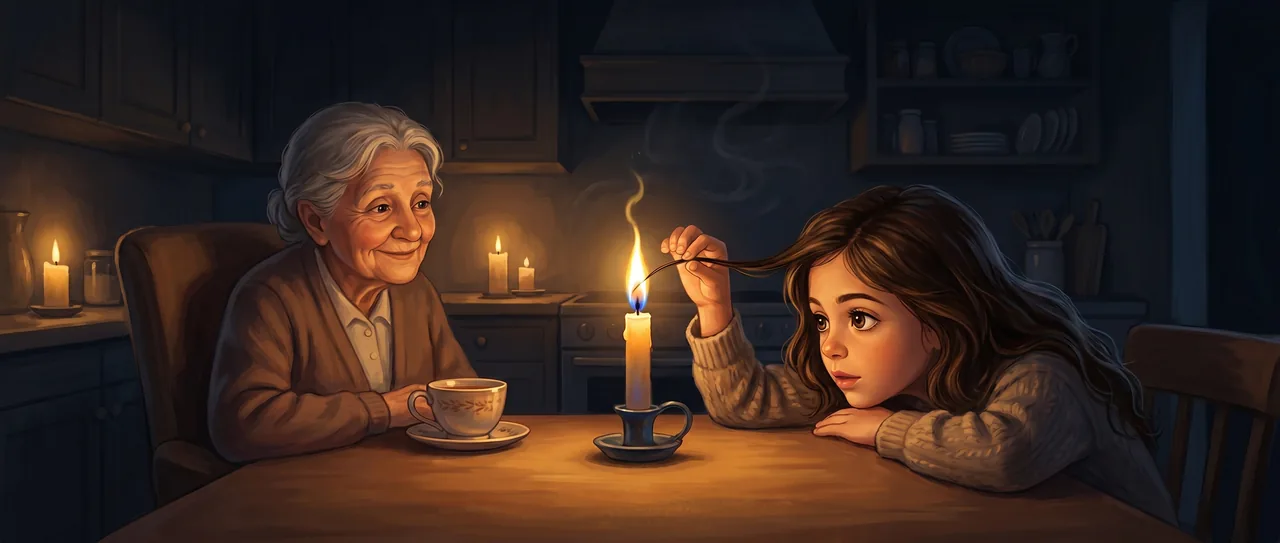
Maya pulled a long strand of her own hair loose and held it, slowly, into the very center of the flame. Into the dark. She braced for it to crisp instantly.
It did not. The hair sat in the dark heart and stayed hair.
She lifted it half a centimeter, into the yellow, and it shriveled and curled and was gone with a tiny smell.
"Did you see that," she said, not as a question, her voice gone very low. "The bright part ate it. The dark part didn't."
Grandmother had stopped drinking her tea.
"The fuel can't burn by itself," Maya said, talking fast now, talking to the flame more than to the room. "It needs air. The air is on the outside. So the burning happens on the outside, in the blue collar and the yellow, where the gas finally touches the air. The middle is full of fuel but starved. It's waiting. It's the coldest part because it's the part that hasn't met any oxygen yet."
She sat back. The four candles threw four small trembling lights across the kitchen, and across each one of them, she could see it now, the same dark core. Four little shadows, each one wrapped in its own fire.
"There's a cold place inside every flame," she said. "And it's the part everyone thinks is the hottest."
Grandmother set her cup down without a sound. "My mother lit the lamps in our house every night," she said slowly. "By hand. Oil lamps. I sat beside her so many nights." She looked at the candle as if it had only just arrived in the room. "I never once saw the middle."
Maya did not say anything. She did not feel proud. She felt the opposite of proud, the feeling of standing at the edge of something and realizing the edge keeps going.
Because if the brightest part of a flame was the part with the least fuel, and the darkest part was the part with the most, then bright did not mean full. Bright meant meeting. Bright meant the place where two things that were starving for each other finally touched.
She pulled one candle closer, slowly, until the heat sat on her face again. She found the blue collar at the very bottom, the cleanest blue, where the gas burned so completely there was no soot, no yellow, no glow of leftover carbon. Above it the yellow, which was just tiny bits of unburned carbon getting white-hot before they vanished. And above the wick, untouched, the dark.
The lights in the building did not come back for another hour.
Maya spent the whole hour with her chin almost on the table, turning the candle a little at a time, watching the cold dark heart hold its breath inside the fire while the bright edges burned themselves away around it.
Read the interactive version, listen to the narration, and earn a gold star →
A science-verified short story for curious kids · Curiosity Land