The Wrong Black
The card was supposed to play eight notes when you opened it in the light. It played nothing.
"Try the window again," Soren said.
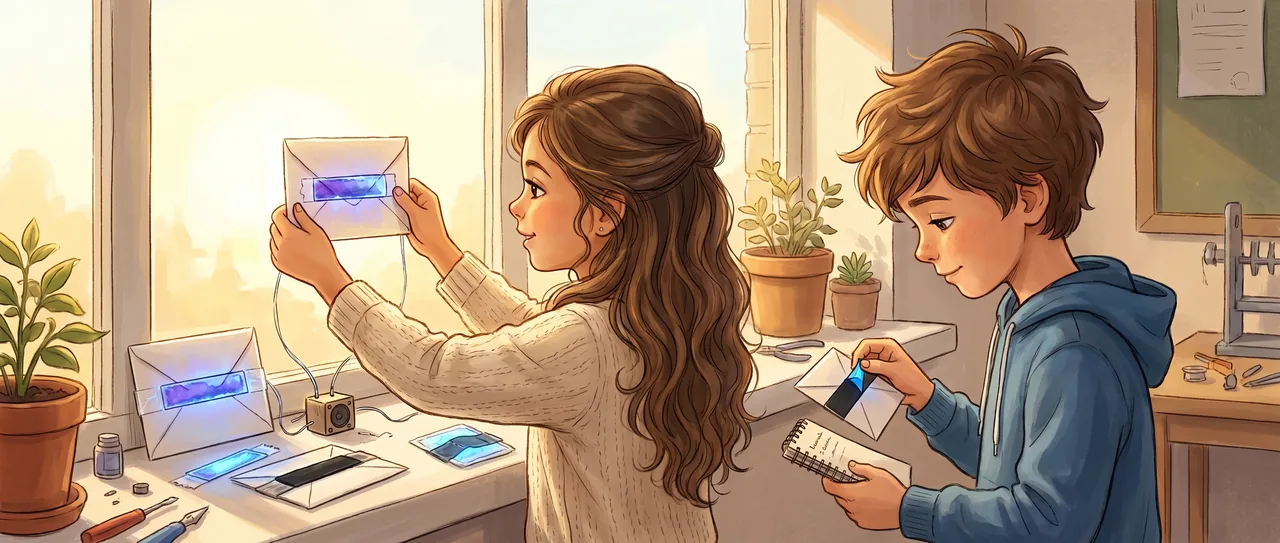
Maya held the paper card up to the late sun coming through the maker space window. The little speaker stayed silent. The thing pasted to the front of the card was a strip about the size of a stick of gum, dark and a little purple, printed onto plain cardstock by the science teacher's new desktop printer before she left for the day.
"It worked this morning," Maya said.
"It worked at lunch," Soren said. He had it written down. Twelve oh five, eight notes. Three fifteen, nothing.
They had thirty-two of these cards to sell on Friday. So far they had one that sang and thirty-one that didn't, and the one that sang had stopped singing.
Maya tilted the card. The purple strip caught the light and went almost blue, then almost black, depending on the angle. She kept tilting it back and forth.
"It changes color," she said.
"Paper doesn't change color."
"It's not the paper. It's the printed part." She held it still. "Look. When it's blue it's wet-looking. When it goes flat black it's the wrong black."
"The wrong black," Soren repeated. He liked that she said things like that. He wrote it down anyway, even though he had no idea yet what it meant.
He picked up one of the dead cards and held it next to hers. Same printer, same ink, the teacher had said. Except she hadn't called it ink. She'd called it a perovskite. She'd said it like it was a normal word and then run out the door.
"Smell it," Maya said suddenly.
"I'm not smelling the card."
"The dead ones. Smell the strip."
He smelled it. Faint, sharp, a little like the inside of a swimming bag left zipped too long. The card that still almost worked didn't smell like anything.
"The dead ones got wet," he said.
"There's no water in here."
They looked at the dead ones. All thirty-one had been stacked by the window in the morning sun to dry, the teacher had said, so the printed layer would set. The one that sang at lunch had been in Maya's backpack in the dark.
Soren stopped writing.
"Maya. The good one was in your bag all morning. We took it out at lunch. It sang. Then we left it on the windowsill all afternoon. Now it doesn't sing."
"So the sun broke it."
"The sun is the whole point. It's a solar card. The sun is supposed to be the food."
They sat with that. A solar thing that the sun was killing.
Maya picked the dead strip with her fingernail. A tiny corner lifted. Underneath, where the strip had been pressed against the paper away from the air, the color was still that wet purple-blue. The top, the part that faced the window all day, had gone the wrong black.
"It rots from the top," she said. "From the light side."
"Or from the air side. They're the same side." Soren frowned. "We can't tell which."
That was the part Maya hated and Soren didn't. Two answers, both fitting, no way to choose yet.
"Then we test it," Maya said, already moving. "One in the dark. One in light but no air. One in air but no light."
They had no equipment. They had a maker space and ten minutes before the custodian wanted the room. So they used what was there. The good card, the singing one that had gone quiet, they cut into three little squares with the printed strip split across them. Square one went into Soren's notebook, slammed shut, dark and airless. Square two they sealed under a strip of clear packing tape pressed flat, no air but full light, and set on the windowsill. Square three they left bare on the table, air and the room's dim light both.
"We come back tomorrow morning," Soren said. "Before the bell."
They came back before the bell.
The square in the notebook, dark and sealed, was still wet-blue and perfect. The bare one on the table had gone halfway to the wrong black. And the one under the tape, full sun all the way to closing time and again at sunrise, no air touching it at all, was still blue.
"It's not the light," Maya said slowly. "The taped one got all the light. It's fine."
"It's the air," Soren said. "Or the water in the air. The tape kept the air off it."
Maya held the taped square up to the window. The morning sun came straight through the clear tape, hit the blue strip, and the little speaker, still wired to that square by two thin threads of foil, made a sound. Three notes. Cracked and thin, because they'd cut the strip in thirds, but a sound.
She didn't say anything. She just kept it in the light, and the three notes hung there.
"Tape the rest," she said. "Tape all thirty-one before the sun gets to them."
They did, fast, both of them, peeling and pressing, sealing the air away from every printed strip while the strips were still the right wet blue. By the time the room filled up with kids the cards were drying under their clear skins and starting, one by one, to find the sun.
The teacher came in with her coffee and saw the taped row of cards singing on the sill and stopped.
"They were dying," Maya said. "The printing breaks when the air gets it. We sealed the air out."
The teacher set her coffee down very carefully.
"That," she said, "is the entire problem. That is the actual problem the whole field is trying to solve. People with real labs. The stuff is the best solar material anyone's ever found, it got good faster than anything in history, and it falls apart in air and nobody's finished fixing it."
"It got good faster than anything in history," Soren repeated, and wrote it down, his pen pressing hard.
"How fast," Maya said.
"Fifteen years, almost nothing to better than a third of all the light that hits it. Faster than silicon ever moved." The teacher looked at the row of singing cards. "And the part you just did at a craft table, with packing tape, before homeroom. That part isn't finished."
Maya picked up the next dead card, the wrong black one, and held it to the window to see if any blue was left underneath.
Read the interactive version, listen to the narration, and earn a gold star →
A science-verified short story for curious kids · Curiosity Land