The Winning Ticket
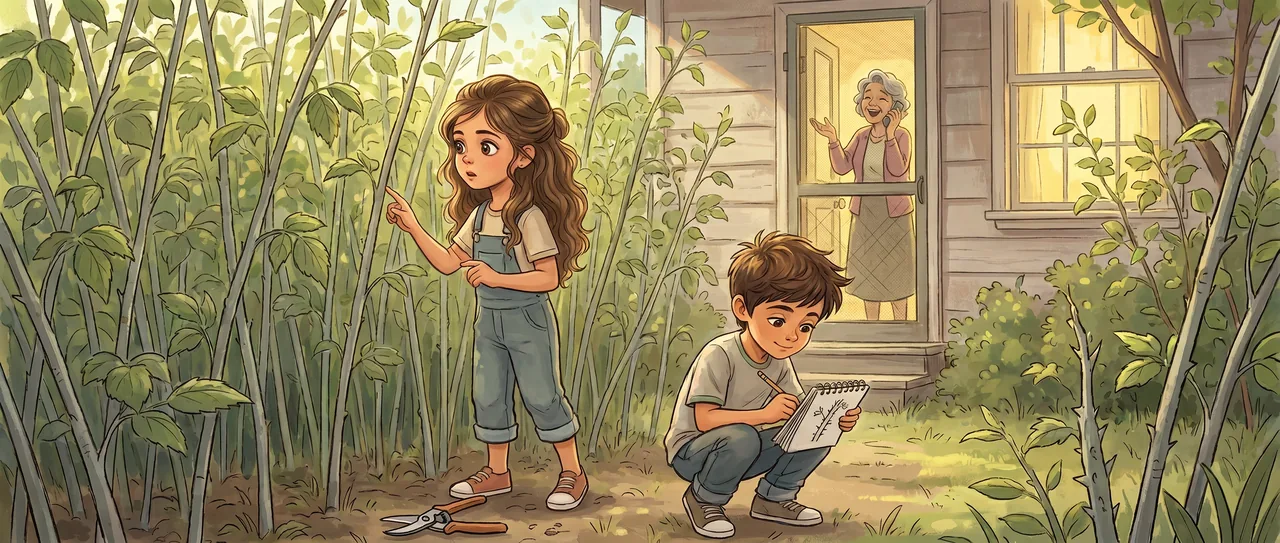
Soren's grandmother handed them each a pair of clippers and said, "Most of this hedge is doing nothing. Cut the dead ones, keep the good ones, and we get twice the raspberries."
Then she went inside to answer the phone, and did not come back out.
"Which ones are the good ones?" Maya asked.
Soren looked at the hedge. It was a mountain of canes, hundreds of them, gray and green and red, crossing over each other like somebody had dumped a box of spaghetti and let it grow.
"She didn't say," he said.
"She said keep the good ones like the good ones are obvious."
"To her they probably are."
Maya crouched and looked along the bottom, where all the canes came out of the dirt. "Okay. Some are clearly dead. Brown, snappy, no buds." She bent one and it cracked. "That one's gone."
"Easy," said Soren. He cut three dead ones in a row.
"But look at these." Maya pointed at a thick green cane and a thin green one growing right next to each other. "Both alive. Which one fruits?"
Soren looked. He touched the buds on each. They felt the same. "No idea. Could be either."
"Could be both."
"But Grandma said most of it does nothing. So most of these alive ones, the raspberries don't actually come from them."
Maya sat back on her heels. "That's the weird part. Most of the canes are alive. Most of them look fine. But only a few of them actually make the berries."
"And the rest are just," Soren waved his clippers, "taking up sun."
"Right. So the question isn't which ones are dead." Maya pulled a leaf and chewed the edge of it. "The question is, out of all the healthy ones, which tiny handful is the hedge that matters."
They both stared at the tangle.
"There's no way to tell by looking," Soren said finally. "I've been trying. The fruiting ones and the do-nothing ones look identical right now."
"Identical now," Maya said. "In July they won't be."
"In July the berries already happened. Too late. We're supposed to cut now."
Maya groaned and lay back in the dirt. "So we'd have to grow the whole giant hedge, wait all summer, watch which canes fruit, and then go back in time and only keep those."
"That's the only way to know for sure," Soren said. "Let the whole thing grow up. See who wins. Then you'd know the winners were in there from the start." He stopped. He pulled out his notebook and wrote a line and a small spiky drawing of a cane.
"What."
"My cousin does this on computers," he said. "The big learning ones. The networks."
"The ones that recognize cats."
"Those. She told me they build them way too big on purpose. Way more connections than the problem needs. Millions of canes, basically. And then they train the whole giant thing, and afterward they can throw away almost all of it. Like ninety percent. And the little bit that's left still recognizes the cats just as good."
Maya sat straight up. "Just as good. With ninety percent gone."
"Just as good."
"So the small one could've done the whole job alone."
"That's the thing she said. The small one was already in there. Hiding inside the big one from the very beginning. A little hedge inside the huge hedge that could've made all the berries by itself." He looked at his drawing. "They call it a winning ticket. Like a lottery ticket that was always going to win, sitting in the pile."
Maya looked at the hundreds of canes with completely new eyes. "So why grow the giant thing at all? If the small winning one was always in there, why not just plant that?"
Soren opened his mouth. Closed it.
"That's the part," he said slowly. "That's the exact part. Nobody can find it first."
"What do you mean nobody."
"Nobody. Not her, not anybody. They can prove the winning ticket is in there. They can find it after, by growing the whole thing and seeing what mattered. But pointing at the winners at the start, before any training, before any berries, nobody has a reliable way to do that." He shook his head. "You'd have to already know."
Maya stood up. She walked the length of the hedge, dragging one finger along the canes, alive ones and dead ones, fast ones and slow ones, all looking the same in the spring.
"So somewhere in this," she said, "there is a small hedge. Twenty canes maybe. And those twenty would make every single berry the whole giant thing makes. They're real. They're right here. We are touching them right now."
"Probably touching them, yeah."
"And there is no test in the world that tells us which twenty."
"Not yet," Soren said. "My cousin said not yet like it was the most interesting two words she knew."
Maya stopped walking. The clippers hung open in her hand.
"People keep asking me how I know things before I can explain them," she said. "Teachers. They hate it. They want me to show the work first, then get the answer."
"I know."
"But sometimes the answer's just there. In the pile. Before the work." She turned and looked at him. "Maybe finding the winning ticket early is a real way to think. Maybe it's a thing humans can sort of do and computers can't yet, and nobody's figured out the rule for it."
Soren wrote that down so fast the pencil skipped.
"Grandma can do it," he said suddenly. "With the hedge. She looked at it for one second and said most of it does nothing. She knows which canes. Forty years of raspberries. She's got the rule, she just can't say it out loud."
Maya laughed, and it came out almost like being scared, the good kind. "So the answer's walking around inside your grandmother and inside my head and inside the hedge, and nobody can get it onto paper."
They both turned and looked at the screen door where the grandmother had gone.
Through the window, she was still on the phone, pointing at nothing, laughing at something neither of them could hear.
Maya set her clippers down in the dirt and did not cut anything.
Read the interactive version, listen to the narration, and earn a gold star →
A science-verified short story for curious kids · Curiosity Land