The Thing in the Petri Dish Remembers
The slime mold was supposed to be dead.
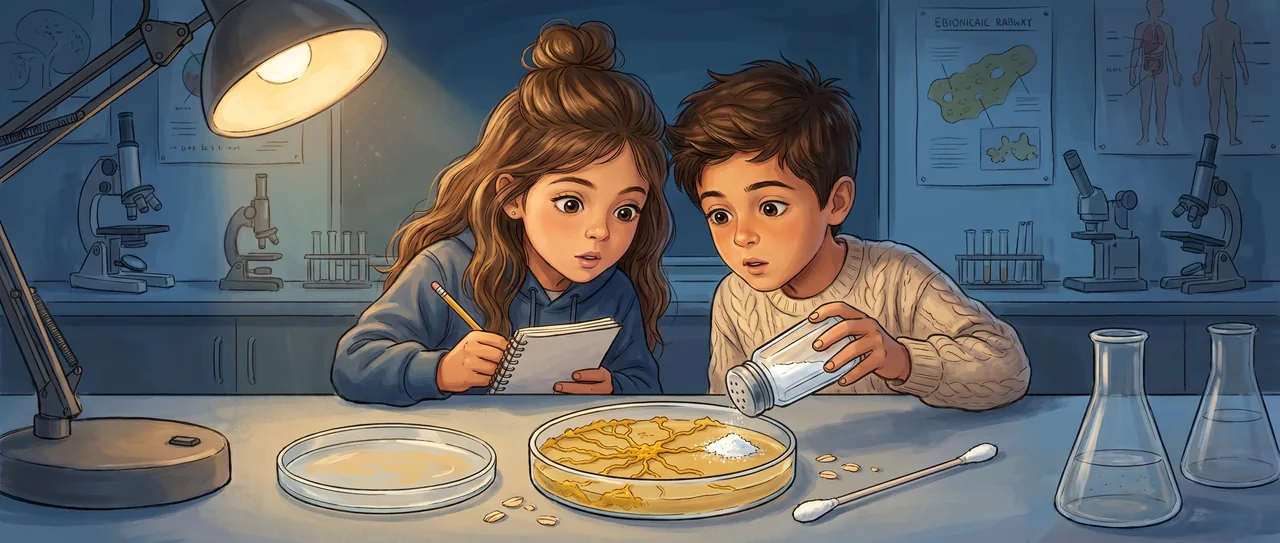
Maya pulled the tray out from under the back counter where the science fair leftovers got shoved after everyone went home. Three weeks of nobody. The room smelled like old agar and pencil shavings.
"It's bigger," she said.
Soren leaned over the dish. The yellow had spread into a fan of veins, thick where it had found the oat flakes, thin everywhere else. It looked like a road map somebody had drawn in mustard.
"Mr. Adler said to throw it out," Soren said. He did not throw it out.
"Mr. Adler said it had no brain."
"It doesn't. That's the whole label." Soren read off the card taped to the lid, in their own handwriting from October. "Physarum polycephalum. One cell. No neurons. No nervous system."
"Then how does it know where the oats are."
Soren didn't answer right away, which Maya liked about him. He pulled his notebook out of his bag and set it open on the counter without saying anything about it.
"Watch," Maya said. She had the salt shaker from the lunch supply shelf. "Mr. Adler did this in October. It hates salt. You put a little near it, it backs off."
She tapped a pinch onto the agar, a few inches from the leading edge of the yellow.
They waited. The slime mold pulled away from the salt, the veins near it thinning, retreating, like a hand drawing its fingers back from a stove.
"Okay," Soren said. "So it doesn't like salt. That's chemistry. That's not knowing."
"Do it again," Maya said.
He did. Another pinch, same spot. The slime mold backed off again, but slower this time. Less far.
Soren wrote something. "Could be tired. Could be using up the salt-sensitive part."
"Then it'd back off the same. Just from a weaker edge." Maya was already shaking a third pinch. "It's not backing off the same. It's backing off less."
The third time, the yellow barely flinched.
They looked at each other.
"Fourth," Soren said. He wasn't asking. He needed more steps than she did and he was getting them. Fourth pinch. The slime mold sat there. A faint shiver in the veins, and then nothing. It just stayed.
"It stopped caring," Maya said.
"It can't care. There's nothing in there to care with." Soren's pencil had stopped. "But look at it. The first time it ran. Now it doesn't."
"Because the salt never actually hurt it," Maya said slowly. "It was just salt. Nothing happened. So it learned the salt was nothing."
"Don't say learned."
"What else do I say."
Soren stared at the dish. "Learned means there's something that holds the old times so the new time can be different. You learn because the second salt lands on top of the first salt, in you, somewhere. A memory. A place that keeps the count." He tapped the lid. "This thing has no place. No neurons. No synapses. No anything. Where is it keeping the count?"
Maya didn't say anything. She was looking at the veins. The whole sprawling yellow web of them.
"What," Soren said.
"Maybe the count isn't in a place," she said. "Maybe the count is the shape."
Soren put his pencil down.
"It's all one cell, right? One bag of stuff. And the stuff moves. The salt comes, the stuff shifts, the veins get thick here, thin there." She traced the air above the dish without touching it. "What if the shifting is the memory. The way it's arranged right now already has the salt in it. It doesn't need to remember the salt. It is the remembering."
"That's not how memory works."
"That's how this memory works."
Soren wanted to argue. She could see him wanting to. He picked the notebook back up, then set it down again.
"Test it," he said.
"How."
"If the shape is the memory, then a different thing it hasn't gotten used to should still scare it. The getting-used-to is only for the salt. Not for everything." He went to the supply shelf. Came back with the bottle they used for cleaning the fish tank, a drop of bitter quinine stuff on a cotton swab. "It's never met this. If you're right, it backs off this hard. Even though it ignores the salt now."
Maya grinned. "You just did my thing. You guessed."
"I'm committing to it," Soren said. "Touch it near the edge."
She brought the swab close, not touching, just near. The slime mold recoiled. Fast, the way it had run from the very first pinch of salt, the veins yanking back across the agar.
Then Maya shook salt right next to where it had just flinched.
Nothing. It ignored the salt and ran from the new thing, both at once, in the same body, in the same second.
"It's holding two answers," Soren said quietly. "Run from this. Don't bother with that. At the same time. With no brain."
"Because the answers aren't thoughts," Maya said. "They're built in. They're how it's standing."
Soren was writing fast now, then he stopped and just looked at the dish, the yellow settling back into its slow spread toward the oats.
"Mr. Adler doesn't know this," he said.
"Mr. Adler told us to throw it out."
"No, I mean." Soren turned the notebook so she could see the line he'd written. Where is it keeping the count. The question, no answer under it. "Nobody knows. I looked it up after October. They can make it solve a maze. They made one grow the exact shape of the Tokyo train map, all the fastest routes, no wasted track. And it learns the salt thing, the habituation, it's real, scientists named it. And they still can't find where it puts the memory. Not because they're not smart. Because there's no part to find."
Maya put her face down level with the dish, eye to eye with a single cell that had no eye.
"So it remembers," she said, "and the place where it remembers is everywhere in it and nowhere you can point to."
"Yeah."
"And it's been doing that the whole time. While everybody thought it was nothing."
"Yeah."
Maya tapped one more pinch of salt onto the agar, gently, like knocking on a door.
The slime mold, which had learned this and could not say so, did not move.
Read the interactive version, listen to the narration, and earn a gold star →
A science-verified short story for curious kids · Curiosity Land